Fake Phones,Real Poison.The Hidden Cost of Counterfeit Electronics in Africa
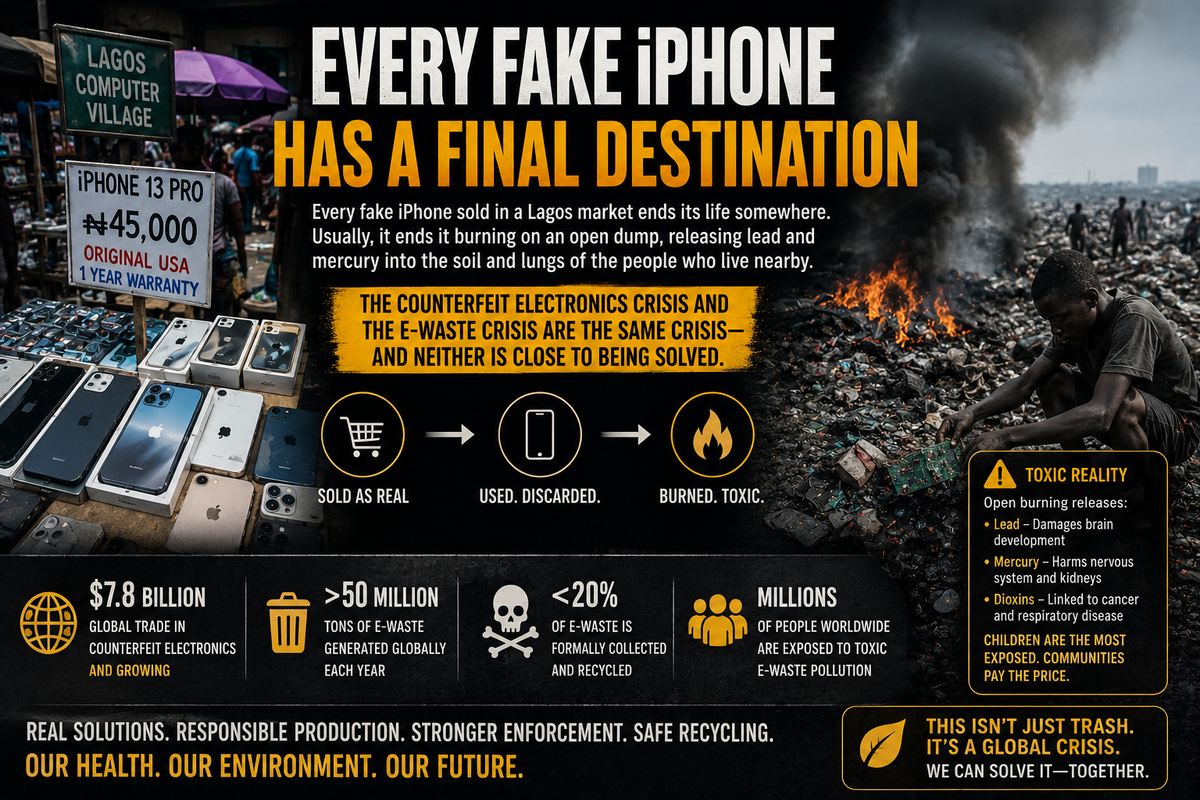
Every fake iPhone sold in a Lagos market ends its life somewhere. Usually, it ends it burning on an open dump, releasing lead and mercury into the soil and lungs of the people who live nearby. The counterfeit electronics crisis and the e-waste crisis are the same crisis — and neither is close to being solved.
In the stalls of Computer Village in Ikeja, Lagos, the phone in your hand could be almost anything. It might be a genuine factory-sealed device imported through a legitimate channel. It might be a UK-used handset from a proper pre-owned supplier, inspected and verified. Or it might be something far more dangerous: a clone assembled in an unregulated facility in Shenzhen using substandard components, a battery with no thermal protection, and software pre-loaded with spyware — dressed in a convincing box, priced just low enough to feel like a bargain.
Nigeria's counterfeit goods crisis is not, as is sometimes portrayed, a minor consumer inconvenience or a problem confined to pharmaceuticals. It is a multi-sectoral economic catastrophe. A new report by the DAWN Commission identifies Southwest Nigeria as the epicentre of Africa's largest and most diversified counterfeit consumer goods economy. Counterfeit goods now account for an estimated 40% of products in Nigerian markets, with the shadow economy representing 57.4% of GDP — roughly ₦1.489 trillion. Electronics form a significant and growing share of that figure.
But the damage doesn't end at the point of sale. When a counterfeit phone stops working — and it will stop working, faster and more unpredictably than any genuine device — it begins the second half of its life. And that second half is far more dangerous than the first.
Every counterfeit phone is built to fail. But the failure doesn't disappear. It accumulates in the soil, the water, and the blood of the communities that live closest to the dumps.
RESEARCH SYNTHESIS — VOXDEV / UNEP / GLOBAL E-WASTE MONITOR
The Anatomy of a Fake
Understanding why counterfeit electronics are so dangerous requires understanding what they are actually made of. Legitimate manufacturers, despite their many flaws, operate under regulatory scrutiny in the markets they sell into. The EU's RoHS directive, the US EPA's restrictions, and similar frameworks limit the use of the most hazardous substances in consumer electronics. Counterfeit producers operate under none of these constraints.
The result is that fake phones and accessories contain significantly higher concentrations of toxic materials. Substandard batteries — present in virtually every counterfeit smartphone — use cheaper chemistry with inadequate protection circuitry. They overheat unpredictably, swell, and in the worst cases catch fire, releasing a cocktail of volatile organic compounds and toxic gases. Fake chargers and cables, built without the correct surge protection, have caused deaths from electrocution.
Beyond the immediate danger, these devices contain the same hazardous substances as genuine electronics — lead in solder, cadmium in batteries, mercury in some displays, brominated flame retardants in circuit boards — but in higher concentrations, with less structural integrity, and with a shorter functional lifespan. They become e-waste faster. And in Nigeria, what becomes e-waste almost inevitably becomes an environmental and public health crisis.
⚠ THE COUNTERFEIT-TO-E-WASTE PIPELINE
01MANUFACTURE WITHOUT STANDARDS
Produced in unregulated facilities, fake electronics use substandard components, excess heavy metals, and no safety certification. Designed to mimic, not to last.
02SALE THROUGH INFORMAL MARKETS
Counterfeit devices enter Nigeria through grey-market import routes, often mislabelled as "UK-used" or "refurbished." 1 in 4 Nigerian consumers unknowingly buys counterfeit products.
03PREMATURE FAILURE
Without genuine components or quality control, counterfeit phones fail faster — often within months. Repairs using counterfeit parts shorten lifespans further.
04INFORMAL DUMPING & OPEN BURNING
Nigeria generated over 1.1 billion pounds of e-waste in 2022 — none of it formally collected. Most is openly burned at informal sites, releasing lead, cadmium and brominated compounds into the environment.
05COMMUNITY HEALTH CATASTROPHE
Research shows living near e-waste sites significantly increases neonatal and infant mortality. Soil lead levels near sites reach 14,000 mg/kg. Toxins bioaccumulate in the food chain and water supply.
The E-Waste Emergency Nobody Talks About
Nigeria is the leading importer of electrical and electronic equipment on the African continent, processing over half a million tonnes of discarded electronics each year. It generates an estimated 1.2 million tonnes of e-waste annually — and by the Global E-Waste Monitor's accounting, zero percent of that is formally collected and recycled.
The people who deal with it instead are informal workers like Asabe, who left Sokoto State to work in Lagos and found his livelihood picking e-waste from open dumps and clogged drainage channels. His story, documented by UNEP-affiliated researchers, is not exceptional. Approximately 100,000 people work in Nigeria's electronics recycling sector — virtually all of them in informal settings, without protective equipment, breathing the smoke from burning circuit boards and handling components leaching lead and mercury into their skin.
The health outcomes are not abstract. Research synthesising data from e-waste sites in Ghana and Nigeria found a clear and alarming pattern: living near these sites significantly increases both neonatal and infant mortality rates. The increase doesn't appear immediately — it begins to manifest approximately three years after a site becomes operational, consistent with the gradual buildup of contaminants to critical levels in surrounding soil, water and air. These are not marginal statistical signals. They are deaths.
SUBSTANCES RELEASED WHEN E-WASTE IS BURNED — WHAT ENTERS THE BODYLead (Pb)
Found in solder and screens. Neurotoxic, especially in children. Soil near dump sites shows lead levels up to 14,000 mg/kg — far exceeding safe thresholds. Causes cognitive impairment and developmental damage.
Cadmium (Cd)
Present in rechargeable batteries. Accumulates in the kidneys and bones. Classified as a Group 1 carcinogen. Topsoil cadmium near e-waste sites reaches 6.8 mg/kg.
Mercury (Hg)
Used in older displays and some batteries. Damages the central nervous system and kidneys. Bioaccumulates through the food chain — contaminating fish, crops and water supplies far from the burn site.
Brominated Flame Retardants
Widespread in circuit boards. Persistent organic pollutants that accumulate in body fat and breast milk. Endocrine disruptors linked to thyroid dysfunction, developmental disorders and cancer.
The toxins released at informal burn sites do not stay local. Persistent organic pollutants travel through the atmosphere and waterways, bioaccumulating at every level of the food chain. UNEP researchers have found traces of e-waste compounds thousands of miles from their source — including in Arctic ecosystems. A phone burned at a Lagos dump doesn't just poison Lagos. It contributes to a transboundary contamination problem with no clear borders.
CONTINUED
The Double Injustice
There is a structural injustice embedded in this system that deserves direct naming. The wealthy world generates the highest per capita volume of e-waste — Europe and North America each produce over 20 kilograms per person per year, compared to under 3 kilograms across Africa. Yet substantial volumes of that waste end up in Nigeria, Ghana, and other West African nations, shipped legally as "used electronics" or illegally as waste.
The Basel Convention, the international treaty designed to restrict transboundary movement of hazardous waste, prohibits wealthy nations from dumping their e-waste in developing countries. The prohibition is routinely circumvented. Containers of broken televisions, dead laptops, and end-of-life phones arrive in Nigerian ports labelled as "second-hand goods for reuse." Some portion is genuinely reusable. Much of it is not. The distinction is difficult to enforce at the border, and enforcement budgets across the region are thin.
Nigeria thus bears a disproportionate share of the health and environmental costs generated by the global electronics consumption cycle — while receiving almost none of its economic benefits. The rare earth metals, gold, silver, and copper that can be extracted from e-waste represent genuine value, but that value accrues primarily to informal intermediaries and export brokers, not to the communities living next to the dump sites.
What Responsible Electronics Commerce Looks Like
Against this backdrop, the verified supply chain model that distinguishes legitimate retailers in Nigeria represents something more than good business practice. When a device is IMEI-verified before sale, its history is confirmed — it is not stolen, not blacklisted, not a clone with a fake serial number. When a pre-owned device is condition-tested and sold with honest labelling, it extends the useful life of genuine hardware and reduces the volume of electronics cycling prematurely into the waste stream.
The opposite — selling counterfeit or mislabelled devices — is not merely consumer fraud. It is an act that shortens device lifespan, accelerates e-waste generation, and contributes directly to the accumulation of toxic materials in communities that have no meaningful ability to manage them safely.
Buying verified. Buying genuine. These are not premium luxuries. In the context of Nigeria's counterfeit and e-waste crisis, they are choices with real downstream consequences for real communities.
The Regulatory Response: Promising, Insufficient
Nigeria's government has taken meaningful steps. Amendments to national environmental regulations — supported by UNEP's Circular Economy Approaches programme — have created the first statutory framework for extended producer responsibility in electronics. The principle is correct: manufacturers and importers who bring electronics into Nigeria should bear responsibility for what happens when those electronics die. The policy architecture is beginning to take shape.
But the gap between regulatory intent and ground reality remains vast. NAFDAC, the agency responsible for consumer goods safety, has demonstrated its willingness to act dramatically: in February 2026 alone, it seized a ₦3 billion haul of fake drugs from the Lagos Trade Fair Complex, followed days later by another ₦3 billion seizure of banned and counterfeit cosmetics. The enforcement energy exists. Whether it can scale to match a shadow economy representing over half of GDP is a different question.
At the Africa Anti-Counterfeiting and Brand Protection Summit in March 2026, the projected market for authentication and verification technologies across Africa was put at $3.7 billion by 2026 — a signal that the private sector is beginning to take the problem seriously. Blockchain-based provenance tracking, serialisation, and IMEI verification at scale are all technically feasible. The challenge is not technological. It is the political and economic will to implement and enforce systems that threaten entrenched grey-market operators with significant influence.
The Consumer's Role
None of this removes individual responsibility from the equation. Every consumer who knowingly or unknowingly buys a counterfeit device sends a market signal — that price matters more than provenance, that a convincing box is good enough, that accountability in the supply chain is optional. The counterfeit economy in Nigeria does not persist because of sophisticated, organised crime alone. It persists because demand for cheap electronics, however understandable given the economic pressures facing Nigerian consumers, does not yet adequately factor in the full cost of counterfeit goods.
That full cost includes: a device that fails faster and provides less value per naira spent; data and financial vulnerability through pre-installed malware on counterfeit devices; fire and electrocution risk from substandard batteries and chargers; and the downstream environmental and health burden placed on communities near dump sites — communities that are overwhelmingly poor, overwhelmingly young, and overwhelmingly not the people making the purchasing decision in Computer Village.
The fake phone is not just a bad deal for its buyer. It is a bad deal for Nigeria.
Sources & References
DAWN Commission — "Southwest Nigeria Under Siege: The Counterfeit Shadow Economy" (2026) · Global E-Waste Monitor, UNITAR / ITU (2024) · UNEP — "Nigeria Acts to Fight Growing E-Waste Epidemic" · VoxDev — "Electronic Waste is a Silent Killer in West Africa" · ScienceDirect — "Electronic Wastes in Sub-Saharan Africa: Environmental and Health Impacts" (2025) · Africa Anti-Counterfeiting & Brand Protection Summit (March 2026) · Market Data Forecast — Africa Smartphone Market Report (2026) · Raw Materials 360 — "Unlocking Nigeria's E-Waste Potential" (March 2025) · Environmental Health Perspectives — "Public Health Burden of E-Waste in Africa"