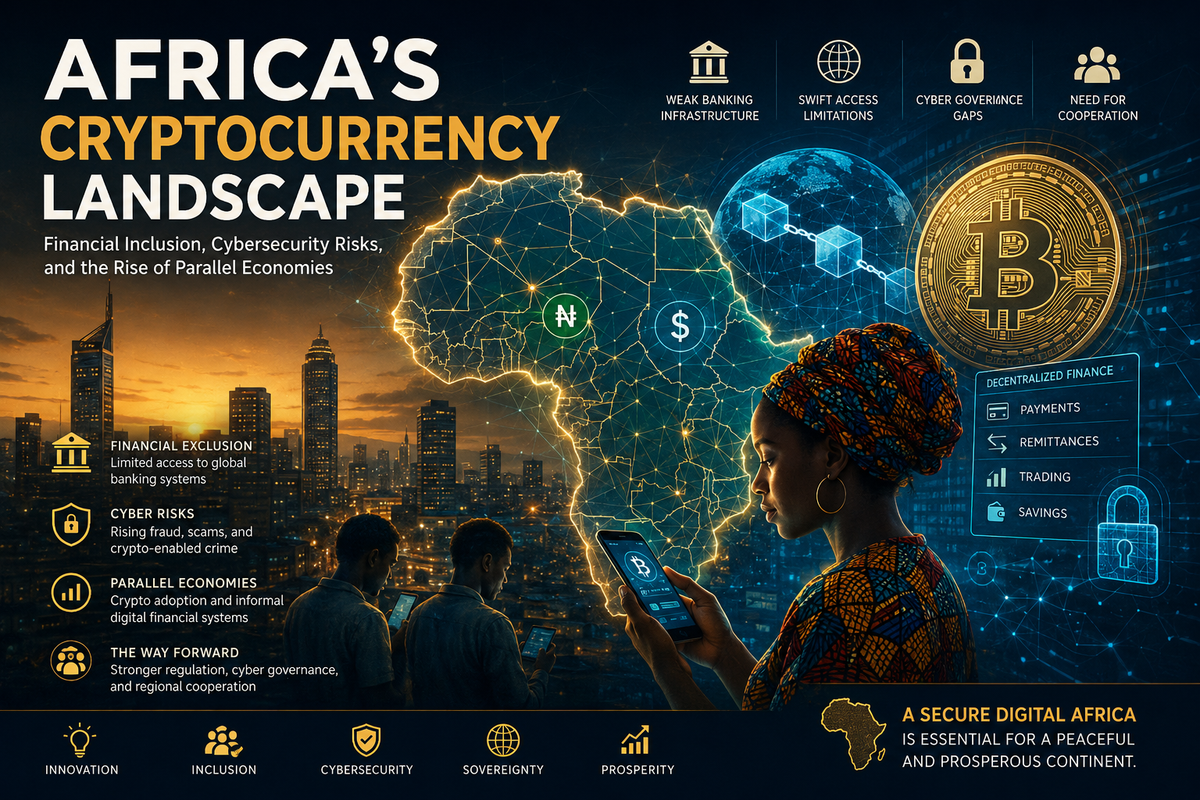
Africa’s Cryptocurrency Landscape: Financial Exclusion, Cybersecurity Risks, and the Rise of Parallel Economies
By Sanjana Rathi
The rise of cryptocurrency in Africa is often discussed through the lens of innovation, investment, or technological disruption. Yet across much of the continent, the growth of digital assets reflects something far more structural: a response to financial exclusion, institutional limitations, and the growing fragmentation of the global financial order.
For many African nations, cryptocurrency did not emerge as a speculative trend imported from Silicon Valley. It evolved as an alternative mechanism within economies where access to global financial infrastructure remains inconsistent, expensive, and, at times, deeply restrictive.
This transformation is now reshaping not only Africa’s financial ecosystem, but also its cybersecurity posture, regulatory priorities, and geopolitical relationships.
At the centre of this shift lies a difficult reality: large parts of the continent continue to operate at the margins of the global financial system.
International financial transactions depend heavily on trust-based infrastructures such as SWIFT, correspondent banking relationships, anti-money laundering compliance frameworks, and increasingly rigorous cybersecurity standards. Participation within this ecosystem requires stable currencies, mature banking systems, strong digital governance, and regulatory predictability.
However, several African economies continue to struggle with currency volatility, limited foreign exchange reserves, fragmented compliance structures, inconsistent digital infrastructure, and weak cyber resilience capabilities. These challenges create friction within cross-border transactions and often restrict participation in international commerce.
The consequences are practical and immediate.
Businesses face delays in receiving international payments. Individuals encounter transaction restrictions, failed transfers, and limited access to global payment platforms. Financial institutions impose strict controls due to foreign exchange shortages and compliance pressures. In many cases, international transactions become prohibitively expensive, operationally unreliable, or entirely inaccessible.
Nigeria offers one of the clearest illustrations of this broader continental challenge.
Despite being one of Africa’s largest digital economies, international transactions involving Nigeria frequently encounter severe limitations. Persistent Naira volatility, foreign exchange controls imposed by the Central Bank of Nigeria, banking network instability, and heightened international scrutiny regarding financial fraud have collectively created a high-friction financial environment.
Digital banking systems regularly experience downtime, settlement failures, delayed transaction processing, and reconciliation disputes. International card usage is often restricted due to dollar shortages, while global payment providers impose tighter controls on Nigerian transactions because of perceived financial crime risks.
As a result, many businesses, freelancers, and ordinary citizens increasingly rely on cryptocurrency exchanges, peer-to-peer financial networks, fintech platforms, and decentralized financial systems to participate in the global economy.
Importantly, this phenomenon is not unique to Nigeria.
Across multiple African states, cryptocurrency adoption is accelerating not because traditional financial systems are being rejected ideologically, but because they are frequently inaccessible in practice.
In this context, cryptocurrency represents more than technological innovation. It functions as a form of financial adaptation.
Decentralized financial systems offer transactional speed, reduced intermediary dependence, lower entry barriers, and access to cross-border digital commerce for populations that have historically remained underserved by traditional banking institutions.
Yet the rapid emergence of these alternative financial ecosystems is also creating a parallel digital economy operating partially beyond conventional regulatory oversight.
This introduces profound cybersecurity and governance implications.
The expansion of cryptocurrency ecosystems across Africa has significantly increased exposure to cyber-enabled financial crime. Fraudulent investment schemes, ransomware operations, digital asset theft, darknet transactions, and illicit financial flows increasingly exploit gaps in regulation, enforcement, and digital awareness.
A critical challenge is that regulatory adaptation has not evolved at the same pace as technological adoption.
In several jurisdictions, there are still no clearly defined operational frameworks for handling cryptocurrency-related crimes. Law enforcement agencies often lack blockchain forensic capabilities, digital evidence handling procedures, cross-border investigative mechanisms, and technical expertise required to investigate decentralized financial offences effectively.
This creates an enforcement asymmetry where cybercriminal networks can operate faster than institutional response systems.
Ironically, blockchain technology itself is not inherently opaque. Most public blockchain systems are fundamentally transparent and traceable. The vulnerabilities instead emerge from the surrounding ecosystem — particularly unregulated exchanges, weak compliance environments, poor cybersecurity hygiene, and fragmented governance structures.
The issue, therefore, is not cryptocurrency alone.
The deeper issue concerns institutional readiness in an era where finance, technology, cybersecurity, and geopolitics are rapidly converging.
This convergence is becoming increasingly visible in the broader global financial landscape.
Many African nations are now exploring alternatives to traditional dollar-dominated financial systems due to concerns surrounding transaction dependency, reserve currency accessibility, rising remittance costs, and geopolitical vulnerability. Emerging payment architectures, local currency settlement agreements, and alternative cross-border payment systems are gradually reshaping how financial influence is distributed globally.
For Africa, this transition carries both opportunity and risk.
On one hand, decentralized finance and digital assets may enhance financial inclusion, expand digital entrepreneurship, reduce transaction inefficiencies, and strengthen participation in global digital commerce.
On the other hand, weak cyber governance frameworks risk enabling financial instability, illicit financial flows, and the normalization of cyber-enabled criminal economies operating beyond effective state oversight.
The policy response therefore requires greater sophistication than simple prohibition or unrestricted liberalization.
Banning cryptocurrency without addressing the underlying causes of financial exclusion merely drives digital transactions further into informal ecosystems. Conversely, unregulated expansion creates conditions where cybercrime, financial exploitation, and systemic vulnerabilities can proliferate unchecked.
What is required is strategic digital governance.
African nations must prioritize the development of harmonized regulatory frameworks capable of balancing innovation with accountability. Cybersecurity capabilities within financial institutions and law enforcement agencies require significant modernization. Regional cooperation on cybercrime investigations, blockchain forensics, digital identity systems, and anti-money laundering mechanisms will become increasingly essential.
Equally important is the need to strengthen domestic digital infrastructure and public trust in financial institutions. Reliable banking systems, secure payment architectures, resilient cyber infrastructure, and transparent compliance mechanisms remain foundational to long-term digital economic stability.
Ultimately, Africa’s cryptocurrency landscape is not simply a story about Bitcoin, blockchain, or speculative finance.
It is a reflection of a continent navigating structural exclusion within the global financial order while simultaneously confronting the realities of digital transformation.
The central question is no longer whether cryptocurrency will shape Africa’s future.
It already is.
The more important question is whether African states can build the cyber resilience, regulatory maturity, and institutional capacity necessary to ensure that this transformation strengthens economic sovereignty rather than undermining it.