AI in Securities Litigation: AI Washing, SOX Compliance, Privilege Pitfalls, and Emerging Cybersecurity Risks

Artificial Intelligence (AI) is transforming the legal, financial, and corporate landscape at an unprecedented pace. Law firms increasingly use generative AI tools to summarize evidence, draft legal documents, conduct legal research, and support litigation strategies. Public companies are integrating AI into their operations, cybersecurity programs, investment platforms, and investor communications to demonstrate innovation and attract capital.
However, the rapid adoption of AI has also introduced a new generation of legal, regulatory, and cybersecurity risks. Courts, regulators, and investors are now closely examining how companies use AI, whether their AI-related claims are truthful, and whether sensitive information processed through AI systems remains secure and legally protected.
In recent securities cases and regulatory investigations, two major issues have emerged prominently:
- “AI Washing” — misleading or exaggerated claims regarding AI capabilities.
- Privilege and Cybersecurity Risks — concerns regarding confidentiality, attorney-client privilege, data exposure, and AI governance failures.
These concerns are increasingly being examined through the lens of securities laws, cybersecurity obligations, and governance frameworks such as the Sarbanes-Oxley Act (SOX) and regulations enforced by the U.S. Securities and Exchange Commission (SEC).
The Expanding Role of AI in Law and Finance
Organisations across industries are rapidly deploying Artificial Intelligence (AI) systems for a wide range of functions, including financial analysis, automated trading, cybersecurity monitoring, contract review, legal research, discovery and litigation preparation, compliance management, fraud detection, and investor relations. Generative AI tools, in particular, have gained significant popularity because of their ability to process vast amounts of information quickly, automate repetitive tasks, and generate human-like outputs with remarkable speed and efficiency. These technologies are helping organisations improve productivity, reduce operational costs, and enhance decision-making capabilities.
However, despite these advantages, the increasing reliance on AI also introduces substantial legal, regulatory, and cybersecurity risks. When organisations deploy AI systems without adequate governance frameworks, verification mechanisms, human oversight, or cybersecurity safeguards, they may expose themselves to issues such as inaccurate outputs, data leakage, misleading disclosures, privilege concerns, compliance failures, and heightened regulatory scrutiny.
Understanding AI Washing
What is AI Washing?
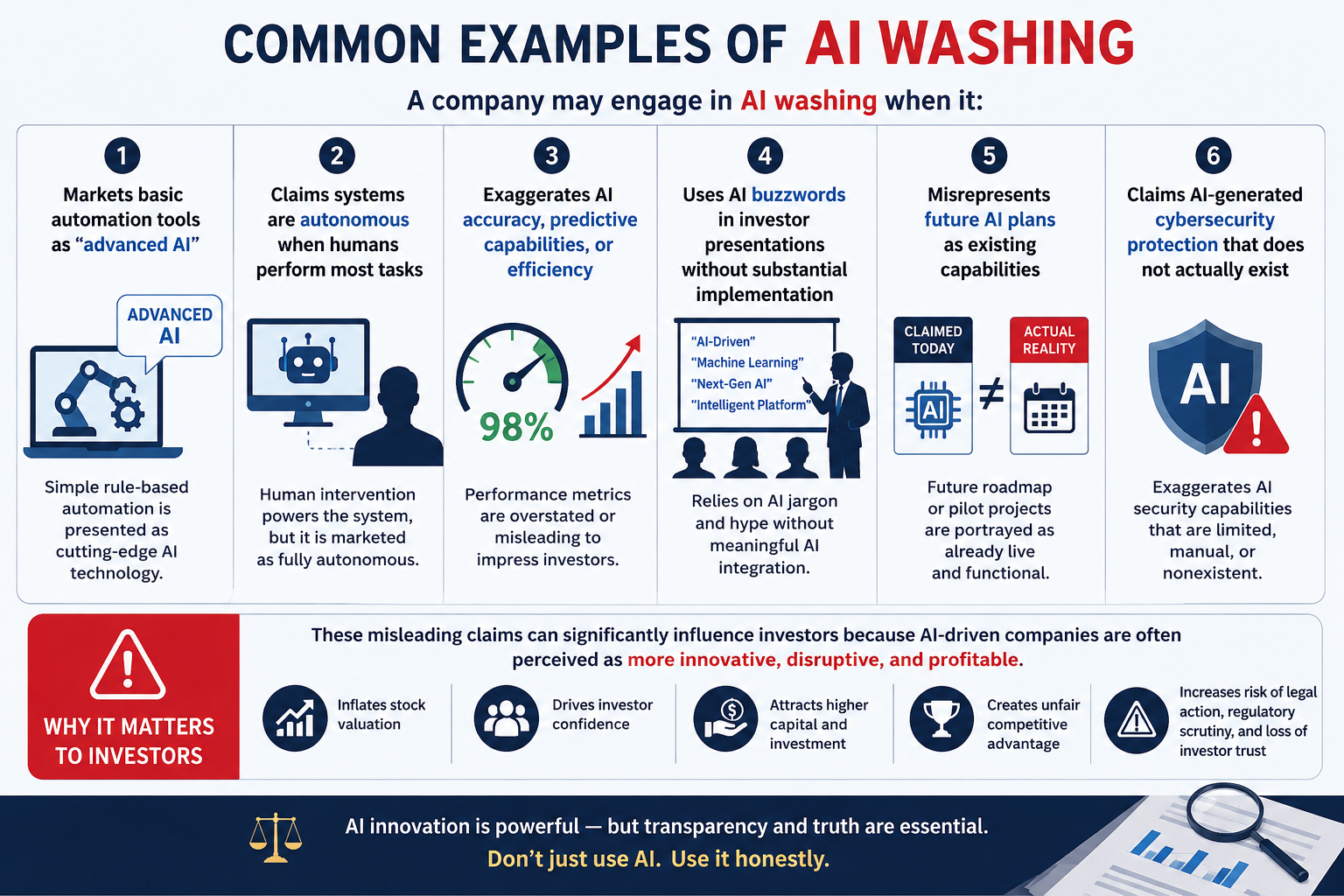
“AI washing” refers to the practice of overstating, exaggerating, or falsely claiming that products, services, or operations are powered by advanced artificial intelligence.
In many cases, organisations use AI-related marketing language to attract investors, increase valuation, or appear technologically advanced, even when the underlying technology has limited AI functionality or relies heavily on manual processes.
AI washing is comparable to “greenwashing,” in which companies exaggerate their environmental or sustainability initiatives to improve public perception.
The Hidden Vulnerabilities of the AI Boom: Cybersecurity, Privilege, and Securities Risk
The rush to integrate Artificial Intelligence (AI) has taken the corporate world by storm. From automating legal research to optimizing threat detection, AI promises unprecedented efficiency. However, beneath the marketing hype lies a complex web of digital liabilities.
For modern enterprises, AI is no longer just a tool for innovation—it is a brand-new frontier for cybersecurity, compliance, and legal risk. Here is what organizations need to know to navigate the dark side of the AI boom.
1. The Perils of "AI Washing"
Many organizations view AI as a silver bullet for digital defense. Vendors frequently market AI tools as autonomous saviors capable of stopping ransomware, detecting insider threats, protecting critical infrastructure, and entirely replacing human analysts.
When these marketing claims are exaggerated, it results in AI Washing—and it is far more than just a deceptive sales tactic; it is a critical cybersecurity vulnerability.
The Cost of False Security
When executives buy into overhyped AI capabilities, they often develop a false sense of security. This miscalculation can lead to:
- Decimated Preparedness: Underestimating actual cyber threats because "the AI has it handled."
- Eroded Oversight: Allowing automated systems to run without necessary human intervention.
- Operational Blind Spots: Leaving critical infrastructure vulnerable to sophisticated attacks.
- Regulatory Backlash: Deceiving investors and oversight boards regarding the company's true cyber resilience.
2. The Legal Dilemma: AI Adoption vs. Attorney-Client Privilege
Law firms and corporate legal departments are rapidly deploying Generative AI to streamline contract drafting, review discovery documents, summarize evidence, and prepare for litigation. But this efficiency comes with a steep price tag: the potential destruction of attorney-client privilege.
How AI Can Waive Your Privilege
Attorney-client privilege hinges on strict confidentiality. When legal professionals upload sensitive, proprietary data into external AI systems, that confidentiality is instantly jeopardized. Major risks include:
The Privacy Leak: Data uploaded to public or poorly secured AI platforms is frequently stored on third-party servers, used to train future AI models, or exposed to cross-border data transfers.
If a court determines that an organization failed to maintain adequate confidentiality controls by feeding data into a third-party AI, the court may rule that the attorney-client privilege has been waived. In high-stakes securities litigation, losing this protection can be catastrophic.
3. Five Broader Cyber Threats Driving AI Liability
AI adoption introduces five distinct security challenges that directly impact corporate governance and securities compliance:
A. Data Leakage
AI systems require massive amounts of data to function. If an AI platform processes internal investigations, trade secrets, financial disclosures, or legal strategies without rigorous security, a data breach is inevitable. The fallout includes shareholder lawsuits, regulatory fines, and reputational ruin.
B. Third-Party Vendor Risks
Most companies do not build their own AI; they outsource to third-party vendors. This introduces severe supply chain vulnerabilities. Organizations often have no visibility into where the vendor stores data, who accesses it, or how long it is retained. A single breach at a major AI vendor could expose the sensitive data of hundreds of corporations simultaneously.
C. AI Hallucinations and Inaccuracy
Generative AI famously "hallucinates" facts, citations, and numbers. Relying on these tools without strict verification can result in false compliance reports, fabricated legal citations, and misleading financial risk disclosures—opening the door to immediate regulatory action.
D. Prompt Injection and Manipulation Attacks
Bad actors are actively learning to hack AI. Through adversarial attacks like prompt injection, cybercriminals can manipulate AI outputs, bypass safety restrictions, corrupt corporate workflows, and trick the system into leaking confidential data.
E. Deepfakes and Market Manipulation
Synthetic media poses a direct threat to the stock market. Sophisticated deepfakes—such as AI-generated video of a CEO making a false announcement, or fabricated earnings statements—can trigger immediate stock volatility, investor panic, and massive financial fraud.
4. Elevating Corporate Governance
In this high-risk landscape, AI oversight can no longer be delegated solely to the IT department. Boards of directors and executive leadership teams are now expected to integrate AI risk into their broader Enterprise Risk Management (ERM) frameworks.
| Key Governance Pillars | Description |
| Vendor Assessments | Auditing the cybersecurity controls of all external AI providers. |
| Data Privacy & Transparency | Knowing exactly what data goes into an AI, and where it lands. |
| Human-in-the-Loop | Requiring human oversight for all AI-generated legal and financial outputs. |
5. Blueprint for Success: Best Practices
To balance innovation with security, organizations should implement targeted guardrails immediately:
For Law Firms & Legal Teams
- Ban Public AI Tools: Never enter privileged or confidential client information into public, open-source AI models.
- Insist on Enterprise-Grade Platforms: Only use AI tools that guarantee absolute data isolation and zero model-training on your inputs.
- Train Your Staff: Educate attorneys and paralegals on the cyber realities and privilege risks of AI usage.
For Public Companies
- Audit Your Marketing: Ensure all public disclosures regarding your company's AI capabilities are realistic, verifiable, and free of hyperbole.
- Update SOX Compliance: Integrate AI data pipelines and automated workflows into Sarbanes-Oxley (SOX) compliance programs.
- Monitor the SEC: Stay aligned with evolving regulatory guidance and enforcement trends regarding AI risk disclosures.
The Horizon: AI Securities Litigation
The future of AI-related litigation is fast approaching. As regulators, investors, and courts grow wiser to the nuances of artificial intelligence, companies that fail to secure their systems will face a wave of securities fraud investigations, shareholder lawsuits, and devastating data breach liabilities.
The businesses that thrive tomorrow will be those that learn to balance rapid technological innovation with rigorous, unyielding cybersecurity resilience today.
Conclusion
Artificial Intelligence is transforming legal and financial industries, but its rapid adoption has also introduced complex legal, regulatory, and cybersecurity challenges.
“AI washing” has emerged as a major concern as companies compete to present themselves as AI-driven innovators, sometimes exaggerating their technological capabilities to attract investors and increase market value. At the same time, the use of generative AI in legal and corporate operations raises serious questions regarding attorney-client privilege, confidentiality, and cybersecurity governance.
Although the Sarbanes-Oxley Act does not explicitly mention AI, its principles of transparency, internal controls, executive accountability, and accurate disclosure are increasingly being applied to AI-related risks and misleading AI claims.
As SEC scrutiny intensifies and AI-related cyber threats evolve, organisations must adopt responsible AI governance, robust cybersecurity safeguards, accurate disclosures, and effective oversight mechanisms. AI offers enormous strategic benefits, but without proper governance and transparency, it may also become a significant source of litigation, regulatory action, and reputational damage.