Analysis: "The Green Grid's Hidden Backdoor"
What the Article Argues
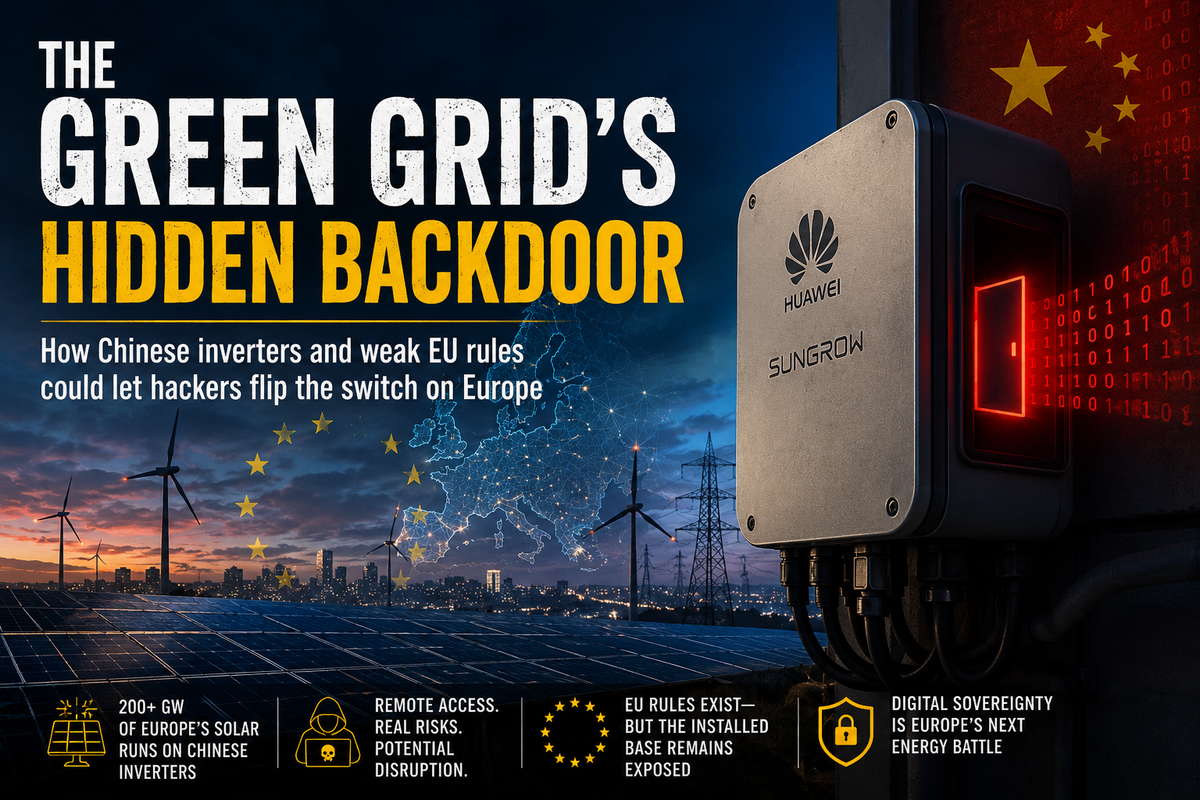
The core thesis is straightforward and well-supported: Europe's clean energy transition has created a massive, largely unacknowledged digital security vulnerability. The hardware (solar panels, wind turbines) may be physically on European soil, but the software and connectivity layer — particularly through Chinese-made inverters — gives foreign actors meaningful remote access to grid infrastructure.
The Vietnam-Starlink example is used as a framing device for what "digital sovereignty" looks like in practice: welcoming foreign technology while insisting that data and control remain under domestic jurisdiction.
Strength of the Core Claims
The inverter exposure is real and well-documented. The article's claim that over 200 GW of European solar is linked to Chinese-made inverters, with Huawei and Sungrow accounting for around 55% of global shipments, is consistent with what European regulators themselves have acknowledged. The EU's own Economic Security Doctrine explicitly identified solar inverters from Chinese suppliers as a high-risk dependency due to supplier concentration, cyber-manipulation risks, and access to grid-relevant operational data.
The Poland attack is real. The article's treatment of the December 2025 Poland incident is accurate. Cybersecurity experts at the SolarPLUS Europe 2026 conference described the EU as "surprisingly" resolved to take "harsh" steps in cyber enforcement, citing the December 2025 attack on digital energy infrastructure in Poland as a key catalyst.
The funding ban is real — but the loophole critique is also valid. The European Commission restricted EU funding, including through the European Investment Bank and European Investment Fund, for solar, wind, and energy storage projects using inverters from high-risk countries — namely China, Russia, Iran, and North Korea — citing cybersecurity risks. But this only covers new EU-funded projects. The 200 GW already installed remains untouched by this policy, which is precisely the critique the article makes.
The Regulatory Landscape: What Laws Actually Exist
The article mentions European Commission action but doesn't map out the full legal architecture. Here's what's actually in play:
1. NIS2 Directive (in force since 2023, enforcement from 2024–2026) NIS2 focuses on protecting essential and important service providers across the EU, covering critical sectors like energy, transport, banking, health, and digital infrastructure. It requires organizations to implement risk management practices, report security incidents, and collaborate with other member states. Critically, energy suppliers must submit an advanced warning within 24 hours of a significant incident, a more detailed report within 72 hours, and a final or progress report after one month. In January 2026, the Commission proposed amendments to NIS2 to address fragmented national implementation — meaning compliance is still uneven across member states.
2. Cyber Resilience Act (CRA) The CRA focuses specifically on product security, requiring manufacturers to build cybersecurity features directly into products with digital elements before they can enter the EU market. It took effect on December 10, 2024, but main obligations apply from December 11, 2027. This is significant: inverters sold today are not yet subject to CRA's full requirements. From September 2026, CRA manufacturers will be obliged to report actively exploited vulnerabilities and serious security incidents — energy suppliers should integrate this information directly into their own processes.
3. The Funding Restriction (May 2026) By November 1, 2026, projects assessed under the previous framework may be required to adopt additional cybersecurity measures or exclude high-risk suppliers. A stricter phase-in follows from April 2027, when new contracts and agreements will fully incorporate the restrictions.
4. National-Level Actions Lithuania has already banned remote Chinese access to management systems of solar, wind and storage facilities. The Netherlands has said it is remaining vigilant to cybersecurity threats from solar inverters, and Czechia's cybersecurity office flagged Chinese solar inverters in small power plants as a potential security threat.
5. ESMC's Recommended Framework The European Solar Manufacturing Council has called for more structural fixes: establishing an EU-level whitelist of trustworthy inverter vendors based on cybersecurity and jurisdictional risk criteria, integrating it into NIS2 and the Net-Zero Industry Act, and enabling member states to deny grid connection to inverter hardware from high-risk vendors.
The Critical Gap the Article Identifies — And Regulations Confirm
The article's most important point is that none of the above laws adequately address the installed base. While the European solar market accounted for around 65 GW in 2025, the EU's current production capacity from European and allied manufacturers stands at over 100 GW per year, with a further 45 GW of expansion planned by 2027 — meaning replacement supply exists. But replacing 200 GW of already-installed, grid-connected Chinese inverters is a different challenge entirely, involving cost, disruption, and political will that no current regulation mandates.
The funding ban, for all its symbolism, was described by DNV's grid cybersecurity principal as helping energy sovereignty "but doing very little to address the cybersecurity of the infrastructure" since it doesn't touch the vast installed base.
Counterarguments the Article Handles Fairly
The article does give space to China's position. China's Ministry of Commerce stated: "Without any factual evidence, the EU has for the first time designated China as a so-called 'high-risk country' and, on this pretext, banned financial support for projects using Chinese inverters." This is a legitimate procedural point — the EU has not published detailed public evidence, relying partly on classified assessments. The article acknowledges this but correctly notes that the vulnerability exists regardless of intent.
Bottom Line
The article is well-grounded in fact and the regulatory picture actually validates its central concern. Europe has a patchwork of laws (NIS2, CRA, the funding ban) that collectively begin to address the problem for future infrastructure, but create no enforceable mechanism for the existing 200 GW exposure. The Vietnam comparison is a useful rhetorical device, though it should be noted that Vietnam's situation with Starlink involves a single operator, while Europe's inverter problem involves millions of distributed installations — a far more complex remediation challenge. The article correctly identifies that the policy response has so far been more about visibility and signalling than structural remediation.