Armenia–US Strategic Partnership Signals Major Geopolitical Shift in the South Caucasus
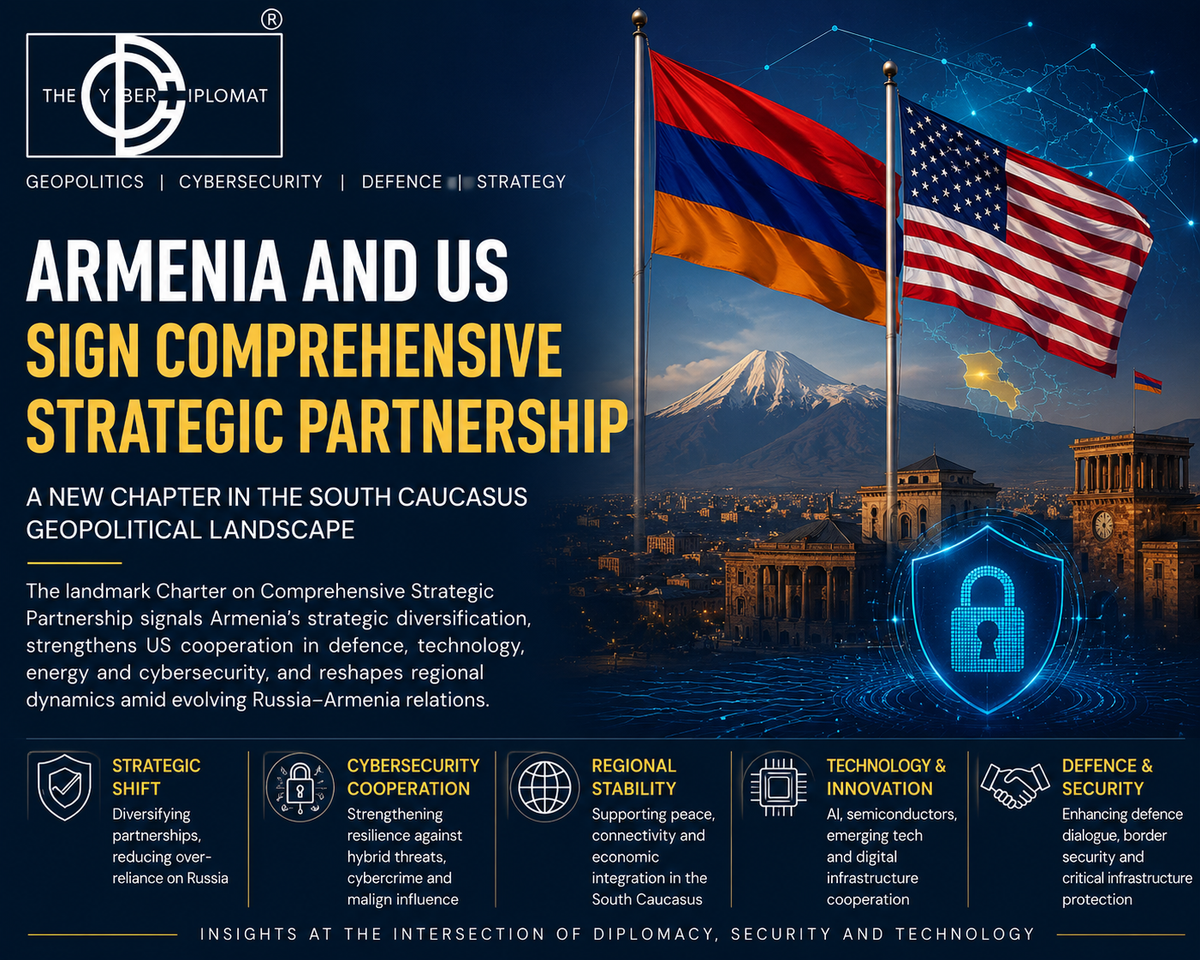
The signing of the Charter on Comprehensive Strategic Partnership between Armenia and the United States marks a potentially transformative moment in the geopolitical and cybersecurity landscape of the South Caucasus.
The agreement, signed amid intensifying global competition over connectivity corridors, critical technologies, and regional influence, reflects Armenia’s accelerating efforts to diversify its strategic partnerships beyond its long-standing security dependence on Russia.
Spanning defence cooperation, cybersecurity, critical infrastructure resilience, artificial intelligence, semiconductors, energy security, and border management, the charter positions Armenia as an increasingly important geopolitical and technological actor in a rapidly evolving Eurasian security environment.
A Strategic Recalibration Away from Moscow?
For decades, Armenia remained one of Russia’s closest regional allies through mechanisms such as the Collective Security Treaty Organization (CSTO), deep military integration, Russian border deployments, and heavy economic dependence.
However, relations between Yerevan and Moscow have deteriorated significantly in recent years.
Armenian frustration intensified following:
- Russia’s limited security response during the Nagorno-Karabakh crises
- Perceived Russian inaction regarding Armenian territorial security concerns
- Armenia’s growing dissatisfaction with CSTO effectiveness
- Expanding Russian geopolitical distractions due to the Ukraine conflict
The new US–Armenia charter may therefore be interpreted as part of Armenia’s broader strategic diversification strategy aimed at reducing excessive reliance on Russian security structures.
The agreement’s language surrounding sovereignty, border control, independent security agencies, and trusted digital infrastructure reflects Armenia’s increasing pursuit of strategic autonomy in both physical and cyber domains.
Cybersecurity Emerging as a Core Pillar of Armenian National Security
One of the most consequential aspects of the agreement lies in its cybersecurity and digital resilience provisions.
The charter explicitly highlights cooperation against:
- Malicious cyber actors
- Hybrid threats
- Cybercrime
- Illicit financial flows
- Critical infrastructure vulnerabilities
- Disinformation and foreign malign influence operations
The United States and Armenia also agreed to pursue regular cyber consultations, technical assistance, and potential technology transfers to strengthen Armenia’s cyber resilience.
This is particularly significant given Armenia’s evolving cybersecurity landscape.
Armenia’s Cybersecurity Environment: Growing Capabilities Amid Persistent Vulnerabilities
Armenia has increasingly emerged as a regional technology and innovation hub, particularly in software engineering, startups, semiconductor research, and digital services.
The country hosts:
- A rapidly expanding IT sector
- International technology partnerships
- AI and semiconductor initiatives
- Growing fintech and telecommunications infrastructure
- Expanding e-governance systems
However, Armenia also faces substantial cybersecurity challenges.
Key Cybersecurity Risks Facing Armenia
1. Geopolitical Cyber Exposure
Armenia remains exposed to cyber operations linked to regional geopolitical tensions involving:
- Azerbaijan
- Russia
- Iran
- Turkey
- broader state-aligned influence ecosystems
Past regional conflicts demonstrated how cyber operations increasingly accompany conventional military and information warfare campaigns.
2. Critical Infrastructure Vulnerabilities
The agreement’s focus on energy grids, telecommunications, finance, and transport connectivity highlights concerns surrounding the resilience of Armenian critical infrastructure.
As Armenia modernizes and digitizes national infrastructure, attack surfaces are also expanding.
3. Hybrid Information Operations
The charter’s emphasis on countering foreign malign propaganda reflects growing awareness of disinformation campaigns and influence operations targeting democratic institutions, public trust, and regional stability.
The South Caucasus has increasingly become an arena for competing narratives and information warfare campaigns conducted by both state and non-state actors.
4. Supply Chain and Emerging Technology Security
The partnership’s semiconductor, AI, and digital economy provisions introduce new dimensions of cyber governance and technology security.
As Armenia seeks integration into global technology supply chains, issues surrounding:
- export controls
- trusted vendors
- secure cloud infrastructure
- AI governance
- cyber espionage
- semiconductor supply chain protection
will become increasingly central to national security planning.
Russia’s Likely Strategic Concerns
From Moscow’s perspective, the charter may raise several strategic concerns.
The agreement expands US involvement in:
- Armenian defence modernization
- cybersecurity cooperation
- border security
- critical infrastructure resilience
- advanced technology ecosystems
- information security frameworks
These are areas Russia historically viewed as within its sphere of influence.
The provisions concerning independent Armenian border management and deeper Euro-Atlantic integration may particularly attract scrutiny from Russian strategic circles.
At the same time, Armenia appears to be carefully avoiding a complete rupture with Moscow. Its balancing strategy likely aims to diversify partnerships while maintaining enough regional flexibility to manage its complex geopolitical realities.
The South Caucasus as an Emerging Cyber-Geopolitical Theatre
The Armenia–US partnership reflects a broader transformation occurring across the South Caucasus, where cybersecurity, digital infrastructure, energy resilience, and connectivity corridors are becoming increasingly intertwined with geopolitics.
The region now sits at the intersection of:
- East-West connectivity competition
- energy transit routes
- critical minerals supply chains
- AI and semiconductor geopolitics
- hybrid warfare dynamics
- NATO-Russia strategic competition
As digital infrastructure and strategic technologies become instruments of geopolitical influence, Armenia’s cyber resilience and technology governance will likely play an increasingly important role in shaping regional stability.
The agreement therefore extends beyond bilateral cooperation. It signals how cybersecurity, emerging technologies, and critical infrastructure protection are rapidly becoming central pillars of modern diplomacy and strategic statecraft in Eurasia.