Arrested by Fear: The Global Rise of Digital Arrest Scams
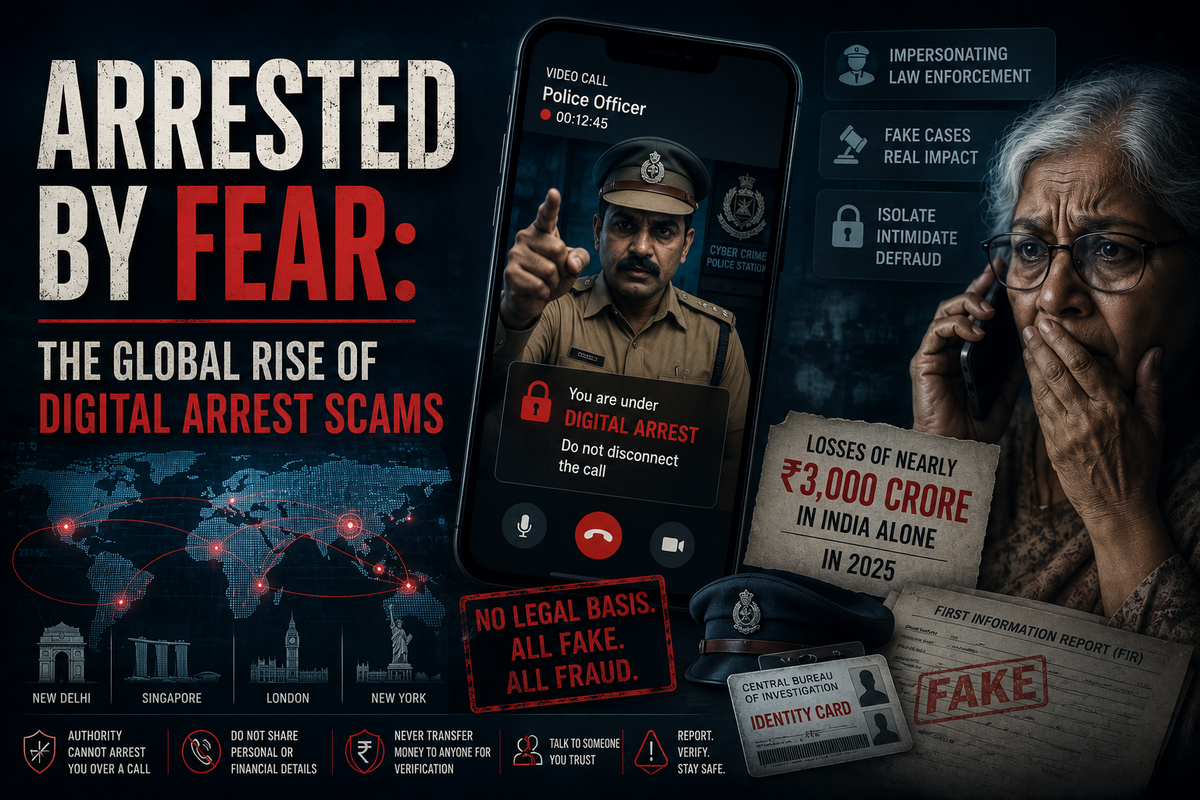
They wear uniforms. They carry badges. They read out charges. They are entirely fictional — and they are stealing billions from people who never suspected that a phone call could cost them everything.
The Call That Changes Everything
A retired school principal in Delhi picks up her phone. The man on the other end wears a police uniform, speaks with authority, and tells her that her Aadhaar number has been linked to a money laundering case. She must stay on the line. She is under "digital arrest". Over the next few hours, as fear replaces reason, her life savings are transferred away. By the time her children are told, there is nothing left to recover.
She is not alone.
In Singapore, a 67-year-old woman loses S$1.2 million over ten days, convinced she is cooperating with a joint investigation involving Interpol. In the United Kingdom, a retired teacher hands over £40,000 after a caller impersonating a Metropolitan Police officer tells him his bank account is being used by criminals. In the United States, an elderly Vietnamese-American couple wires $300,000 to "clear their names" from a drug trafficking allegation that exists only in a scammer's script.
The geography changes. The script does not.
What "Digital Arrest" Actually Means
The phrase "digital arrest" has no legal standing anywhere in the world. No police force, no court, no government agency on Earth has the authority to place a citizen under arrest through a WhatsApp video call, Skype session, or Zoom meeting. The term is invented — a piece of theatrical terminology designed to sound official enough to generate compliance and obscure enough that the victim doesn't know to challenge it.
The scam typically unfolds in three acts.
In the first, contact is made. A victim receives a call, often on their mobile, from someone claiming to be a courier company, telecom regulator, or government department. A parcel in their name has been intercepted carrying drugs or illegal documents. Or their SIM card has been used to make fraudulent calls. Or their Aadhaar or national ID is linked to criminal accounts. The opening accusation varies, but its purpose is singular: to establish that the victim is in trouble.
In the second act, the "escalation" arrives. A senior official — a police inspector, a CBI officer, an enforcement directorate deputy, a customs superintendent — joins the call via video. They are in uniform. Behind them is a backdrop resembling a police station or government office. They carry what appear to be official documents. They read out charges. They tell the victim this matter is "highly confidential" and must not be discussed with family members or friends. Isolation is installed.
In the third act, the solution is offered. The victim can "clear their name" by transferring money to a secure government account for "verification" or "interim deposit during investigation". Once the matter is resolved, they are assured, the money will be returned. It never is.
India: Ground Zero of a Growing Crisis
India has emerged as the country most severely affected by digital arrest fraud, both in terms of the number of victims and the scale of organised criminal infrastructure behind it.
Data from the National Cybercrime Reporting Portal reveals that India recorded over 32,000 complaints related to digital arrest scams in 2025 alone — roughly 89 every single day. The Supreme Court, while hearing a suo motu case involving forged judicial documents used in such frauds, estimated nationwide losses at close to ₹3,000 crore. That figure almost certainly understates the true toll, given that many victims — particularly elderly ones — never report the crime out of shame or a sense of futility.
What makes India particularly vulnerable is a convergence of factors that fraudsters have learned to exploit with surgical precision. The country has undergone rapid, mass-scale digital adoption over the past decade. Hundreds of millions of people — many of them first-generation digital users — entered the online banking and digital payment ecosystem without proportional exposure to cybersecurity awareness. The Aadhaar biometric identity system, while a genuine administrative achievement, has also created a single identifier whose alleged compromise can be weaponised to generate instant fear. And perhaps most crucially, trust in institutional authority — the police, the judiciary, government departments — remains deep enough that a uniformed face on a screen still carries enormous psychological weight.
The NCRP found that impersonation of law enforcement agencies features in nearly 90 per cent of digital arrest complaints. Fraudsters impersonate police officers, CBI and ED officials, customs authorities, and increasingly, judges. Fake ID cards, forged notices, fabricated FIR numbers, and video call backdrops designed to resemble government offices create an atmosphere that victims describe as completely convincing.
Authorities have identified close to 8.5 lakh mule accounts linked to cybercrime operations spread across more than 700 bank branches — a network of staggering scale, suggesting that the criminal ecosystem behind digital arrest fraud is not opportunistic but industrial.
The Elderly: A Deliberately Chosen Target
If the digital arrest scam has a preferred victim, it is an elderly person living alone.
This is not accidental. India's shifting social structure has produced millions of senior citizens living independently while their children work in other cities or abroad. The same pattern repeats in the diaspora communities of the US, UK, Canada, and Singapore. Social isolation, limited digital familiarity, and an instinctive respect for official authority create a vulnerability profile that fraud networks explicitly target.
The psychological mechanics are well understood by the criminals who deploy them. Accusation involving sexual misconduct, drug trafficking, or illegal financial activity generate immediate, disproportionate fear. These allegations are chosen because the shame they produce is so acute that victims often cannot think clearly — and crucially, will not tell their children what they have been accused of. The fraudsters use that shame as a wall, keeping the family out and the victim trapped inside the deception.
One complaint on the NCRP describes a 93-year-old retired railway engineer from Karnataka who lost ₹60 lakh from his fixed deposits after prolonged WhatsApp video calls with fraudsters posing as government officials. This was not a small or casual sum. It was a lifetime of accumulated security, liquidated over the course of a few hours of sustained psychological pressure.
The financial damage is profound in a way that aggregate statistics cannot fully capture: elderly victims are not losing discretionary income. They are losing the savings that were supposed to carry them through their remaining years. Fixed deposits, mutual funds, jewellery, and in some cases, personal loans taken under the fraudster's direction — all of it gone. The emotional damage compounds it. Studies and survivor accounts consistently describe anxiety, withdrawal, loss of dignity, and a deep reluctance to discuss the experience with family.
A Global Operation
The digital arrest scam is not a cottage industry. It is a transnational criminal enterprise with the characteristics of a well-run business: scripted processes, hierarchical management, geographic diversification, and efficient money laundering infrastructure.
The operational hubs of the largest networks have been traced to parts of Southeast Asia — particularly northern Myanmar, Laos, and Cambodia — where fraud compounds operate in territories with minimal law enforcement presence. These compounds are themselves scenes of another crime: they are frequently staffed by trafficked workers, recruited from India, China, and other countries through fake job advertisements, then trapped and coerced into running fraud operations under threat of violence.
Money extracted from victims is moved through layered mule account networks, converted into cryptocurrency, and distributed across jurisdictions. The use of VoIP and caller ID spoofing allows criminals to display numbers with local country codes, bypassing the first instinct many potential victims have of checking whether a number looks foreign. AI tools — deepfake video and voice synthesis — are increasingly used to make video calls more convincing, including documented cases involving deepfake likenesses of senior judicial figures.
In the United States, the FBI's Internet Crime Complaint Center (IC3) has documented a dramatic rise in government impersonation fraud, with elderly Americans losing billions annually. A particular variant — the "grandparent scam" — involves a caller pretending to be a grandchild in legal trouble, a fraud that shares the same emotional architecture as the digital arrest scam even if the surface details differ. In the UK, Action Fraud records tens of thousands of impersonation fraud cases each year, with losses running into hundreds of millions of pounds.
Across the Asia-Pacific, Australia's Scamwatch and Singapore's Anti-Scam Centre have both flagged surging volumes of government impersonation fraud. Singapore, despite having one of the highest digital literacy rates in the world, has seen its elderly citizens victimised at scale — a reminder that familiarity with technology does not immunise against social engineering. The scam's real weapon is not technical complexity. It is psychological exploitation.
Why the Scam Keeps Working
To ask why people fall for digital arrest scams is to misunderstand how they work. These are not simple tricks that a moment's rational reflection would defeat. They are carefully engineered psychological experiences designed to disable rational reflection entirely.
Fear is the primary mechanism. When a person is told they are under investigation for a serious crime — money laundering, drug trafficking, child pornography — the brain's threat-response systems are activated in ways that genuinely impair logical thinking. The constant presence of a "police officer" on a video call creates the cognitive equivalent of being watched by authority. Instructions to stay silent and not contact family members sever the social connections that would otherwise quickly expose the fraud.
The scam also exploits the legitimate complexity of modern bureaucratic life. Most people in India genuinely do not know all the processes by which Aadhaar can be linked to accounts, or how customs interceptions are handled, or what ED investigations look like. That uncertainty becomes exploitable. When a fraudster says "your number has been linked to an account in Tamil Nadu that received drug money", the victim cannot immediately disprove it — and in the window of that uncertainty, fear takes hold.
The very success of digital systems in government — UPI, Aadhaar, DigiLocker, NCRP — has inadvertently lent credibility to the scam. Fraudsters reference real systems and real processes by name, mixing accurate detail with fabrication in ways that feel convincing. When someone says "your Aadhaar has flagged on the NCRP database", they are speaking the language of a real world the victim inhabits.
What Needs to Change
The response to digital arrest fraud has to operate at several levels simultaneously, because no single intervention is sufficient.
Public awareness must be relentless and simple. The core message — no police officer, judge, or government official in any country will call you on WhatsApp to arrest you or ask you to transfer money — needs to be repeated in every medium, in every language, until it becomes common knowledge. Television and radio remain the most effective channels for reaching elderly audiences. Banks, post offices, pension disbursement centres, and Resident Welfare Associations should carry this message as a standard part of their communication.
Banks must act as active guardians, not passive conduits. Large unusual transactions from accounts belonging to senior citizens — particularly rapid fund movements to unfamiliar accounts — should trigger mandatory verification calls or delays. The Supreme Court has already directed the RBI to examine the use of AI and machine learning to identify mule account clusters. That examination needs to become action. In the UK, major banks now offer "safe-to-call" callbacks specifically designed to catch moments when a customer is being coached by a fraudster on another line.
Law enforcement coordination needs to cross borders. The fraud compounds in Southeast Asia cannot be dismantled by any single country's police force. India has deepened bilateral cooperation on cybercrime with Singapore and the US, and the I4C's work in coordinating domestic response is genuinely significant. But the international legal architecture for extraditing and prosecuting cross-border cybercriminals remains woefully inadequate relative to the speed and scale of the criminal networks involved.
Data protection is a foundational issue. Fraudsters open conversations with accurate personal information — a name, an Aadhaar number, an address, a family member's detail — because that accuracy is what makes the fake investigation feel real. Much of this information comes from data breaches, leaked databases, and dark web marketplaces. Until India's data protection framework meaningfully constrains the collection, storage, and sale of personal data, fraudsters will always have a head start.
Survivors must be destigmatised. Many victims never report their loss because they are ashamed. This silence serves the criminals and deprives law enforcement of the data needed to map and disrupt fraud networks. Framing digital arrest fraud as a sophisticated psychological attack — which it is — rather than a failure of individual intelligence will encourage reporting and help more families recognise the signs before money is lost.
A Civilisational Reckoning
There is something deeply troubling about a world in which the elderly are systematically targeted because they answer their phones in good faith and because they still believe that a person in uniform represents the law.
The digital arrest scam did not create distrust of authority, or fear of institutions, or the vulnerability of living alone in old age. It found those things already present in society and learned to weaponise them. In that sense, the scam is not just a crime. It is a mirror — reflecting back the fractures in how societies have managed the transition to digital life, the gaps left in communities as families disperse, and the inadequacy of a cyber safety infrastructure that has never kept pace with the digital expansion it was supposed to protect.
India's Prime Minister Narendra Modi has spoken directly to the nation about digital arrest scams, issuing clear warnings in his monthly radio addresses. The Supreme Court has taken suo motu cognisance. The I4C coordinates arrests. These are real responses. But the gap between the scale of the problem and the scale of the response remains vast.
Every day, 89 people in India alone file a complaint. Millions more, abroad and at home, do not file anything at all.
Until a retired teacher in Bengaluru, a grandmother in Toronto, a former civil servant in London, and a retired engineer in Ohio can all answer an unknown call without the fear that it might cost them everything — the job is not done.