Cambodia’s Cyber Scam Crisis: A Rogue-State Warning for ASEAN and Global Cybersecurity

Cambodia was once viewed through the lens of Angkor Wat, Siem Reap, Buddhist heritage, tourism revival, and post-conflict development. Today, that image is being challenged by a darker reputation: a major hub for transnational cyber fraud, human trafficking, and forced online criminality. The issue is no longer only a law-and-order problem. It has become a national security, cyber regulation, human rights, tourism, and ASEAN credibility crisis.
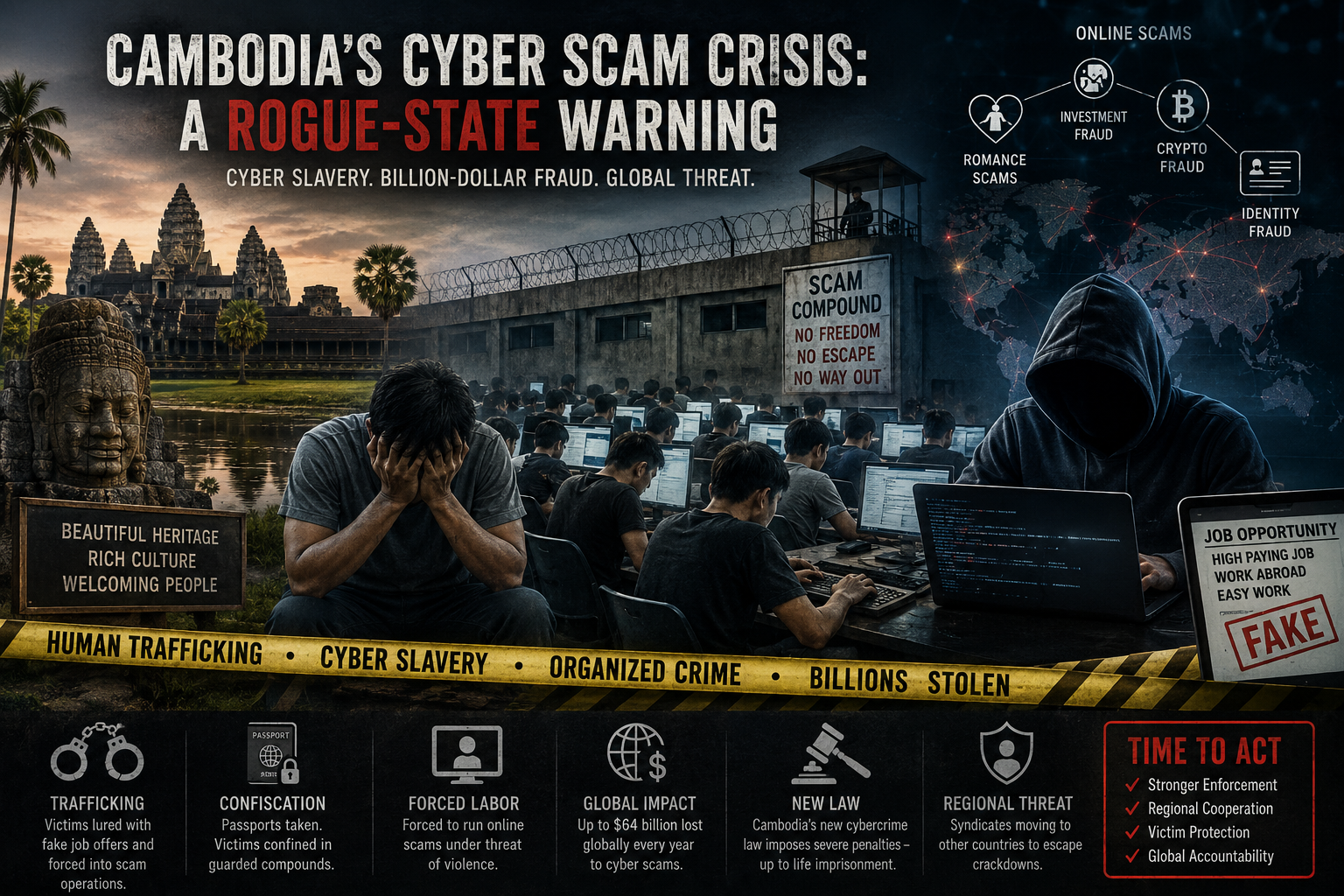
Recent reports from India show how Indian citizens are being lured to Cambodia with fake overseas job offers, only to be forced into cyber scam operations. India’s National Investigation Agency has chargesheeted five accused in a Cambodia-linked human trafficking and “cyber slavery” case, where victims were allegedly promised legitimate work and then forced into scam operations after arrival. A separate case in Tamil Nadu alleged that a Madurai-based recruiter trafficked more than 100 Indian youths to Cambodia under the pretext of employment.
From Tourist Destination to Scam-State Reputation
Cambodia’s tragedy lies in the contrast between its civilisational beauty and its criminal economy. Siem Reap and Angkor Wat remain symbols of cultural heritage, but fortified scam compounds, often linked to casinos, border towns, and special economic zones, have reshaped the country’s global image.
These compounds typically operate through a familiar pattern: educated young people are recruited through fake job advertisements, moved across borders, stripped of passports, confined in guarded facilities, and forced to run romance scams, cryptocurrency frauds, investment scams, impersonation rackets, and digital extortion. The victims are not merely “cybercriminals”; many are trafficked labourers coerced into criminality.
UNODC has estimated losses of US$18–37 billion in 2023 from scams targeting East and Southeast Asia, with a large share linked to organised crime groups in Southeast Asia. A USIP study cited estimates that scam syndicate revenue in Cambodia alone may exceed US$12 billion annually, and estimated global “pig-butchering” scam revenue at US$63.9 billion.
Cyber Slavery as a National Security Threat
The term “cyber slavery” captures the hybrid nature of this crisis. It combines human trafficking, cybercrime, money laundering, corruption, illegal gambling, cryptocurrency misuse, telecom abuse, weak border governance, and state-capacity failure.
For India, the concern is direct: Indian citizens are being recruited, trafficked, coerced, and used as instruments of cyber fraud abroad. For ASEAN, the issue undermines regional trust. For global victims, Cambodia-linked syndicates are part of a criminal ecosystem that reaches into personal savings, banking systems, crypto exchanges, telecom networks, and digital platforms.
The security threat is not limited to financial loss. These operations create shadow economies, corrupt officials, distort tourism, exploit visa regimes, and provide organised crime groups with industrial-scale revenue. Once such revenue becomes politically protected or economically embedded, the line between a weak state and a rogue-state ecosystem begins to blur.
Is Cambodia Becoming a Rogue State?
The phrase “rogue state” must be used carefully. Cambodia is a recognised sovereign state, a member of ASEAN, and a country with legitimate cultural, economic, and diplomatic interests. However, a “rogue-state warning” is justified when a country repeatedly becomes a permissive environment for transnational criminal networks, fails to dismantle protection structures, and allows its territory to be used for large-scale harm against foreign nationals.
The risk is not that Cambodia officially declares support for cybercrime. The risk is that cybercrime becomes structurally tolerated: protected by corruption, enabled by weak regulation, embedded in local economies, and addressed only through selective crackdowns when international pressure becomes unbearable.
OCCRP has described Cambodia as a global epicentre for scam centres and highlighted allegations of corruption and official complicity enabling trafficking and transnational crime. Similar policy analyses have warned that Cambodia has become one of the leading locations for large-scale, human-trafficking-fuelled cybercrime.
Cambodia’s New Cybercrime Law: Necessary but Not Sufficient
Under growing international pressure, Cambodia has moved to legislate. Its parliament approved its first law specifically targeting online scam centres, with penalties reportedly ranging from five to ten years in prison and up to life imprisonment in severe cases involving trafficking, violence, or death.
This is important. But law on paper is not the same as enforcement. Cambodia has previously announced crackdowns, shutdowns, arrests, deportations, and repatriations. AP reported that Cambodia identified around 250 suspected scam locations, claimed to have dismantled about 80% since July 2025, and repatriated nearly 10,000 workers from 23 countries. Yet experts remain sceptical unless the financial, political, real-estate, casino, telecom, and protection networks behind the industry are dismantled.
The extradition of alleged scam kingpin Chen Zhi to China shows that Cambodia is responding to external pressure, especially from powerful states. But selective action against high-profile figures will not solve the systemic problem if replacement networks continue operating under new names or move to Laos, Myanmar, Sri Lanka, or other jurisdictions with weaker oversight.
ASEAN’s Credibility Problem
ASEAN has recognised online scams as a regional threat. The 2025 ASEAN Declaration on Combating Cybercrime and Online Scams acknowledged that cybercrime and online scams have become a complex transnational organised threat linked to phishing, financial fraud, money laundering, people smuggling, and trafficking in persons. UNODC has also noted growing ASEAN cooperation to address trafficking for forced criminality in scam compounds, especially in the Mekong sub-region.
However, ASEAN’s non-interference principle creates a dilemma. If member states avoid direct pressure on one another, scam economies can flourish behind sovereignty. If ASEAN acts too weakly, it risks becoming a region where cybercriminal syndicates shop for the easiest jurisdiction.
Cambodia’s crisis is therefore not only Cambodia’s problem. It is an ASEAN governance test.
Tourism, Reputation, and the Misuse of “Cyber Tourism”
Cambodia’s legitimate tourism sector is also a victim. “Cyber tourism” should not be treated as a tourist attraction; it is a reputational wound caused by cybercrime. Scam-centre stigma, trafficking stories, and safety concerns have damaged regional confidence and affected travel sentiment. CSIS has noted that concerns around scams and trafficking have affected regional tourism, including sharp drops in Chinese tourism to Thailand after scam-centre trafficking incidents.
Cambodia is trying to repair its image through digital tourism initiatives such as the official “Visit Cambodia” app and tourism platforms. But branding cannot substitute for enforcement. Tourists may return for Angkor Wat; investors and governments will not return trust unless Cambodia proves that cybercriminal protection networks are being dismantled.
Recommendations
Cambodia should publish verified data on scam-centre raids, prosecutions, convictions, asset seizures, victim repatriations, and officials investigated for complicity. Enforcement must move beyond rescuing victims and arresting low-level operators.
India should strengthen pre-departure job verification, embassy-level rescue protocols, immigration alerts, and public advisories for high-risk job destinations. Recruitment agents involved in cyber slavery should face organised-crime and trafficking charges, not merely immigration violations.
ASEAN should create a regional cyber trafficking task force with shared watchlists, suspicious recruitment indicators, crypto-wallet tracing, telecom intelligence, and fast victim identification channels.
Cybercrime laws must be integrated with anti-trafficking, anti-money-laundering, cryptocurrency regulation, casino regulation, telecom licensing, and beneficial ownership transparency.
Travel platforms, job portals, telecom operators, crypto exchanges, and banks should be brought into a public-private early-warning system for scam recruitment and fund flows.
Conclusion
Cambodia is not beyond repair. It remains a country of immense cultural value, strategic relevance, and human potential. But its current trajectory is dangerous. When a country’s territory becomes a safe operating base for billion-dollar cyber fraud, forced labour, and transnational organised crime, the issue moves beyond policing. It becomes a question of sovereignty, governance, and national security.
The world should not reduce Cambodia to its scam compounds. But neither should it romanticise Angkor Wat while ignoring cyber slavery. Cambodia now faces a defining choice: reclaim its future as a responsible ASEAN member and tourism economy, or allow criminal syndicates to turn it into a warning case of a rogue cyber-crime state in the making.