Echoes of Evolution: Why the World Needs Cyber Diplomats
Evolution reshaped the natural world over millions of years. Our digital world has had decades—and we are already falling behind. The question isn't whether we adapt. It's whether we adapt fast enough.
Author: Sanjana Rathi, CEO/Founder - The Cyber Diplomat · International Security Specialist · TEDx Speaker
This essay is adapted from Sanjana Rathi's TEDx talk, "Echoes of Evolution." Sanjana works at the intersection of cybersecurity, law, and international diplomacy, and has worked with national law enforcement agencies, defence institutions, and INTERPOL.
When we think of evolution, we imagine nature reshaping itself—animals adapting, environments transforming, species emerging from struggle. But evolution is not limited to biology. It echoes through history, through societies, through the systems we build to govern ourselves. Today, it echoes through cyberspace. And the question is whether we are listening.
A Mirror Moment: WannaCry and the World That Wasn't Ready
Take yourself back to 2017. The WannaCry ransomware attack swept across 150 countries in days. Hospitals shut down. Governments stalled. Chaos rippled across continents. In the aftermath, police officers from multiple nations convened at INTERPOL's Global Centre for Innovation—not with answers, but with uncertainty. Many of their governments had issued no guidance, no policies, no framework. There was no international regulation to reference. No shared playbook. No common language.
That moment wasn't just a crisis. It was a mirror. It reflected how the world had failed to evolve fast enough to meet a digital threat. While technology had surged forward, our laws, our systems, and our capacity to cooperate had lagged behind—still clinging to structures built for an offline era.
"The world doesn't need more experts who speak in silos. We need translators—people who can bridge the worlds of code and countries."
Between Codes and Countries: A Personal Journey
My own path into this space didn't begin with a courtroom or a command line. It began in the middle—between disciplines. I started as a computer science engineer, fascinated by systems and how they fail. Then I studied management, politics, diplomacy, law, and international security. Somewhere in that journey, I understood something that changed everything: the world doesn't need more siloed experts. It needs translators.
People who can hold the precision of technology in one hand and the patience of diplomacy in the other. People who understand why a firewall matters to a foreign minister, and why a treaty clause matters to a security engineer. People who can stand in the gap between code and country—and actually get things done.
In my work with national law enforcement agencies, security and defence institutions, and INTERPOL, I saw the same story repeat itself. Cybercrime was not a niche concern. It was a global epidemic. But the response was disconnected, delayed, and deeply bureaucratic. And the people paying the price were ordinary people—not governments, not corporations. Ordinary people.
The Real Face of Cybercrime
I remember the case that changed everything for me. A farmer in Solapur, India, lost ₹10,000—his entire savings—to an international phishing scam. He walked into his local police station hoping for help. But that crime hadn't stopped at his phone. It had traveled through servers in three countries, used anonymous cryptocurrency accounts, and left no traceable trail. There was no system equipped to help him. The time, the cost, the complexity of recovering that money made it virtually impossible.
He is one of millions.
This is the real face of cybercrime—not the headlines about nation-state hackers or ransomware gangs. It's a farmer in rural India who lost his dignity and his savings to a faceless system, and couldn't find a single institution capable of standing in his corner. That gap—between the scale of the threat and the reach of the response—is what I have spent my career trying to close.
Living in the Digital Jungle
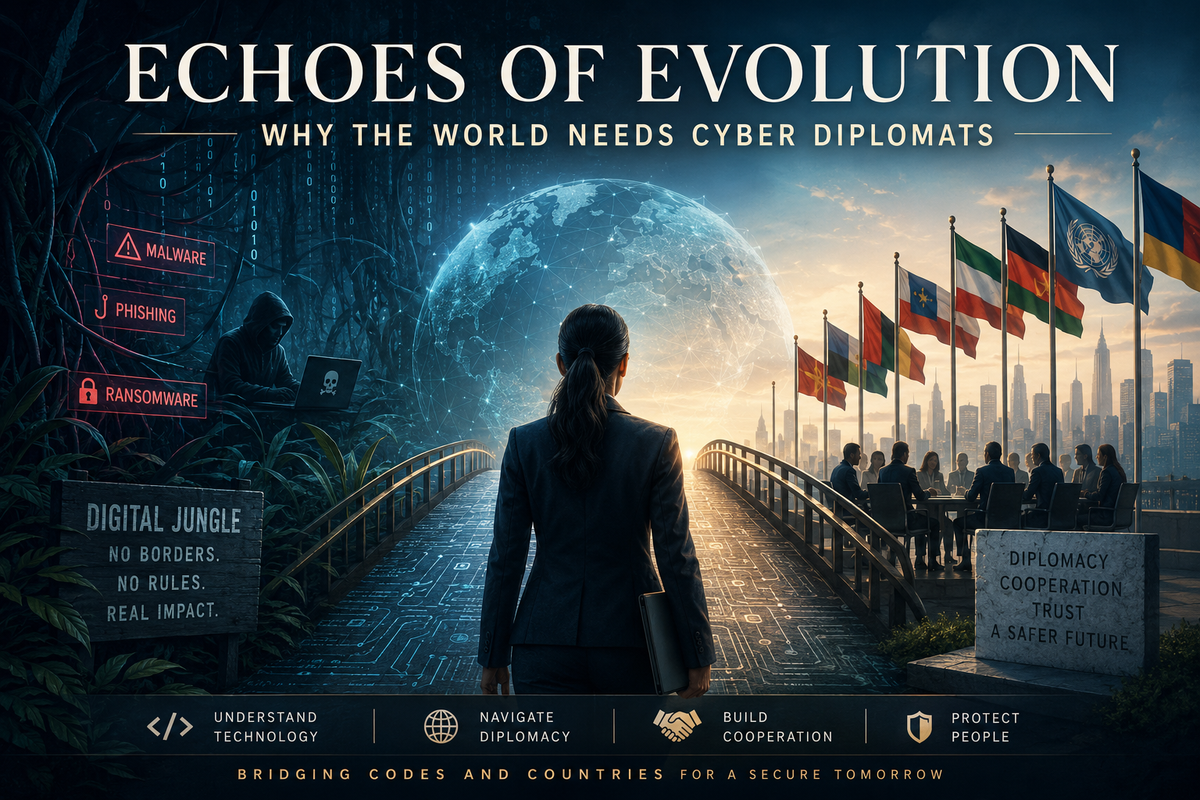
We are living in what I call the Digital Jungle. Every click, every connection, every keystroke traces a path through a vast, invisible landscape. In this jungle, predators don't wear masks or carry weapons. They use malware, misinformation, and manipulation. And the laws that govern our protection were written before smartphones even existed.
Governments pour billions into new policies, institutions, and schemes. But instead of building agility, we build more silos. We treat cyber threats like checkboxes—not like the dynamic, evolving dangers they are. This is not a failure of intention. It is a failure of evolution.
Let me paint three scenes that make this concrete—because these aren't theoretical threats. They are happening to people like you and me, right now.
SCENE ONE · THE HACKED CARSt. Louis, 2015
A man was driving his Jeep Cherokee at 70 mph when, without warning, the air conditioning blasted, music blared, and the windshield wipers went haywire. His accelerator stopped responding. The vehicle slowed to a crawl and eventually drove into a ditch—controlled remotely by two security researchers miles away. It was a controlled experiment. A wake-up call. But imagine if it hadn't been. Imagine a family on the highway at night, their smart car hijacked by a criminal demanding ransom for control. Or a city where autonomous vehicles suddenly veer off course in coordinated response to a single malicious command. The technology that promises to keep us safe can, in the wrong hands, turn our roads into chaos.
SCENE TWO · THE FROZEN PORT
Global shipping, 2017–2021
In June 2017, NotPetya malware—originating in a conflict half a world away—struck Maersk, one of the world's largest shipping companies. Port terminals from Mumbai to Rotterdam went dark. Cranes sat idle. Containers couldn't be tracked or moved. The final cost: an estimated $300 million. Years later, South Africa's Transnet suffered a ransomware attack that shut ports in Durban, Cape Town, and beyond. The Port of Durban—normally handling 60% of South Africa's trade—dropped to 10% capacity. Trucks queued for miles in sweltering heat. A factory in East Africa waited on parts that never arrived. Supermarket shelves in Europe went empty. A few lines of malicious code had jammed the lifeblood of a nation's economy.
SCENE THREE · THE MISLED SHIPS
Black Sea, 2017
Over twenty ships suddenly reported their GPS location somewhere impossible—32 kilometers inland, at a random airport. Imagine being a ship's captain, your instruments placing a 200-meter oil tanker on top of a hill, when you are actually out at sea. This was not a glitch. It was deliberate GPS spoofing—someone electronically deceiving navigation systems. The captains trusted their eyes over their instruments and no accidents occurred. But the implications are clear. Mislead a ship's GPS and you can send it off course, into hazardous waters, into collision. In an era when logistics and timing are everything, such attacks can send shockwaves through global supply chains within hours.
The hacked car. The frozen port. The misled ships. Each of these stories shares a common truth: in cyberspace, borders mean nothing. The hacker controlling the car might be in another country. The ransomware crippling the port was launched from another continent. The GPS spoofing signal could have come from a state actor or a lone operator with illicit equipment. The threats are cross-border, instantaneous, and mercilessly effective. And the people affected—the family in the car, the dock worker at the port, the ship's crew—are left bewildered, asking: who did this? Why? What now?
"Critical infrastructure is not just a security target. It's the arteries of modern life. And they are all connected—digitally, vulnerably, and often without adequate protection."
Enter Cyber Diplomacy
So what do we do? We don't need more bureaucracy. We need bridges. That is what cyber diplomacy offers—not a utopian concept, but a practical, necessary evolution in how nations, institutions, and people protect themselves and each other.
Cyber Diplomacy is about recognizing that cyberspace needs its own language of cooperation—one that blends the precision of technology with the empathy of diplomacy. It requires people who understand both firewalls and foreign policy, both encryption and the human cost when it fails. People who can act swiftly across borders, cut through institutional red tape, and coordinate responses in real time—not just reacting to crises, but anticipating them.
Imagine a world where every international organization, every government body, every piece of critical infrastructure had its own cyber diplomat—someone trained not just in response, but in anticipation. Someone who could liaise between a security engineer in Singapore and a foreign ministry official in Brussels and get them working toward the same outcome before the attack happens rather than after.
That is not science fiction. It is the next step in our institutional evolution. And it is long overdue.
Why This Matters Now More Than Ever
The future isn't coming—it's here. Generative AI is producing deepfakes in seconds. State-backed hackers are targeting vaccine data, election systems, and food supply chains. Teenagers in remote villages are running sophisticated phishing networks. Nation-states are fighting proxy wars through code. And somewhere in this chaos, people are losing hope—and losing trust.
If we don't evolve, we risk losing more than data. We risk losing trust—in our systems, our institutions, and in each other. That erosion is not recoverable quickly. It takes generations to rebuild what can be destroyed in a single breach.
Evolution is not just about survival. It is about adaptation—about learning from the past and stepping into the future with intention. The echo we hear today is this: it is time to adapt. Not with fear, but with vision.
I want to leave you with one image.
The farmer in Solapur, checking his phone, does not know his savings are gone. The police officer, wanting to help, but stuck in a system that hasn't evolved. The cyber diplomat, standing between them and the world—ready, connected, prepared.
That is the evolution we need. That is the echo we must answer. Let's not wait for the next global cyber crisis to remind us what we already know. Let's listen to the echoes—and act.
Cyber diplomacy |TEDx | Critical infrastructure | Cybercrime