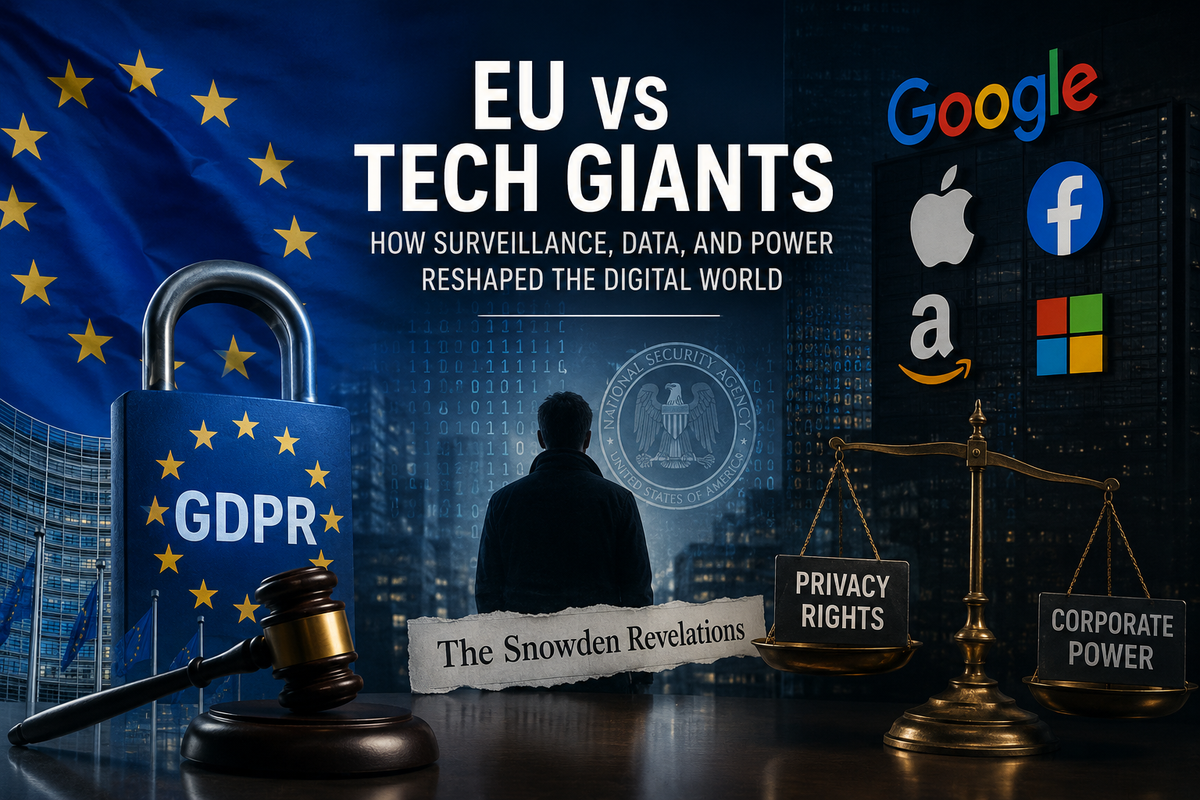
EU vs Tech Giants: How Surveillance, Data, and Power Reshaped the Digital World
By Sanjana Rathi
The story of GDPR is often simplified into a discussion about privacy notices, cookie banners, and data protection compliance. Yet the origins of GDPR run far deeper than website regulations or corporate compliance obligations.
GDPR emerged from a much larger geopolitical and technological struggle — one involving surveillance, cross-border data transfers, corporate dominance, digital sovereignty, and the growing concentration of power in the hands of global technology companies.
At its core, GDPR was Europe’s response to a fundamental question of the digital age:
Who controls data?
Governments?
Corporations?
Or individuals?
Understanding GDPR therefore requires understanding the broader conflict between the European Union and major technology corporations — a conflict that reshaped global conversations around privacy, surveillance, and digital governance.
The Early Battle: Europe vs Microsoft
Long before GDPR was introduced, the European Union had already begun challenging the growing influence of large technology corporations.
One of the earliest and most significant confrontations involved Microsoft between 2001 and 2012. The European Commission accused Microsoft of abusing its market dominance by restricting interoperability information and bundling Windows Media Player with the Windows operating system.
At the surface, this appeared to be an antitrust dispute.
However, beneath the legal proceedings was a deeper concern about technological concentration and digital dependency.
The EU increasingly feared that a small number of corporations were becoming gatekeepers of digital ecosystems — controlling not only software markets, but also information access, consumer behavior, and technological standards.
This marked the beginning of Europe’s broader effort to challenge the unchecked dominance of technology giants.
Surveillance, SWIFT, and the Expansion of Data Access
The geopolitical environment after the September 11 attacks fundamentally changed global approaches toward surveillance and financial intelligence.
One of the most controversial developments during this period involved the SWIFT financial messaging network, which became central to counterterrorism investigations and transatlantic intelligence cooperation.
Through programs linked to financial terror tracking, large volumes of financial transaction data were shared between Europe and the United States in the name of national security.
This raised serious concerns within Europe regarding:
- cross-border data access,
- state surveillance,
- privacy protections,
- and the growing exposure of European citizens’ financial information to foreign authorities.
The debate surrounding SWIFT and financial surveillance introduced a new geopolitical reality:
data was no longer merely commercial information — it had become a strategic asset tied directly to national security and sovereignty.
These tensions contributed significantly to Europe’s evolving approach toward data protection and cross-border data governance.
The Snowden Revelations: Europe’s Digital Awakening
If the post-9/11 era planted the seeds of European concern, Edward Snowden’s revelations in 2013 transformed those concerns into urgency.
Snowden exposed extensive surveillance programs conducted by the United States National Security Agency, including large-scale collection of digital communications and data flows involving major technology companies.
For Europe, these disclosures represented a turning point.
The revelations confirmed fears that personal data transferred outside European jurisdictions could become vulnerable to foreign intelligence access beyond the protections guaranteed under European law.
This fundamentally changed how Europe viewed digital governance.
Privacy was no longer treated solely as a consumer rights issue.
It became a geopolitical issue.
A sovereignty issue.
A democratic issue.
The Snowden disclosures accelerated European efforts to reassess transatlantic data-sharing arrangements and eventually contributed to the collapse of the Safe Harbor Agreement governing EU-US data transfers.
The foundations for GDPR were now firmly in place.
GDPR: Europe’s Assertion of Digital Sovereignty
When the General Data Protection Regulation was formally introduced, it represented far more than a privacy framework.
GDPR was Europe’s attempt to redefine the rules of digital governance.
For the first time, individuals were granted stronger legal rights over how their personal data could be collected, processed, stored, and transferred. GDPR introduced principles such as:
- informed user consent,
- data minimization,
- privacy by design,
- privacy by default,
- breach notification obligations,
- and strict restrictions on cross-border data transfers.
Perhaps most importantly, GDPR challenged the business model underpinning much of the modern internet:
the large-scale extraction, monetization, and commodification of personal data.
Through GDPR, the EU signaled that privacy was not simply a market preference — it was a fundamental right.
In doing so, Europe positioned itself as a global regulator of digital power.
The EU’s Broader Confrontation with Big Tech
While GDPR addressed data governance, the EU simultaneously intensified regulatory pressure on major technology companies through antitrust and taxation investigations.
Google became one of the most prominent targets.
The European Commission found Google guilty of favoring its own Google Shopping services over competitors within search results, arguing that the company had leveraged its dominance in one market to establish control in another.
The issue extended far beyond search engines.
The EU increasingly viewed large technology platforms as digital infrastructures with the ability to shape markets, visibility, information access, and public discourse itself.
At the same time, Europe pursued tax-related actions against multinational corporations including Apple and Google. The Apple-Ireland case became especially symbolic after the European Commission ordered Apple to pay billions in unpaid taxes.
These disputes revealed growing tensions between:
- European regulatory sovereignty,
- American technology dominance,
- and global digital capitalism.
Digital regulation was no longer simply about competition law.
It had become a matter of international relations.
The Right to Be Forgotten and the Battle Over Digital Memory
Among GDPR’s most controversial concepts was the “Right to be Forgotten.”
This principle allowed individuals to request the removal of personal information from search engines and digital platforms under certain conditions.
The concept triggered global debate.
Should individuals have the right to erase parts of their digital history?
Who determines what information remains publicly accessible?
Can privacy override freedom of expression?
The conflict exposed a philosophical divide between Europe and the United States.
American digital culture traditionally emphasized free expression and unrestricted information flows.
Europe increasingly prioritized human dignity, privacy rights, and individual control over personal information.
GDPR therefore became more than legislation.
It evolved into a competing model for governing the digital world.
The Geopolitics of Data
Today, the conflict between governments and technology companies continues to intensify.
Artificial intelligence, cloud computing, biometric surveillance, algorithmic governance, digital currencies, and cross-border data flows are reshaping the global balance of power.
In this environment, data has become one of the most strategically valuable resources in the world.
Control over data increasingly means control over:
- economic influence,
- political power,
- technological innovation,
- intelligence capabilities,
- and societal behavior.
The European Union’s response through GDPR marked one of the first major attempts by a state actor to challenge the concentration of digital power within global technology corporations.
Whether GDPR fully achieved its objectives remains debated.
However, its impact is undeniable.
GDPR fundamentally transformed the global conversation on privacy, surveillance, cybersecurity, and digital sovereignty.
More importantly, it established a new reality:
The future of geopolitics will not be shaped solely by territory, military capability, or natural resources.
It will increasingly be shaped by data, digital infrastructure, and the governance of cyberspace.
And in that struggle, the battle between states and technology giants has only just begun.