Europe Bets on Mistral
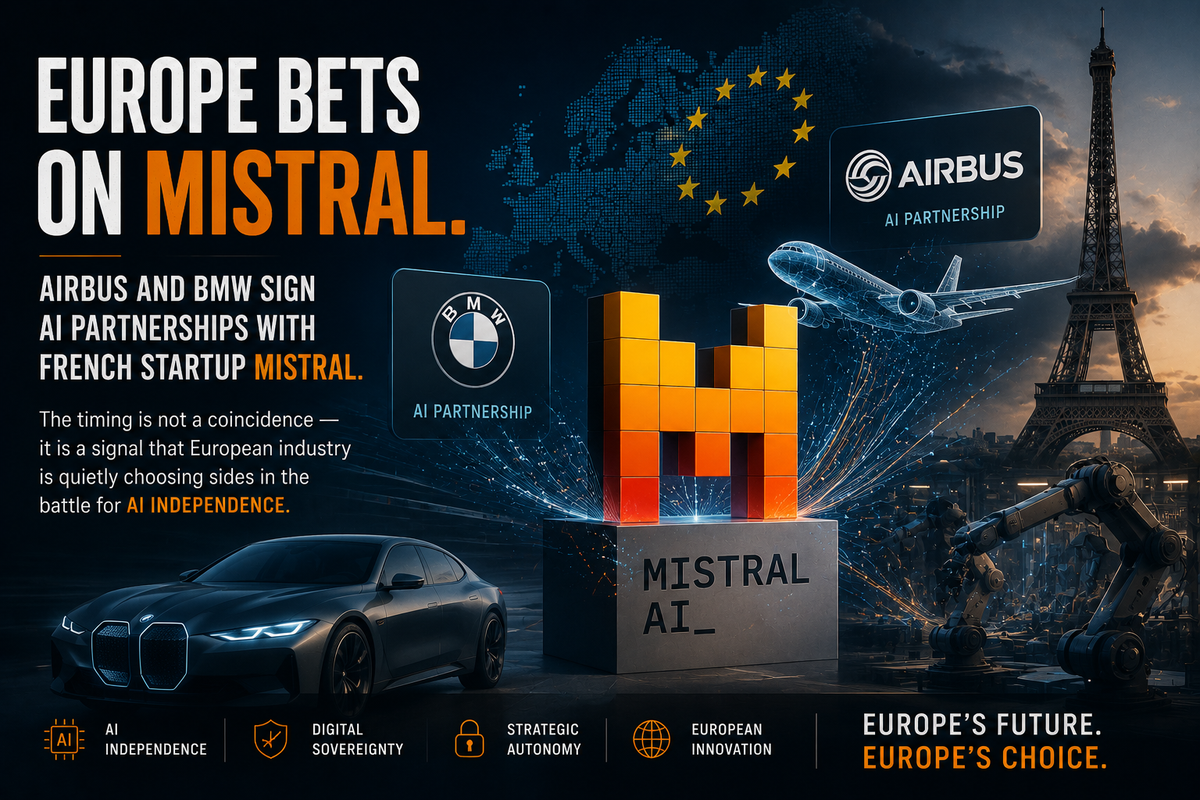
On the same day, Airbus and BMW both signed AI partnerships with French startup Mistral. The timing is not a coincidence — it is a signal that European industry is quietly choosing sides in the battle for AI independence.
Two of Europe's most iconic industrial names — one that puts aircraft in the sky, another that puts precision engineering on the road — announced AI partnerships with the same French startup on the same day. Airbus and BMW both chose Mistral AI, the Paris-born model company founded in 2023 that has become the clearest embodiment of Europe's ambition to build a credible alternative to American AI dominance.
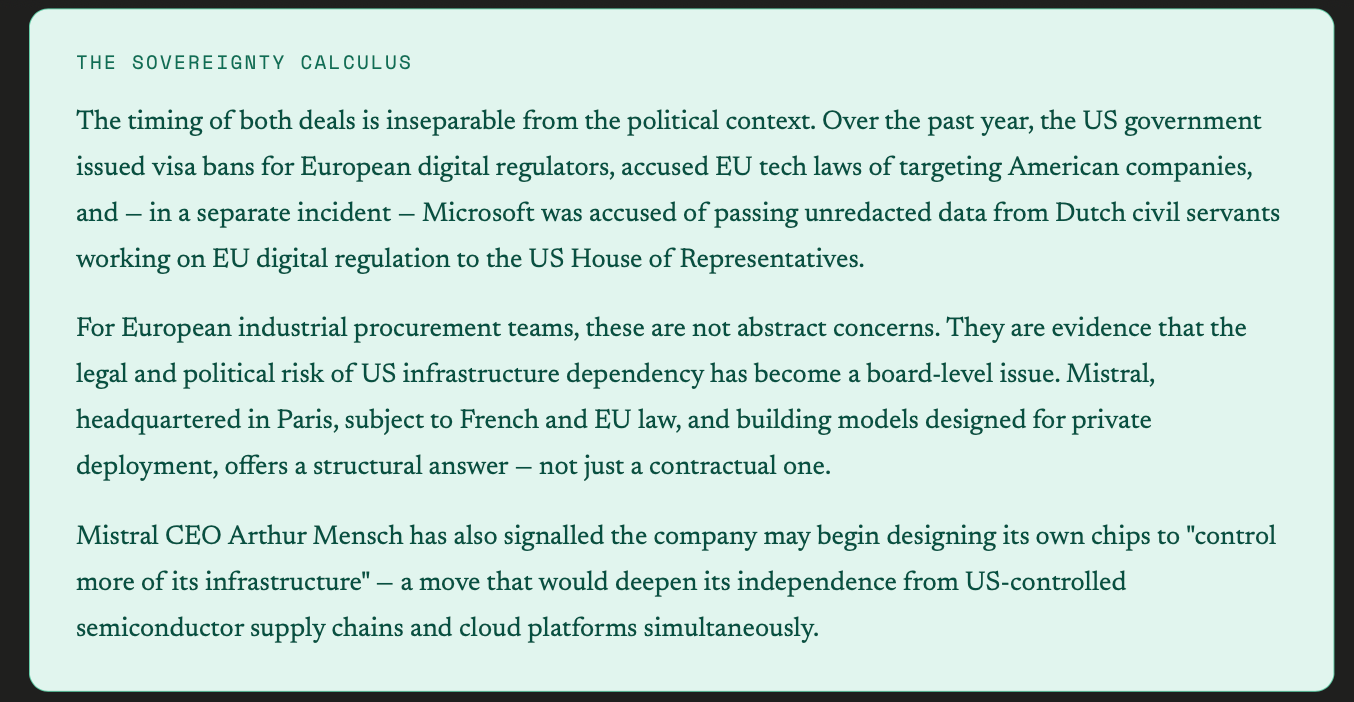
The deals are different in scope and application. But they share a common thread that runs far deeper than technology procurement: a growing conviction inside European boardrooms that dependence on US-based AI infrastructure carries risks that are no longer theoretical — legal, geopolitical, and strategic risks that have been made uncomfortably visible over the past 18 months.

Two deals, one message
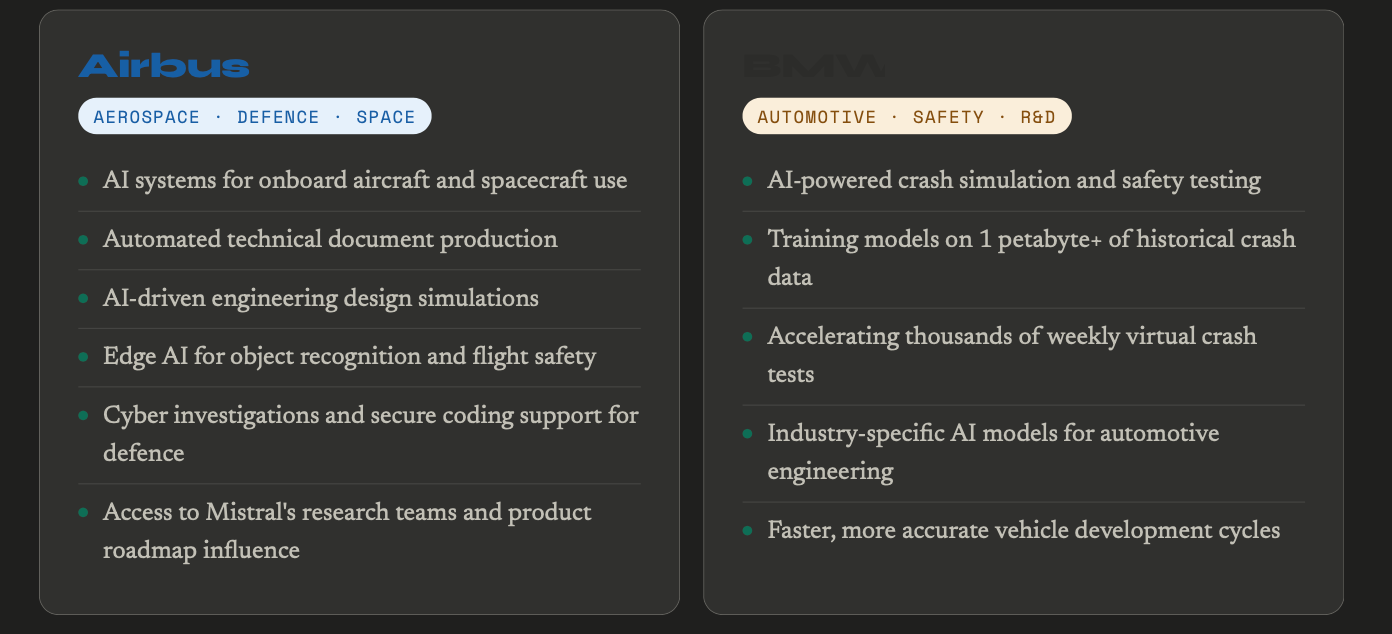
The Airbus deal is the more strategically significant of the two. Aerospace and defence are among the most data-sensitive sectors on earth. The combination of commercial aircraft systems, military applications, and space operations means that Airbus handles information that cannot, under any regulatory or security framework, be routed through infrastructure subject to foreign government access. The EU AI Act, GDPR, and defence procurement rules all create hard boundaries around where sensitive AI workloads can run and whose laws govern the data they process.
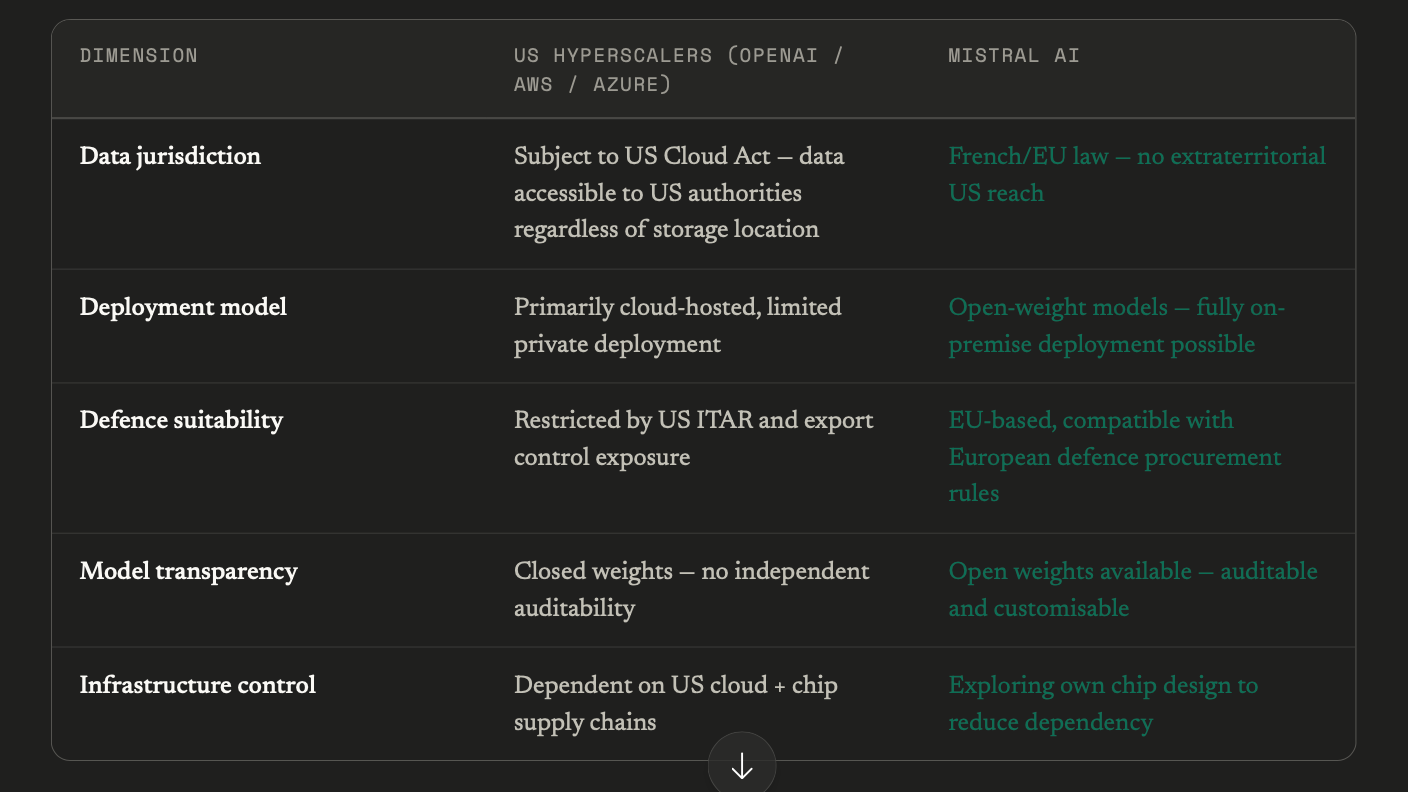
Mistral's architecture — built around open-weight models with on-premise and private deployment options — maps directly onto those requirements. You cannot get that guarantee from a US hyperscaler, regardless of what the contract says, because the Cloud Act can override the contract.
"This partnership paves the way for the deployment of high-impact, high-value use cases of trusted and responsible AI in aerospace."— Catherine Jestin, EVP Digital, Airbus
Why Mistral, and why now
Mistral vs. the US giants — a frank comparison
What "edge AI" means for the cockpit
One of the more technically interesting elements of the Airbus deal is the focus on edge AI — models that run directly on hardware, without a cloud connection. In an aircraft or spacecraft, this is not a performance preference. It is a necessity. You cannot rely on a data connection at 40,000 feet over the mid-Atlantic, and you certainly cannot route sensitive military flight data through a third-party server in real time.
Edge AI for automatic object recognition — one of the stated priority areas — could support collision avoidance, runway incursion detection, and airspace awareness in contested or GPS-denied environments. Given the current landscape of Russian GPS spoofing across European airspace, the overlap between Airbus's AI safety agenda and active operational threats is striking and not incidental.
BMW's quieter bet
The BMW deal receives less strategic fanfare, but the scale is remarkable on its own terms. The company runs thousands of virtual crash tests every week and has accumulated over a petabyte of historical simulation data — a dataset that is precisely the kind of proprietary, domain-specific corpus on which fine-tuned industrial AI models can dramatically outperform general-purpose ones.
Training Mistral's models on that data creates something genuinely valuable and genuinely European: a safety AI system that understands the specific physics, materials, and failure modes of BMW's engineering environment, running on infrastructure that BMW's legal and security teams can fully control. The IP stays in Munich. The data stays in Munich. The model stays auditable.
The bigger picture
Taken individually, each deal is a significant but contained business announcement. Taken together — alongside France, Germany, and Switzerland replacing Microsoft software in government, the ICC migrating off American platforms, and growing political momentum behind European cloud sovereignty — they suggest something more structural is underway.
European industry is not abandoning American AI out of ideology. It is responding to a rational risk calculation: the legal, regulatory, and geopolitical environment has shifted enough that building critical systems on US infrastructure now carries costs that many procurement teams are no longer willing to accept.
Mistral was founded three years ago with fewer than a dozen people. It now has Airbus building defence AI on its stack and BMW training safety models on its platform. The European AI ecosystem is no longer a promise — it is a supply chain option. And for the continent's largest industrial companies, that option is starting to look like the prudent choice.
Sources: Airbus–Mistral AI joint press statement, May 28 2026 · BMW–Mistral AI announcement · CNBC interview with Arthur Mensch · European Commission DSA/GDPR framework · US Cloud Act (2018)