FIFA World Cup 2026 Faces Rising Drone and Hybrid Security Threats Amid Global Counter-Terror Concerns
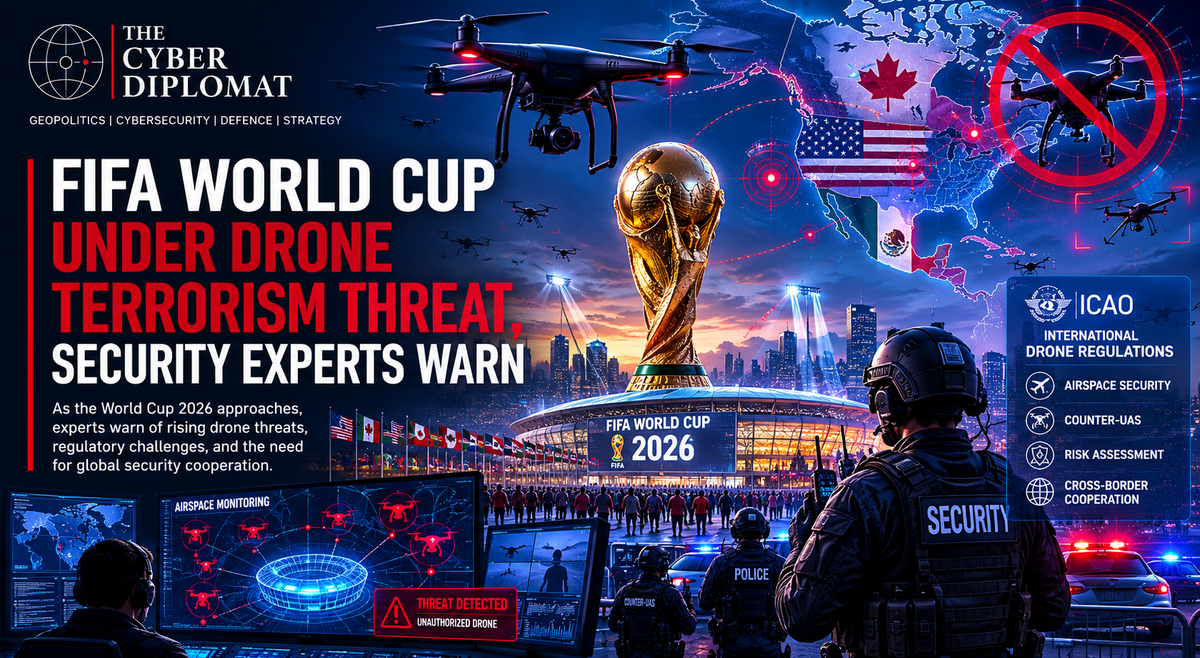
As preparations intensify for the FIFA World Cup 2026 across the United States, Canada, and Mexico, security experts are warning that the tournament could face an unprecedented convergence of drone-related threats, cyber risks, and hybrid terrorism challenges.
The expanded tournament — featuring 48 national teams and more than 100 matches across North America — is expected to become one of the largest international sporting events ever hosted. With millions of fans anticipated to travel across multiple host cities, authorities are increasingly focused on safeguarding stadiums, transportation systems, digital infrastructure, and public spaces from evolving security threats.
The Growing Threat of Weaponized and Malicious Drone Activity
Security analysts have highlighted the rising concern surrounding the misuse of commercially available unmanned aerial systems (UAS), commonly referred to as drones, by extremist actors, lone-wolf attackers, or organized terror networks.
Modern drones are no longer limited to surveillance or recreational use. Across recent global conflicts and security incidents, modified drones have been used for:
- Reconnaissance and surveillance
- Delivery of explosive payloads
- Disruption of critical infrastructure
- Smuggling and unauthorized aerial access
- Intelligence gathering and propaganda operations
Experts warn that densely populated stadium environments and fan zones present attractive targets for malicious drone activity, particularly due to the psychological and operational disruption such incidents could create even without physical casualties.
International Aviation and Drone Security Regulations Under Scrutiny
The World Cup is also expected to test the effectiveness of existing international drone governance frameworks and aviation security coordination mechanisms.
Authorities across North America are likely to rely on a combination of national and international regulatory frameworks, including:
- International Civil Aviation Organization (ICAO) drone and airspace management guidance
- FAA Part 107 regulations in the United States governing commercial drone operations
- Canadian and Mexican civil aviation drone regulations
- Temporary Flight Restrictions (TFRs) around stadiums and event zones
- Counter-UAS coordination protocols among law enforcement and military agencies
However, experts caution that fragmented regulations, inconsistent enforcement standards, and overlapping jurisdictional responsibilities continue to create operational gaps.
The increasing accessibility of advanced drones — including autonomous and AI-assisted systems — has outpaced many traditional regulatory and law enforcement mechanisms globally.
Counter-Drone Systems and Coordination Challenges
Security professionals have emphasized that counter-drone operations themselves introduce additional risks.
Anti-drone technologies such as radio frequency jammers, signal interception systems, radar tracking platforms, and directed energy systems require careful coordination to avoid disrupting civilian communications, emergency response systems, and aviation operations.
Concerns have also emerged regarding interoperability between federal, state, provincial, and local agencies operating across multiple host cities and jurisdictions.
The scale of the tournament means that effective security will depend less on isolated technological deployments and more on integrated command structures, intelligence sharing, and real-time operational coordination.
Cybersecurity and Hybrid Threat Dimensions
Beyond physical threats, cybersecurity experts continue to warn that major sporting events are increasingly becoming targets for cyber-enabled disruption campaigns.
Potential threats include:
- Ransomware attacks targeting event infrastructure
- Disinformation campaigns designed to create panic
- GPS spoofing and drone signal interference
- Ticketing system breaches
- Attacks on transportation and smart city infrastructure
- Disruption of broadcasting and telecommunications systems
The convergence of cyber threats with physical drone risks reflects a broader shift toward hybrid security challenges where digital and physical attack vectors increasingly overlap.
Sporting Events as Strategic Security Flashpoints
Historically, major international sporting events have remained attractive targets for extremist organizations and politically motivated actors due to their global visibility and symbolic significance.
From historical terror plots targeting previous tournaments to modern cyber and drone threats, international sporting events are now viewed through the broader lens of national resilience, public safety, and critical infrastructure protection.
For FIFA World Cup 2026, the challenge extends beyond securing stadiums alone. Authorities must now navigate an increasingly complex security environment shaped by emerging technologies, geopolitical tensions, cyber warfare, and evolving international regulatory gaps surrounding unmanned systems.
As drone technologies continue to proliferate globally, the tournament may ultimately become a defining test case for future international counter-UAS governance, cross-border security cooperation, and hybrid threat preparedness at mega sporting events.