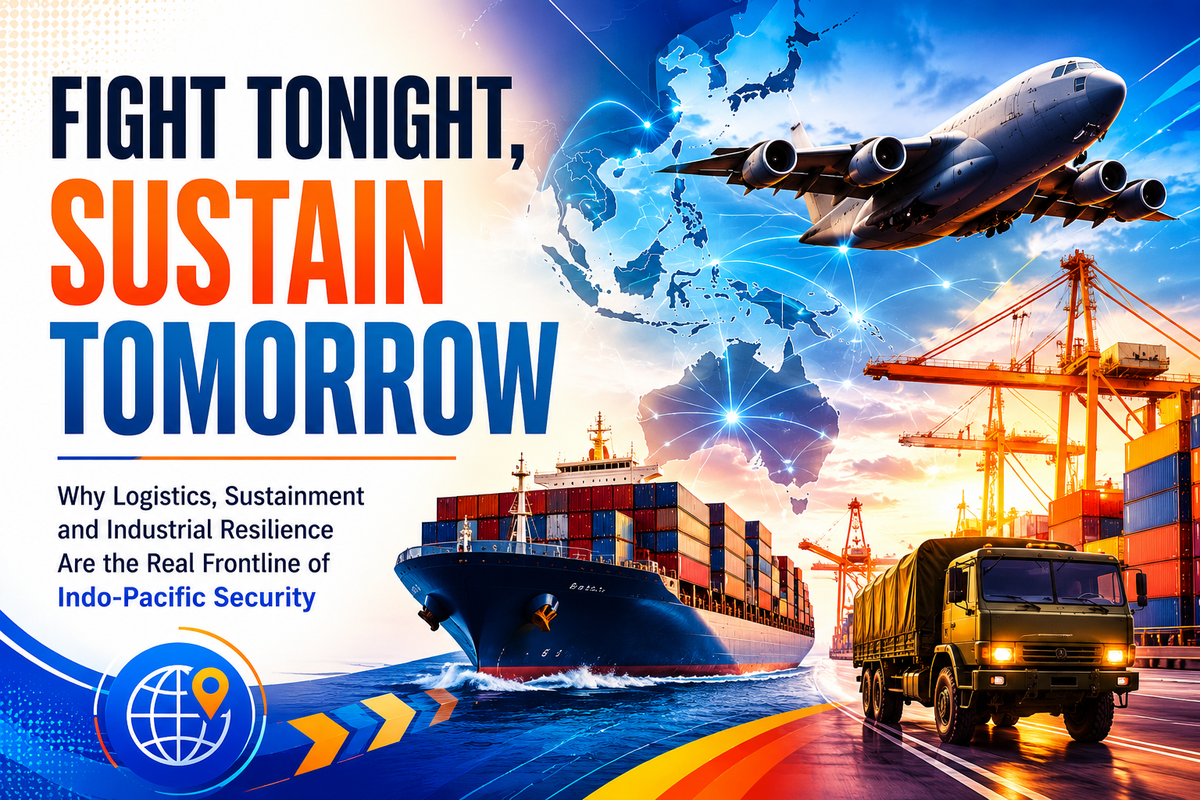
“Fight Tonight” in the Pacific: Why Logistics, Sustainment, and Industrial Resilience Are Becoming the Real Frontline of Indo-Pacific Security
For years, discussions around Indo-Pacific security have focused heavily on:
- Aircraft carriers
- Advanced fighter jets
- Missile systems
- Naval deployments
- Strategic deterrence
- Military alliances
But increasingly, U.S. military leaders are highlighting a different reality:
Future conflict in the Indo-Pacific may ultimately be decided not by who has the most weapons — but by who can sustain the fight the longest.
The recent remarks from senior U.S. and allied military officials at the Indo-Pacific Security Forum and LANPAC 2026 reveal a profound shift in military thinking.
The challenge is no longer simply preparing to fight.
The challenge is maintaining combat power across enormous distances in one of the most logistically complex operational theaters in the world.
This is why sustainment, logistics resilience, advanced manufacturing, forward repair capability, and industrial base readiness are rapidly becoming central pillars of modern deterrence strategy in the Indo-Pacific.
The “Tyranny of Distance” is the Indo-Pacific’s Defining Security Challenge
The Indo-Pacific is unlike any other military theater.
As Brig. Gen. Jim Bliss explained:
- Hawaii is 3,000 miles from the U.S. West Coast
- Guam is another 5,000 miles from Hawaii
- The first island chain stretches further into East Asia
This creates what military planners often call:
“The Tyranny of Distance”
Unlike Europe — where NATO forces operate across relatively connected land corridors — the Indo-Pacific depends heavily on:
- Maritime logistics
- Distributed supply chains
- Long-range sustainment
- Vulnerable sea lines of communication
- Limited forward logistics hubs
This creates enormous operational risk.
If military assets, fuel, ammunition, spare parts, and repair capabilities are not already positioned forward before conflict begins, reinforcement timelines may become strategically unacceptable.
As Marine Maj. Gen. Matthew Mowery bluntly stated:
“If you don’t have those forces here when the shooting starts, you’d better plan to live without them.”
This statement reflects a major doctrinal shift in U.S. military thinking.
The Pacific is Driving a New Logistics-Centric Security Doctrine
Historically, logistics was often treated as a support function operating behind frontline combat operations.
That paradigm is changing rapidly.
Today, logistics itself is increasingly viewed as:
- A strategic deterrence capability
- A warfighting function
- A resilience mechanism
- A geopolitical signal
- A critical vulnerability
Marine Maj. Gen. George Rowell captured this transformation clearly:
“Resilience is no longer a support function, but has to be a warfighting function.”
This may become one of the defining military concepts of the next decade.
Modern conflict increasingly depends on:
- Sustained operational readiness
- Rapid repair capability
- Distributed logistics networks
- Industrial production scalability
- Supply chain survivability
- Infrastructure resilience
Without these, even technologically superior militaries may struggle to maintain combat effectiveness.
Why “Fix Forward” is Becoming a Strategic Priority
One of the most important developments highlighted during the conference is the growing emphasis on:
“Fix Forward” Sustainment Strategy
Traditionally, damaged military platforms often had to return to the continental United States for repair.
In a high-intensity Indo-Pacific conflict scenario, this model becomes operationally unsustainable.
Maj. Gen. Gavin Gardner emphasized that:
- Ships can now be repaired in South Korea
- Maintenance can occur in Japan
- Sustainment can happen in the Philippines
- Australia and Singapore can support repair operations
This is strategically significant.
Forward repair capability dramatically reduces:
- Operational downtime
- Logistics burden
- Reinforcement delays
- Supply chain vulnerability
It also enhances:
- Force survivability
- Theater persistence
- Deterrence credibility
- Operational flexibility
In modern warfare, the ability to rapidly regenerate combat power may become as important as initial combat capability itself.
The Real Vulnerability: Supply Chains
A major underlying concern throughout the discussions is supply chain exposure.
Modern military operations rely heavily on:
- Global manufacturing
- Semiconductor ecosystems
- Maritime transport
- Commercial shipping
- Critical minerals
- Industrial production networks
This creates vulnerabilities that adversaries may exploit through:
- Cyberattacks
- Economic coercion
- Maritime disruption
- Infrastructure targeting
- Supply chain sabotage
- Information warfare
The logistics conversation therefore extends far beyond transportation.
It is fundamentally about:
Strategic resilience.
China’s Industrial Scale is Reshaping Military Calculations
One of the most revealing statements came from Maj. Gen. George Rowell:
“China possesses over 50 percent of the global commercial shipbuilding capacity, while the U.S. has about 0.1 percent.”
This statistic highlights a growing concern among Western military planners:
Industrial capacity itself is becoming a geopolitical weapon.
Military superiority is no longer determined solely by technological sophistication.
It increasingly depends on:
- Production scale
- Industrial resilience
- Manufacturing speed
- Supply chain depth
- Repair infrastructure
- Economic mobilization capability
This echoes lessons from World War II, where industrial output played a decisive role in determining strategic outcomes.
Admiral Samuel Paparo explicitly referenced this historical parallel:
Allied forces won World War II because industry built combat power at scale.
This historical lesson is now shaping modern Indo-Pacific strategy.
Logistics is Becoming a Cybersecurity Issue
One of the most overlooked dimensions of this discussion is cybersecurity.
Modern military sustainment systems depend heavily on:
- Digital logistics platforms
- Satellite communications
- Cloud infrastructure
- Industrial control systems
- Maritime tracking systems
- AI-enabled supply chain management
- Smart manufacturing ecosystems
This creates an enormous cyber attack surface.
Future adversaries may not need to destroy logistics infrastructure physically.
They may instead seek to:
- Disrupt supply chains digitally
- Target transportation systems
- Compromise industrial systems
- Manipulate logistics data
- Disrupt communications
- Attack operational technology environments
This means cyber resilience is becoming deeply intertwined with military sustainment capability.
The future logistics battlefield will likely be both:
- Physical
- Digital
The Shift Toward Distributed Deterrence
Another important insight emerging from the Indo-Pacific discussions is the growing move toward:
Distributed deterrence architecture.
Rather than concentrating logistics and military assets in a few large hubs, the U.S. and allies are increasingly:
- Pre-positioning supplies
- Expanding regional repair capacity
- Building distributed sustainment nodes
- Strengthening allied interoperability
- Developing resilient logistics corridors
This reduces vulnerability to:
- Missile attacks
- Cyber disruption
- Infrastructure targeting
- Blockades
- Strategic chokepoints
The objective is to create a more survivable and adaptive operational network.
Alliances are Becoming Logistics Alliances
An especially important geopolitical takeaway is that alliances are evolving beyond traditional military cooperation.
The Indo-Pacific security environment increasingly requires:
- Shared logistics infrastructure
- Industrial interoperability
- Repair agreements
- Supply chain integration
- Advanced manufacturing cooperation
- Joint sustainment planning
Countries like:
- Japan
- Australia
- South Korea
- Singapore
- The Philippines
are becoming strategically critical sustainment partners.
This represents a major evolution in alliance architecture.
Future alliances may increasingly be judged not only by combat capability — but by sustainment interoperability.
AI and Advanced Manufacturing Will Transform Sustainment
Military leaders also referenced:
- Advanced manufacturing
- Expanded repair contracts
- Theater-level sustainment innovation
This suggests future military logistics will increasingly leverage:
- AI-enabled predictive maintenance
- Additive manufacturing (3D printing)
- Autonomous logistics systems
- Smart warehousing
- Real-time supply chain analytics
- Digital twin technology
The future battlefield may depend heavily on which side can:
- Adapt faster
- Repair faster
- Produce faster
- Sustain operations longer
The Strategic Message to Adversaries
Much of this logistics transformation is ultimately about deterrence.
By:
- Expanding forward sustainment
- Building resilient logistics networks
- Strengthening industrial partnerships
- Enhancing allied interoperability
the United States and its partners are signaling that they are preparing for:
- Long-duration competition
- Contested logistics environments
- Potential high-intensity conflict scenarios
The message is clear:
Deterrence is no longer only about firepower.
It is about resilience.
Final Thoughts
The Indo-Pacific security environment is forcing a major rethink of modern warfare.
The future may not belong solely to the side with:
- The most advanced missiles
- The largest fleets
- The fastest aircraft
Instead, it may belong to the side that can:
- Sustain combat power
- Protect supply chains
- Repair forward
- Scale industrial production
- Defend logistics digitally
- Maintain operational resilience under pressure
In many ways, logistics is becoming strategy itself.
And in the Indo-Pacific, the ability to sustain the fight may ultimately determine the balance of power in the 21st century.