Ghana’s E-Visa Initiative: Digital Innovation, Cybersecurity Risks, and the Need for Stronger Governance
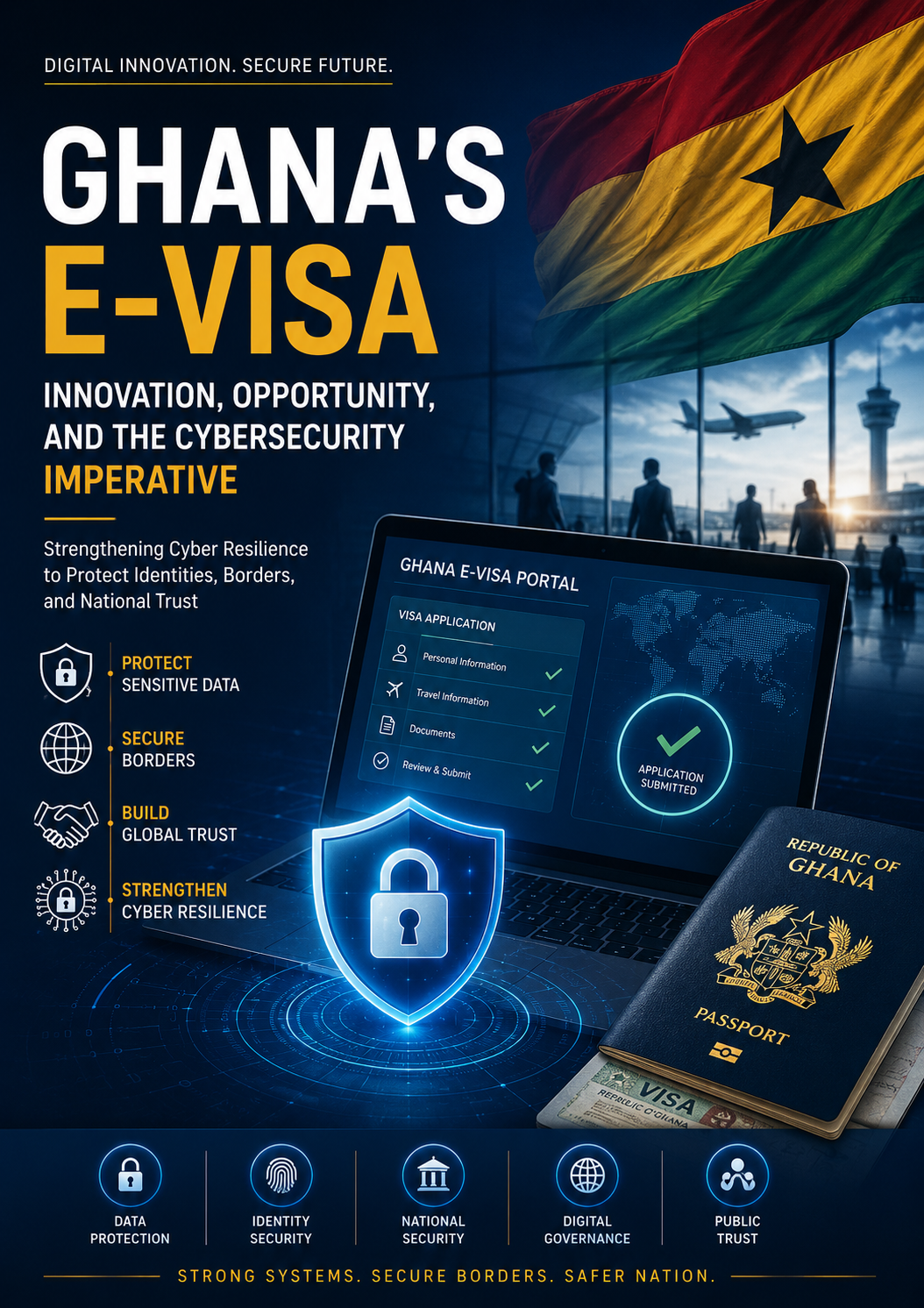
Ghana’s recently introduced e-visa initiative has been widely recognised as a significant step toward digital transformation and modernisation of public services. By digitising visa application processes, the government aims to improve efficiency, reduce processing delays, strengthen international accessibility, and position Ghana as a forward-looking digital economy. Such initiatives align with broader global trends where governments increasingly adopt digital platforms to streamline immigration, border management, and citizen services.
However, while the initiative reflects innovation and technological ambition, it also raises an equally important question:
Is Ghana’s current cybersecurity and regulatory framework sufficiently prepared to secure such a sensitive digital ecosystem?
As governments digitise immigration systems and rely more heavily on online platforms, cybersecurity becomes more than a technical concern — it becomes an issue of national security, digital sovereignty, economic trust, and public confidence.
The Promise of Digital Immigration Systems
E-visa systems provide numerous advantages for governments and travellers alike. These platforms can:
- Reduce bureaucratic inefficiencies
- Improve processing speed
- Enhance international accessibility
- Support tourism and economic growth
- Minimise paperwork and manual processing
- Increase operational transparency
- Improve border management through digital verification
For countries seeking to modernise governance and improve service delivery, digital immigration systems represent an important milestone.
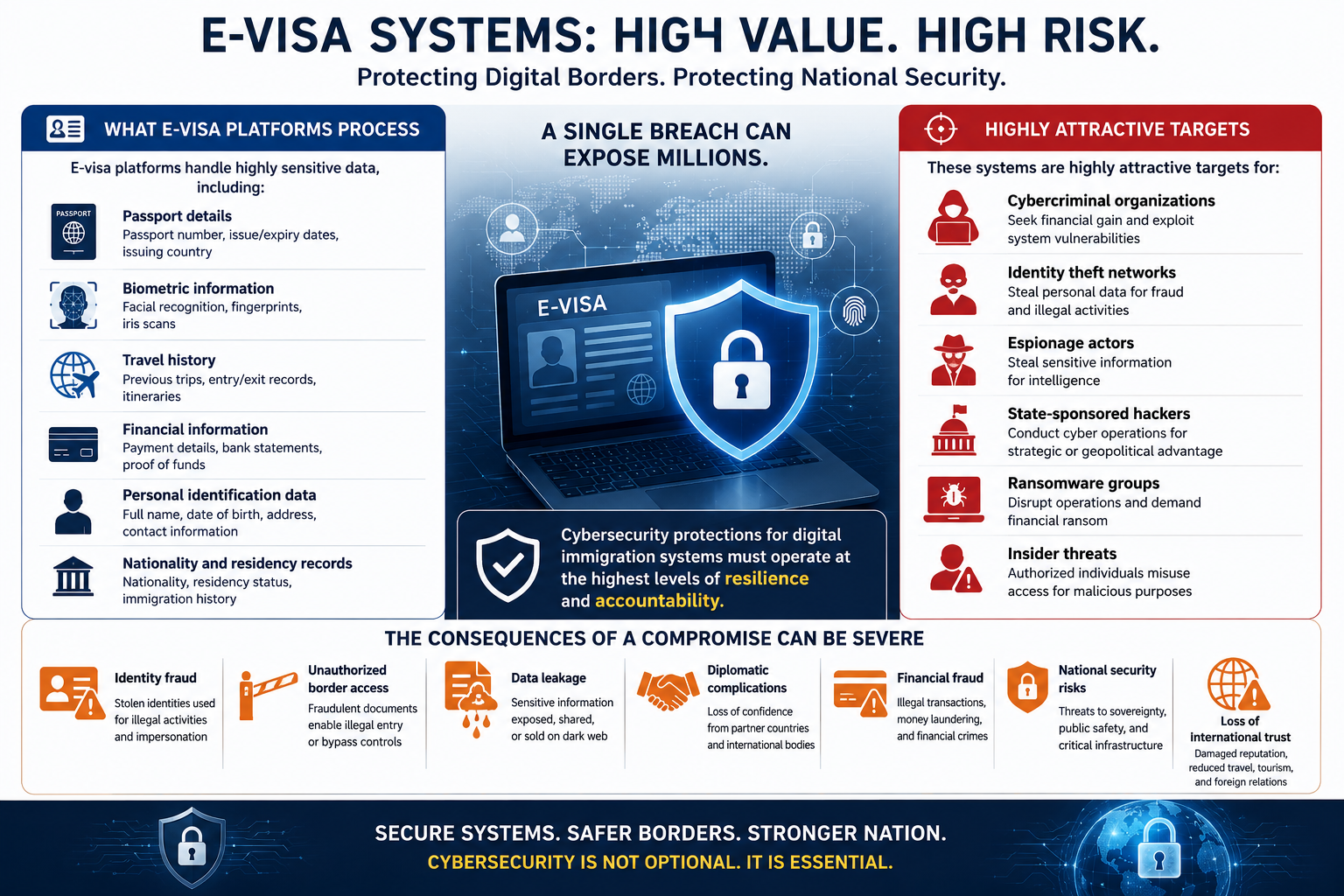
Yet, the digitisation of immigration services also creates an enormous concentration of sensitive data and critical infrastructure dependencies.
Why E-Visa Platforms Are High-Value Cyber Targets
Does Ghana Have Cybersecurity Regulations in Place?
Ghana has made notable progress in developing a cybersecurity and digital governance framework. Several important laws and institutions already exist, including:
- Cybersecurity Act, 2020 (Act 1038) — establishing the Cyber Security Authority (CSA) to oversee national cybersecurity efforts.
- Data Protection Act, 2012 (Act 843) — governing the collection, processing, and protection of personal data.
- Electronic Transactions Act, 2008 — recognizing and regulating electronic systems and digital transactions.
These frameworks provide a foundational structure for cybersecurity governance, incident response, and data protection.
However, the existence of legislation alone does not automatically guarantee cybersecurity resilience.
The key challenge lies in implementation, enforcement, operational readiness, technical capacity, and adaptation to emerging technologies such as AI-enabled systems and cloud-based digital infrastructures.
The Cybersecurity Concerns Behind the E-Visa System
While digital visa systems improve convenience and modernization, they also introduce several cybersecurity concerns that require careful attention.
1. Data Protection and Privacy Risks
Immigration systems process highly sensitive personal and biometric data. If improperly secured, these systems could expose citizens and travelers to identity theft, surveillance risks, or unauthorized data access.
Questions that become critical include:
- Where is applicant data stored?
- Is the data encrypted?
- Who has access to the information?
- Are third-party vendors involved?
- How long is data retained?
- Are there cross-border data transfer safeguards?
Without strong data governance mechanisms, personal information may become vulnerable to misuse or cyberattacks.
2. Third-Party Vendor and Cloud Security Risks
Many digital government platforms rely on external vendors, cloud infrastructure providers, or outsourced service operators.
This creates supply chain cybersecurity risks because governments may not fully control:
- Data hosting environments
- Vendor cybersecurity practices
- Access management controls
- Incident response procedures
- Cross-border data processing activities
A breach involving a third-party service provider could compromise sensitive immigration records on a large scale.
3. AI and Automation Risks
If AI-enabled systems are integrated into visa screening, document verification, or applicant analysis, additional governance concerns emerge.
These include:
- Algorithmic bias
- False positives or false rejections
- Lack of transparency in automated decision-making
- Overreliance on automation
- Weak human oversight
- Inaccurate AI-generated assessments
There is also the growing risk of “AI washing,” where governments or technology vendors overstate the sophistication or cybersecurity capabilities of AI systems without adequate technical implementation.
For example, a platform may claim to use “advanced AI-driven security” while relying primarily on basic automation or manual review processes.
This creates both cybersecurity and public trust concerns.
The Compliance-Implementation Gap
One of the biggest challenges faced by many developing digital ecosystems globally is the gap between legal frameworks and operational implementation.
A country may possess modern cybersecurity laws on paper, yet still struggle with:
- Limited technical cybersecurity capacity
- Inconsistent enforcement mechanisms
- Shortages of cybersecurity professionals
- Insufficient security audits
- Weak incident response preparedness
- Budgetary limitations
- Limited public awareness
This “compliance-implementation gap” often becomes the greatest vulnerability in national digital transformation initiatives.
Why Cybersecurity Must Be Treated as a National Security Issue
Cybersecurity in immigration systems is not merely an IT or administrative issue.
It directly affects:
- Border security
- National identity systems
- International diplomatic trust
- Economic resilience
- Tourism confidence
- Critical government infrastructure
- Digital sovereignty
As governments increasingly digitize public services, cybersecurity governance becomes inseparable from national governance itself.
Policy Recommendations for Strengthening Ghana’s E-Visa Cybersecurity Framework
To ensure long-term trust, resilience, and security in Ghana’s digital immigration ecosystem, several policy and governance measures should be considered.
1. Establish Mandatory Independent Cybersecurity Audits
The government should require regular independent cybersecurity assessments and penetration testing of the e-visa platform and associated infrastructure.
Audits should evaluate:
- System vulnerabilities
- Cloud security configurations
- Access controls
- Encryption mechanisms
- Incident response capabilities
- Third-party vendor security
Independent assessments improve transparency and strengthen public trust.
2. Strengthen Data Protection and Privacy Oversight
Ghana should ensure strict enforcement of data protection obligations under the Data Protection Act.
This includes:
- Clear data retention policies
- Data minimization principles
- Encryption standards
- Cross-border data transfer controls
- Privacy impact assessments
- Transparency regarding data usage
Citizens and travelers should clearly understand how their information is processed and protected.
3. Develop AI Governance Standards for Public Sector Systems
If AI tools are used in immigration or border management systems, Ghana should establish clear AI governance frameworks addressing:
- Transparency
- Human oversight
- Algorithmic accountability
- Bias mitigation
- Explainability
- Security testing
- Ethical AI deployment
Governments should avoid deploying opaque or poorly tested AI systems in critical public infrastructure.
4. Implement Stronger Third-Party Vendor Governance
Government agencies should conduct cybersecurity due diligence on all vendors involved in digital infrastructure projects.
This should include:
- Vendor risk assessments
- Security certification requirements
- Contractual cybersecurity obligations
- Incident reporting requirements
- Supply chain security monitoring
Third-party cybersecurity weaknesses often become national security vulnerabilities.
5. Invest in National Cybersecurity Capacity Building
Long-term resilience requires sustained investment in:
- Cybersecurity workforce development
- Public sector cybersecurity training
- National incident response capabilities
- Digital forensic capabilities
- Public awareness programs
Technology alone cannot secure digital ecosystems without skilled human capacity.
6. Enhance Transparency and Public Accountability
Governments should communicate openly about:
- Cybersecurity measures
- Incident response plans
- Data governance policies
- AI usage in public systems
- Security certifications and audits
Transparency is essential for maintaining public trust in digital governance initiatives.
Conclusion
Ghana’s e-visa initiative reflects an important and commendable step toward digital modernization and improved public service delivery. However, the success of such platforms depends not only on innovation, but also on cybersecurity resilience, regulatory maturity, operational readiness, and public trust.
While Ghana has established important cybersecurity and data protection frameworks, evolving digital threats and AI-driven technologies require continuous adaptation, stronger enforcement, independent oversight, and enhanced governance mechanisms.
As governments increasingly embrace digital transformation, cybersecurity must be treated not as a secondary technical issue, but as a foundational pillar of national security, digital sovereignty, and sustainable innovation.
The future of digital governance will not be determined solely by how quickly systems are deployed, but by how securely, transparently, and responsibly they are governed.