
Kazakhstan’s Digital Transformation Ambition: Cybersecurity Governance, Data Sovereignty, and the Rise of Platform-Centric Ecosystems
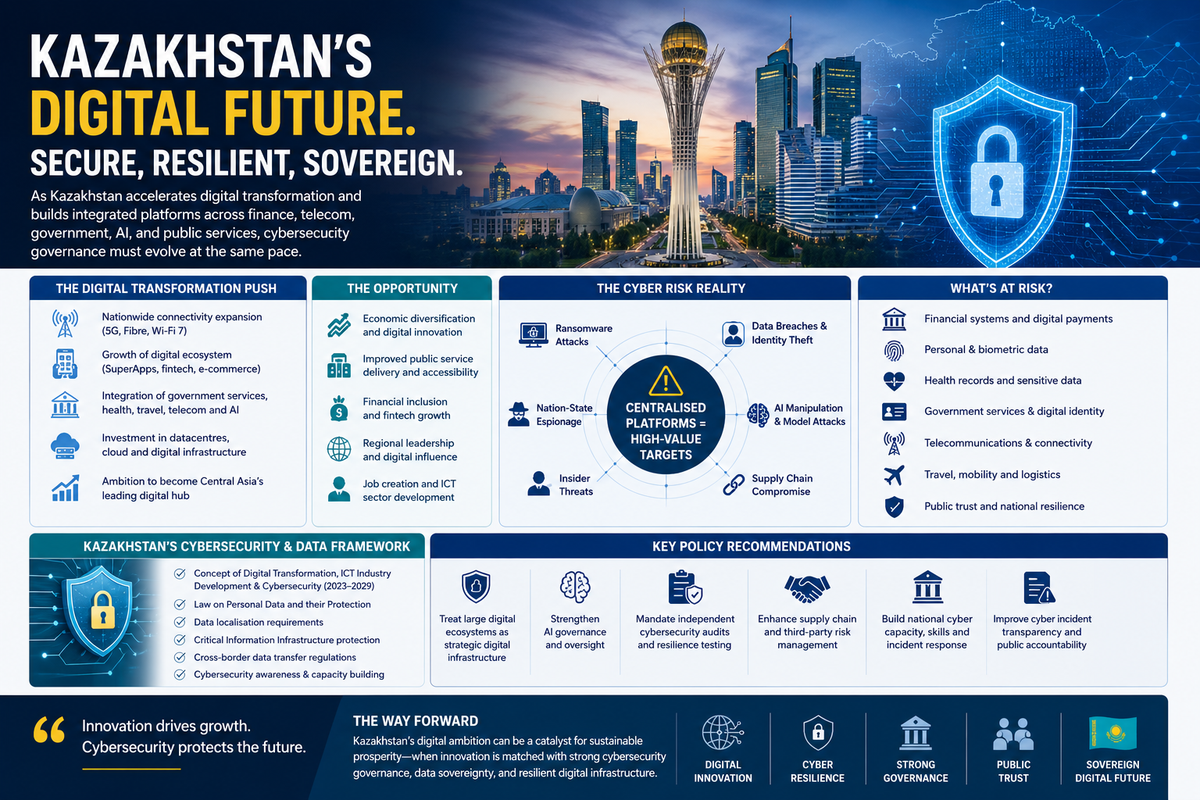
Kazakhstan is rapidly positioning itself as one of Central Asia’s emerging digital economies. Over the last few years, the country has accelerated investments in telecommunications infrastructure, digital government services, fintech ecosystems, cloud infrastructure, AI-driven services, and nationwide connectivity initiatives. This transformation reflects Kazakhstan’s broader ambition to diversify its economy, modernize public services, strengthen regional digital influence, and establish itself as a technology-driven state.
However, as Kazakhstan’s digital ecosystem becomes increasingly interconnected, the country also faces a growing cybersecurity challenge: how to balance innovation, platform integration, data concentration, and national digital resilience.
The expansion of large digital ecosystems that combine telecommunications, finance, government services, AI, e-commerce, health records, and digital identity functions into unified platforms is reshaping the cybersecurity landscape across the region. While these ecosystems improve efficiency and accessibility, they also create systemic cyber risks that require strong governance, regulatory maturity, and operational resilience.
The Rise of Integrated Digital Ecosystems
Kazakhstan’s digital transformation strategy reflects a global trend toward highly integrated digital ecosystems. Telecommunications operators, fintech providers, cloud platforms, AI services, and public digital services are increasingly interconnected through centralized applications and digital platforms.
These ecosystems often combine:
- Digital payments and banking
- Telecommunications services
- E-government access
- Health-related services
- Travel and mobility platforms
- AI-enabled customer services
- E-commerce and financial products
- Identity verification systems
- Cloud-based infrastructure
From a user perspective, this creates convenience, accessibility, and operational efficiency. Citizens increasingly expect seamless digital experiences where multiple services are accessible through a single platform.
However, from a cybersecurity perspective, this convergence also creates a concentration of operational dependencies and sensitive data.
The Cybersecurity Risks of Platform Centralization
As digital ecosystems expand, cybersecurity risks become significantly more complex.
When a single platform integrates financial services, telecommunications, identity systems, AI functionality, government services, and personal data, the platform itself becomes a high-value target for cybercriminals, espionage actors, ransomware groups, and nation-state threat actors.
A compromise of such ecosystems could potentially expose:
- Financial information
- Personal identity records
- Health-related data
- Government service access credentials
- Telecom subscriber information
- Location and travel data
- AI-generated user interactions
- Authentication systems
This creates systemic cyber risk because the disruption of one ecosystem may affect multiple sectors simultaneously.
Unlike traditional cyber incidents involving isolated IT systems, attacks against integrated digital ecosystems may create cascading operational, financial, and governance consequences.
Kazakhstan’s Cybersecurity and Data Protection Framework
Kazakhstan has already established several legal and strategic frameworks aimed at strengthening cybersecurity governance and digital transformation.
The country’s national digital transformation and cybersecurity policies emphasize:
- Development of digital infrastructure
- Protection of critical information infrastructure
- Cybersecurity resilience
- Data governance
- Telecommunications modernization
- Expansion of digital government services
- ICT sector development
Kazakhstan also maintains a personal data protection framework regulating the collection, storage, processing, and transfer of personal information. The country’s legal framework includes provisions related to:
- Personal data protection
- Data localization
- Cross-border data transfers
- Information security obligations
- Operator responsibilities
- Technical and organizational safeguards
This demonstrates that Kazakhstan recognizes cybersecurity and data governance as strategic national priorities.
However, the existence of regulation alone does not automatically guarantee cyber resilience.
The Challenge: Regulation vs. Digital Acceleration
One of the most significant challenges facing rapidly digitizing states is the growing gap between digital innovation and regulatory adaptation.
Digital ecosystems are evolving faster than many traditional governance structures can respond.
Kazakhstan’s regulatory framework addresses cybersecurity and data protection at a foundational level, but emerging technologies and highly integrated digital ecosystems introduce newer and more sophisticated risks, including:
- AI governance challenges
- Platform concentration risk
- Cloud dependency risk
- Third-party vendor vulnerabilities
- Supply chain cybersecurity concerns
- Cross-sector operational dependencies
- Data aggregation risks
- Digital identity exposure
- Systemic infrastructure vulnerabilities
As digital ecosystems become increasingly centralized, cybersecurity incidents may no longer remain isolated technical events — they may evolve into national operational disruptions.
Data Sovereignty and National Cyber Resilience
Data sovereignty is becoming an increasingly important issue for digitally transforming nations.
As countries centralize citizen services, financial systems, telecommunications infrastructure, and cloud-based operations, questions surrounding data ownership and national control become more strategically significant.
Key concerns include:
- Where is sensitive national data stored?
- Which entities control the infrastructure?
- How are third-party vendors governed?
- What protections exist against external cyber influence?
- How resilient are national digital systems during geopolitical or cyber crises?
For countries building large-scale digital ecosystems, cybersecurity is closely tied to national sovereignty and strategic autonomy.
AI Integration and Emerging Governance Risks
Kazakhstan’s digital modernization efforts also reflect the growing integration of AI-enabled technologies across customer services, operational management, telecommunications, and digital service delivery.
AI offers substantial advantages, including:
- Operational efficiency
- Predictive analytics
- Automation
- Personalized digital services
- Enhanced data processing
- Improved service accessibility
However, AI adoption also introduces a new layer of cybersecurity and governance risks.
Potential concerns include:
- AI-driven fraud and impersonation
- Automated cyberattacks
- Data leakage through AI systems
- Bias in algorithmic decision-making
- Manipulation of AI models
- Overreliance on automated systems
- Lack of explainability and transparency
- Adversarial attacks against AI platforms
As AI becomes embedded within finance, telecom, and government-related services, cybersecurity and AI governance must evolve together.
Critical Infrastructure and Telecom Security
Telecommunications infrastructure plays a foundational role in Kazakhstan’s digital future.
5G networks, fibre infrastructure, datacentres, cloud systems, and digital service platforms are now deeply interconnected with economic activity, public administration, and national operations.
This makes telecom infrastructure a strategic cybersecurity priority.
Modern telecom environments face threats including:
- Supply chain compromise
- Network intrusion
- State-sponsored espionage
- Infrastructure disruption
- Malware targeting operational systems
- Cloud platform attacks
- Insider threats
Because telecom systems support multiple sectors simultaneously, disruptions may have nationwide operational consequences.
As digital ecosystems expand, telecommunications resilience becomes directly linked to national resilience.
Why Cybersecurity Must Become a Strategic Governance Issue
Cybersecurity can no longer be treated solely as an IT or technical issue.
In highly digitized ecosystems, cybersecurity affects:
- Economic stability
- Public trust
- Financial resilience
- Government continuity
- National security
- Digital sovereignty
- Critical infrastructure protection
For rapidly digitizing countries, the long-term success of digital transformation depends not only on technological deployment, but also on governance maturity, operational resilience, and public confidence.
Policy Recommendations for Kazakhstan
To strengthen long-term cyber resilience and digital governance, Kazakhstan should consider several strategic priorities.
1. Strengthen Oversight of Large Digital Ecosystems
Highly integrated digital platforms should be treated as strategically important digital infrastructure subject to enhanced cybersecurity governance, resilience testing, and operational oversight.
2. Develop Comprehensive AI Governance Frameworks
AI systems operating within finance, telecom, health, and public services should include:
- Human oversight
- Transparency requirements
- Security testing
- Bias mitigation
- Explainability standards
- AI-specific incident response procedures
3. Expand Critical Infrastructure Cybersecurity Regulations
Kazakhstan should continue strengthening cybersecurity obligations for telecommunications, cloud infrastructure, financial systems, and large-scale digital service providers.
4. Improve Supply Chain and Vendor Risk Governance
Third-party vendors, telecom suppliers, and cloud infrastructure providers should undergo enhanced cybersecurity assessments and operational risk evaluations.
5. Build National Cybersecurity Capacity
Long-term resilience requires investment in:
- Cybersecurity workforce development
- Incident response capabilities
- Threat intelligence sharing
- Cybersecurity education
- Public-private collaboration
6. Increase Cyber Incident Transparency
Transparent reporting of major cyber incidents and operational disruptions is critical for public trust, accountability, and ecosystem resilience.
Conclusion
Kazakhstan’s digital transformation reflects an ambitious vision for technological modernization, economic diversification, and regional digital leadership. The country has established important cybersecurity and data governance foundations and continues investing heavily in digital infrastructure and connected services.
However, as digital ecosystems become more centralized, interconnected, and AI-driven, cybersecurity governance becomes increasingly critical.
The greatest challenge for Kazakhstan will not simply be accelerating digital innovation — it will be ensuring that innovation is supported by resilient cybersecurity frameworks, strong governance mechanisms, transparent oversight, and long-term operational security.
The future of digital transformation will ultimately depend not only on how connected systems become, but on how securely, responsibly, and sustainably those systems are governed.