Latin America's Cargo Crime Wave Has a Digital Dimension
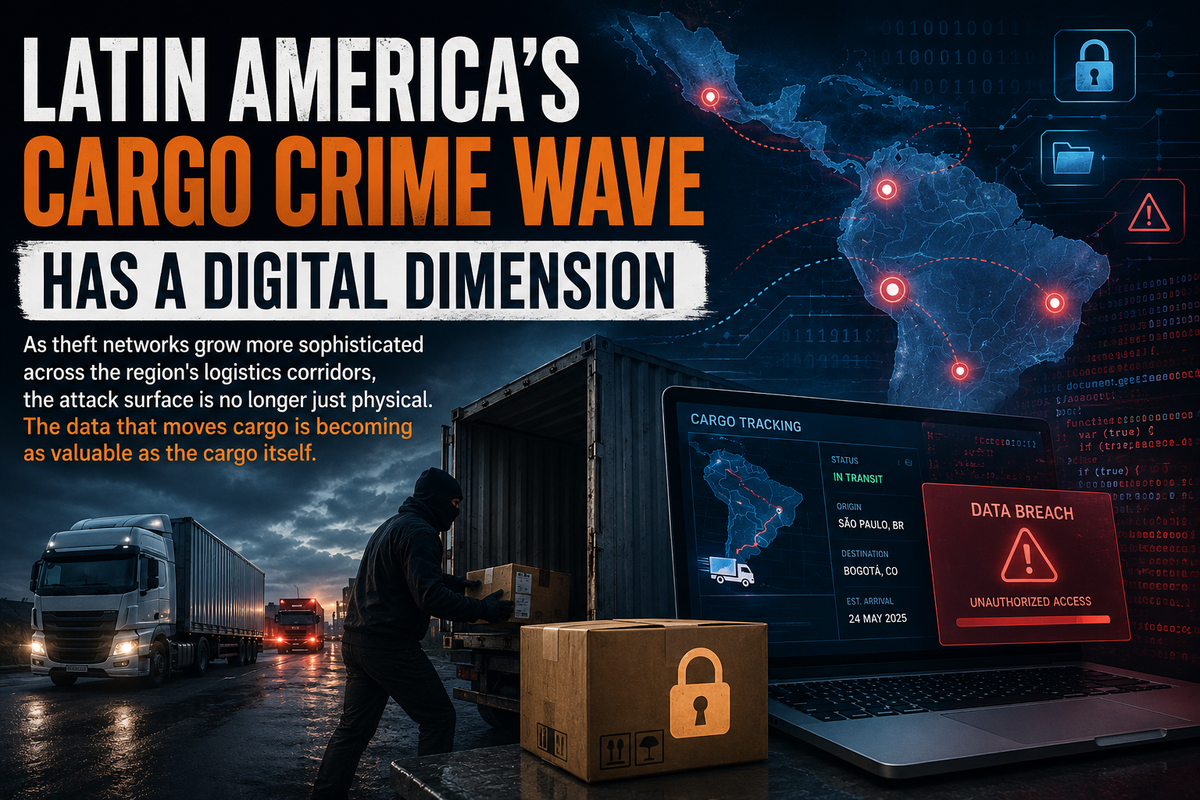
As theft networks grow more sophisticated across the region's logistics corridors, the attack surface is no longer just physical. The data that moves cargo is becoming as valuable as the cargo itself.
Latin America's logistics boom is producing two parallel economies. One moves goods across a region whose export volumes grew 6.4% in 2025, feeding global supply chains and fueling e-commerce. The other shadows it—organized, adaptive, and increasingly violent—extracting value from every vulnerability in the chain.
New data tracking cargo theft across the region reveals the scale of the problem. In Mexico, 82% of all cargo theft incidents during 2025 were concentrated in just ten states, with the corridors linking the State of Mexico and Puebla emerging as the most dangerous chokepoints in the hemisphere. Eight in ten incidents involved direct violence against drivers. In Brazil, 8,570 thefts were recorded in the same period, generating losses approaching 900 million reais, with São Paulo and Rio de Janeiro bearing the heaviest burden.
For most analysts, this reads as a law enforcement and insurance story. For students of cybersecurity and critical infrastructure, it should read as something else: an early warning about the digitization of criminal logistics operations, and about the expanding attack surface that comes when physical supply chains are managed through connected platforms.
82%of Mexico's 2025 cargo thefts in 10 states8,570cargo thefts recorded in Brazil in 2025R$900Mestimated losses in Brazil alone30%insurance cost increase on high-risk routes
The intelligence behind the theft
What makes the current wave of cargo crime distinct from earlier periods is its operational sophistication. Theft networks in Mexico and Brazil are not opportunistic—they are coordinated. Incidents cluster along specific corridors at specific times, targeting specific cargo categories with a precision that suggests access to information about shipment schedules, contents, and routes.
This is the juncture where physical crime and cybersecurity converge. Route planning data, fleet tracking dashboards, logistics management platforms, and customs documentation systems all carry commercially sensitive information about what is being shipped, when, by whom, and through which corridors. In environments where criminal networks are already demonstrating intelligence-gathering capabilities, the question is not whether that information is being exploited—it is how.
"Today logistics chains are much more dynamic and complex. The growth of international trade expanded exposure to risk and led the most competitive companies to integrate security as a central part of their strategy."
The industry's response—investment in satellite monitoring, real-time geolocation, predictive analytics, and route traceability—addresses part of this problem. But these technologies also expand the digital footprint of logistics operations. Each new layer of connectivity creates new entry points. A fleet management platform that can track a vehicle in real time can, if compromised, hand that information to the wrong actors.
Supply chain cybersecurity: the Latin American gap
Latin America has made genuine progress on national cybersecurity frameworks over the past five years, but the pace of that progress is uneven, and the logistics sector sits in a particularly exposed position. Smaller carriers and freight operators—who handle a significant share of regional distribution—frequently lack the resources to implement and maintain robust digital security practices. They are connected enough to be targeted, but not resourced enough to defend themselves effectively.
The risks are compounded by the cross-border nature of regional logistics. A cargo shipment moving from Bogotá to Buenos Aires may pass through multiple jurisdictions, each with different cybersecurity regulations, different levels of enforcement capacity, and different standards for how logistics platforms must protect operational data. This patchwork creates seams that sophisticated actors can exploit.
EMERGING CYBER-PHYSICAL THREAT VECTORS IN REGIONAL LOGISTICS
- Compromise of fleet management and GPS tracking platforms to surveil high-value shipments
- Infiltration of logistics management software to access route and schedule data
- Phishing attacks targeting dispatchers and operations staff with access to cargo manifests
- Ransomware against freight operators to disrupt operations and extract sensitive data
- Interception or manipulation of customs and documentation systems on cross-border routes
- Social engineering of port access and warehouse management personnel
Colombia and Peru, identified in recent reports as experiencing growing logistics-sector incidents particularly in mining and mass-consumption supply chains, illustrate how the problem scales with economic exposure. As commodity export routes expand, so does the intelligence value of the operational data flowing through the connected platforms that manage them.
Argentina and the AMBA corridors
Argentina presents a distinct but related picture. Growing concern is being documented around strategic logistics corridors linked to the greater Buenos Aires metropolitan area, port accesses, and national distribution routes. The country's e-commerce expansion is driving higher-value cargo through urban distribution networks that were not designed with security—physical or digital—as a primary consideration.
Urban last-mile logistics, which is where e-commerce pressure is most intensely felt, is also where digital integration is deepest and oversight is thinnest. Delivery platforms, route optimization software, and mobile dispatch systems create rich operational datasets that, if exposed, offer detailed intelligence about delivery schedules, access points, and high-value shipments.
· · ·
What a regional cybersecurity response requires
The industry is beginning to move. Companies are combining real-time monitoring, predictive analysis, geolocation, and prevention protocols tailored to specific cargo types and routes. But the cybersecurity dimension of this response remains underdeveloped relative to the physical security investment.
A credible regional response to the cyber-physical threat in Latin American logistics needs to operate on several levels simultaneously. At the firm level, logistics operators must treat their digital platforms—fleet management systems, route databases, customer APIs—as critical infrastructure subject to the same risk assessment they apply to physical routes. Penetration testing, access controls, and incident response planning are not optional features for any operator handling high-value goods on contested corridors.
At the sectoral level, information-sharing mechanisms between operators, insurers, and law enforcement need to include cyber-threat intelligence alongside physical incident reporting. When a fleet management platform is compromised, neighboring operators need to know. Currently, most of that information stays siloed within individual companies or insurers.
"In markets where crime has become more sophisticated, the difference between a controlled contingency and a critical operational impact may lie in how well you understood the risk before the incident."
At the policy level, regional bodies—including the economic commissions and trade blocs that govern cross-border logistics frameworks—need to begin treating logistics platform security as a trade infrastructure question, not merely a domestic law enforcement one. A shipment moving through five jurisdictions is only as digitally secure as its weakest link.
The convergence that demands attention
What the cargo theft data from Mexico, Brazil, Colombia, Peru, and Argentina collectively describe is not simply a crime wave. It describes the contours of an emerging threat environment in which criminal networks are acquiring operational intelligence through whatever means are available—including digital ones—and applying it with increasing precision to physical targets.
This is precisely the kind of cyber-physical convergence that security professionals have theorized about for years. It is now occurring at scale, in a region whose logistics infrastructure is expanding rapidly, whose digital integration is deepening, and whose regulatory frameworks for supply chain cybersecurity are still catching up.
The window for getting ahead of this problem is narrowing. As Latin America's trade volumes grow and its logistics networks digitize further, the intelligence value of the data flowing through those networks will only increase. The criminal networks operating in Mexico's central corridors and Brazil's southeastern distribution hubs are not standing still. Neither can the region's cybersecurity posture.