
NATO, Russia’s Grey War, and the Growing Cybersecurity Battle Over Europe’s Energy Infrastructure
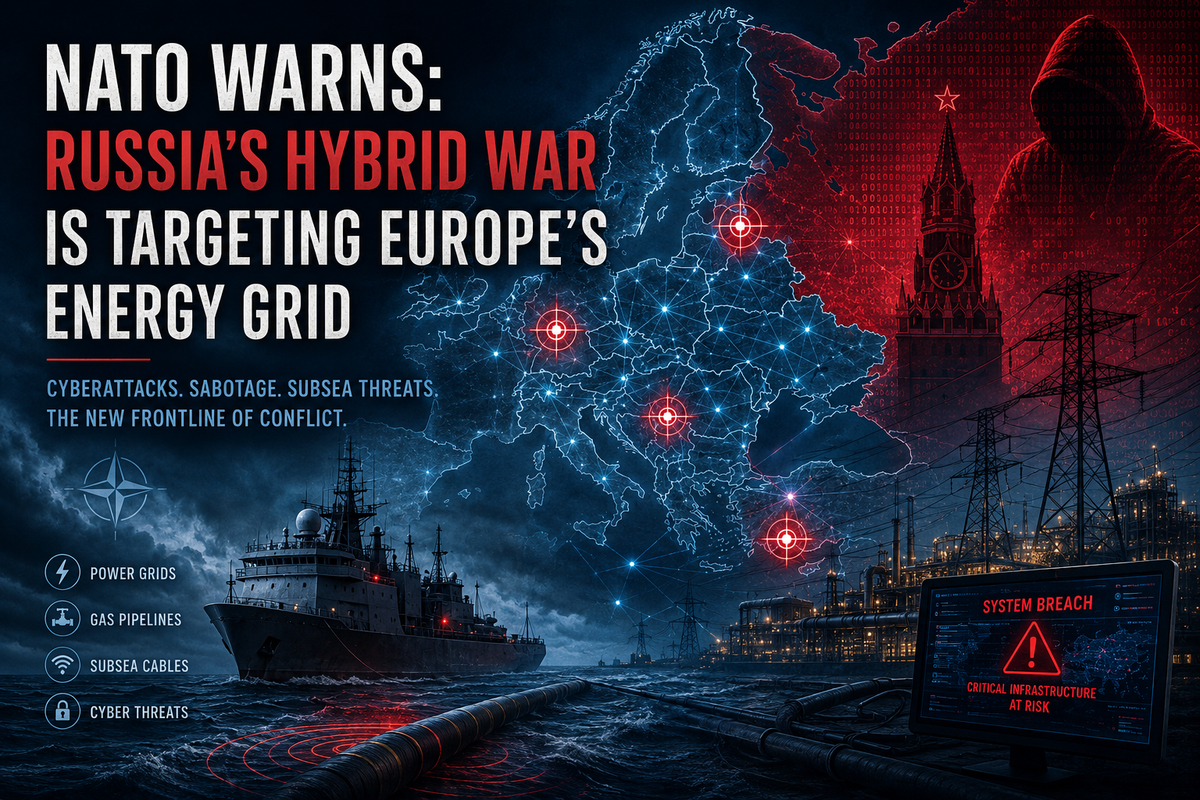
Europe’s energy infrastructure is increasingly becoming one of the most strategically vulnerable targets in modern geopolitical conflict. What was once viewed primarily as a network of pipelines, electricity interconnectors, offshore infrastructure, and industrial control systems is now being treated as part of a broader battlefield shaped by cyber operations, hybrid warfare, sabotage, and strategic economic pressure.
Recent warnings from NATO-linked security circles and European officials suggest that the threat landscape surrounding Europe’s energy systems is entering a far more dangerous phase. The growing concern is not simply about conventional military escalation, but about the expansion of what many analysts describe as “grey zone” or hybrid warfare — operations designed to destabilize critical infrastructure, weaken public confidence, disrupt economic continuity, and test political resolve without crossing the threshold into direct conventional conflict.
The Evolution of Russia’s Hybrid Warfare Strategy
The current security concerns surrounding Europe’s energy infrastructure cannot be understood in isolation. They are part of a broader pattern of geopolitical and cyber escalation that European security officials increasingly trace back over nearly two decades.
The progression reflects a gradual evolution from:
- Cyber disruption
- Information operations
- Economic coercion
- Infrastructure pressure
- Energy dependency leverage
- Hybrid operational tactics
What makes modern hybrid warfare particularly difficult to counter is that it often operates below the threshold that would trigger direct military retaliation. Instead of large-scale conventional attacks, hybrid strategies focus on exploiting vulnerabilities in interconnected systems — especially critical infrastructure and digital ecosystems.
Energy infrastructure has become especially attractive because it sits at the intersection of:
- Economic stability
- Public confidence
- Industrial continuity
- National security
- Political resilience
In highly interconnected European economies, even limited disruptions to energy systems can create cascading operational and economic consequences across multiple sectors simultaneously.
Europe’s Energy Grid Is Now a Strategic Cyber Battleground
The modern European energy ecosystem is deeply dependent on interconnected digital and operational infrastructure.
This includes:
- Subsea electricity interconnectors
- Offshore energy platforms
- Gas pipelines
- LNG infrastructure
- Industrial control systems (ICS)
- Supervisory Control and Data Acquisition (SCADA) environments
- Cross-border transmission systems
- Digital operational networks
These systems were historically designed with operational efficiency and reliability in mind — not necessarily resilience against advanced cyber warfare or coordinated hybrid attacks.
Today, however, energy infrastructure is increasingly exposed to:
- Cyber sabotage
- Supply chain compromise
- Undersea infrastructure targeting
- Operational Technology (OT) attacks
- Physical-digital hybrid attacks
- State-sponsored cyber campaigns
- AI-enabled infrastructure reconnaissance
The concern raised by European officials is that attacks against energy systems are no longer hypothetical future risks. Many of the tactics now causing concern in Europe have already been observed in operational environments connected to the war in Ukraine.
Why Subsea Infrastructure Has Become a Major Security Concern
One of the most strategically vulnerable areas highlighted by European security discussions is subsea infrastructure.
Europe relies heavily on:
- Undersea electricity interconnectors
- Offshore communication cables
- Subsea gas pipelines
- Maritime energy infrastructure
These systems form the hidden backbone of Europe’s energy and communications ecosystem. Yet they are difficult to monitor continuously and extremely challenging to protect across vast maritime environments.
Recent incidents involving damaged interconnectors, suspicious vessel activity, and surveillance operations near critical infrastructure have heightened concerns that subsea systems may increasingly become targets within broader hybrid warfare strategies.
The strategic logic is clear:
targeting subsea infrastructure allows adversaries to create disruption, uncertainty, and economic pressure without necessarily initiating direct military confrontation.
The Convergence of Cybersecurity and Geopolitics
Perhaps the most important insight emerging from these warnings is that cyber threats are no longer separate from geopolitical conflict.
Cyber operations are increasingly integrated into broader geopolitical strategy through:
- Infrastructure disruption
- Economic destabilization
- Information warfare
- Energy leverage
- Strategic signaling
- Psychological pressure
- Political coercion
This convergence fundamentally changes how governments must think about cybersecurity.
Cybersecurity is no longer solely about protecting networks or preventing data breaches. It is increasingly about protecting:
- National resilience
- Economic continuity
- Public trust
- Energy security
- Strategic autonomy
- Operational stability
In this environment, energy infrastructure becomes both a technical and geopolitical target.
The Growing OT Cybersecurity Challenge
The threats facing Europe’s energy systems also highlight the growing importance of Operational Technology (OT) security.
Unlike traditional IT systems, OT environments directly control physical infrastructure operations such as:
- Electricity transmission
- Pipeline management
- Power generation
- Industrial automation
- Grid balancing
- Offshore operational systems
A successful cyberattack targeting OT systems may create immediate physical and operational consequences.
This is especially concerning because many energy-sector OT environments still rely on:
- Legacy systems
- Insecure protocols
- Limited segmentation
- Vendor dependencies
- Remote access vulnerabilities
As IT and OT systems become increasingly interconnected, the attack surface expands significantly.
Modern hybrid threats increasingly exploit the convergence between cyber systems and physical infrastructure operations.
AI and the Future of Hybrid Cyber Conflict
Another emerging concern is the growing role of Artificial Intelligence in cyber operations.
AI-enabled systems are increasingly capable of:
- Automated vulnerability discovery
- Infrastructure mapping
- Adaptive cyberattacks
- Real-time operational reconnaissance
- High-speed exploitation
- AI-generated disinformation
This creates a major challenge for defenders because traditional reactive cybersecurity approaches may no longer operate fast enough against AI-enabled threats.
The concern is particularly serious for critical infrastructure operators because disruptions to energy systems can create cascading consequences across:
- Financial markets
- Telecommunications
- Transportation systems
- Emergency services
- Industrial operations
- Public services
In highly interconnected societies, infrastructure resilience becomes deeply linked to national resilience.
NATO and Europe’s Strategic Response
Europe’s evolving response reflects a growing recognition that critical infrastructure protection must become a strategic security priority.
This includes:
- Expanding cyber resilience frameworks
- Increasing infrastructure monitoring
- Strengthening OT cybersecurity
- Enhancing maritime surveillance
- Improving intelligence coordination
- Investing in energy resilience
- Increasing public-private cybersecurity collaboration
There is also increasing emphasis on reducing strategic vulnerabilities associated with:
- Energy dependency
- Infrastructure concentration
- Supply chain exposure
- Third-party technology risks
At the same time, Europe is accelerating broader defense modernization and resilience initiatives in response to shifting geopolitical realities.
Why Economic Security and Cybersecurity Are Now Interconnected
The growing focus on Europe’s energy grid illustrates a broader global transformation:
economic security and cybersecurity are rapidly converging.
Disruptions to critical infrastructure now directly affect:
- Economic stability
- Market confidence
- Industrial continuity
- Public trust
- National security
- Political resilience
Cybersecurity can no longer be treated solely as a technical or operational issue delegated to IT departments.
It is increasingly becoming a central component of:
- National strategy
- Infrastructure governance
- Energy policy
- Defense planning
- Economic resilience
Conclusion
The warnings surrounding Europe’s energy infrastructure reflect a larger strategic reality: modern geopolitical conflict increasingly operates through hybrid pressure, cyber operations, infrastructure targeting, and operational disruption rather than traditional conventional warfare alone.
Energy infrastructure has emerged as one of the most strategically vulnerable components of Europe’s digital and economic ecosystem. The convergence of cyber threats, OT vulnerabilities, subsea infrastructure risks, and geopolitical tension is reshaping how governments and security institutions approach resilience and defense.
The challenge ahead for Europe will not simply be preventing isolated cyberattacks. It will involve building long-term resilience across interconnected infrastructure ecosystems capable of withstanding increasingly sophisticated hybrid threats.
In the modern geopolitical environment, energy infrastructure is no longer merely an economic asset. It is increasingly part of the frontline of strategic competition itself.