NATO’s New Cyber Partnerships: Why the Alliance’s Cooperation with Microsoft, Palo Alto Networks, and ESET is a Major Cyberdiplomacy Development
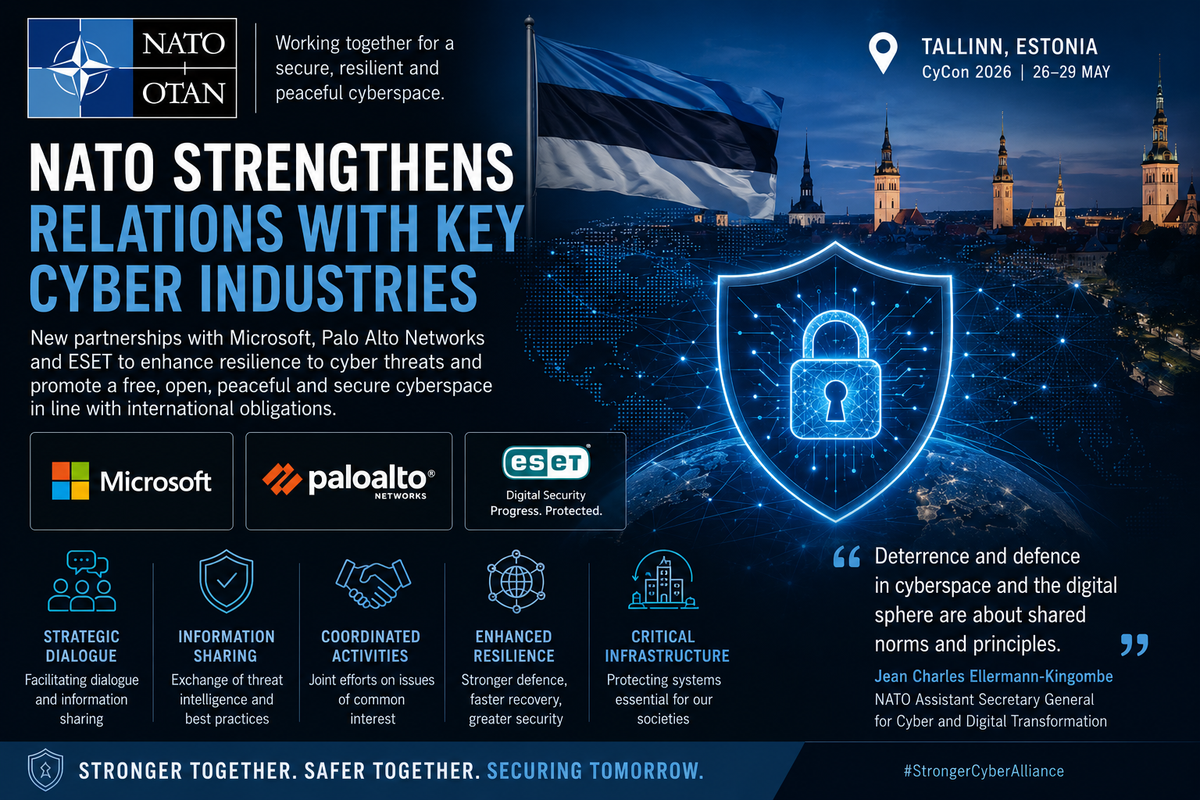
NATO’s recent announcement of strategic cyber partnerships with Microsoft, Palo Alto Networks, and ESET may appear at first glance to be a technical cybersecurity collaboration.
In reality, it represents something far more significant.
The move signals the continued evolution of cyber diplomacy from a state-centric security model toward a multi-stakeholder geopolitical framework where governments, military alliances, private technology companies, and cybersecurity firms increasingly shape global cyber stability together.
Announced during the International Conference on Cyber Conflict (CyCon) in Tallinn, Estonia, NATO’s strengthened cooperation with major cyber industry players reflects how modern security architecture is being redefined in the digital age.
This development is not only important for NATO’s cyber defence posture — it is also highly significant for the future of:
- Cyber diplomacy
- Digital governance
- Critical infrastructure protection
- Public-private cyber cooperation
- Global cyber norms
- Collective cyber resilience
The partnerships demonstrate that cyber defence is no longer confined to military institutions alone. Increasingly, technological sovereignty and national resilience depend on cooperation between states and the private sector.
Why This Matters Strategically
Historically, military alliances primarily relied on:
- Government intelligence agencies
- Defence contractors
- National military cyber units
However, cyberspace operates differently from conventional security domains.
Much of the world’s critical digital infrastructure today is owned, operated, monitored, or secured by private companies.
Cloud infrastructure, operating systems, enterprise security platforms, telecommunications systems, software supply chains, and cybersecurity monitoring capabilities are often controlled by global technology firms rather than governments.
This creates a strategic reality:
Private sector companies now hold significant influence over cyber resilience, threat intelligence, and even geopolitical stability.
NATO’s partnerships with Microsoft, Palo Alto Networks, and ESET formally acknowledge this reality.
The Rise of Public-Private Cyber Diplomacy
One of the most important dimensions of this development is the growing institutionalisation of public-private cyber diplomacy.
Traditionally, diplomacy was conducted primarily between states.
Today, however, major technology companies:
- Influence global cyber norms
- Participate in attribution discussions
- Support cyber incident response
- Help defend critical infrastructure
- Contribute to threat intelligence sharing
- Shape cybersecurity governance frameworks
This is especially evident in conflicts involving:
- Ransomware campaigns
- State-sponsored cyber operations
- Supply chain attacks
- Information warfare
- Critical infrastructure targeting
Companies such as Microsoft have already played major roles in identifying and publicly attributing nation-state cyber campaigns.
Similarly, cybersecurity firms increasingly function as strategic intelligence partners for governments and international organisations.
NATO’s new partnerships therefore reinforce a broader trend:
Cyber diplomacy is becoming increasingly multi-stakeholder and operational.
Why Estonia Remains Symbolically Important
The announcement being made in Tallinn, Estonia is also highly symbolic.
Estonia occupies a unique position in global cyber diplomacy history.
Following the 2007 cyberattacks against Estonia, NATO and its allies began recognizing cyberspace as a strategic operational domain requiring collective resilience and coordinated defence.
Estonia subsequently emerged as:
- A leading digital governance nation
- A NATO cyber policy influencer
- A hub for cyber defence cooperation
- Host of NATO’s Cooperative Cyber Defence Centre of Excellence (CCDCOE)
The CyCon conference itself has become one of the world’s most influential forums for cyber conflict, international law, cyber strategy, and digital security governance.
The theme of this year’s conference — “Securing Tomorrow” — reflects growing concerns over:
- AI-enabled cyber threats
- Critical infrastructure attacks
- Geopolitical cyber tensions
- Emerging technology governance
- Hybrid warfare
Critical Infrastructure is Driving Cyber Cooperation
One of the strongest underlying drivers behind NATO’s enhanced industry cooperation is the increasing threat to critical infrastructure.
Jean Charles Ellermann-Kingombe, NATO’s Assistant Secretary General for Cyber and Digital Transformation, specifically highlighted concerns around attacks targeting infrastructure essential for societies to function.
This is particularly important because:
- Power grids
- Transportation systems
- Telecom infrastructure
- Financial systems
- Healthcare systems
- Cloud environments
- Industrial control systems
are increasingly becoming targets of sophisticated cyber operations.
Modern conflicts may begin digitally long before conventional military escalation occurs.
Cyberattacks against infrastructure can:
- Disrupt logistics
- Undermine public trust
- Create economic instability
- Affect military readiness
- Influence political decision-making
As a result, NATO’s cyber posture is becoming increasingly focused on resilience rather than purely reactive defence.
NATO is Expanding Beyond Traditional Military Cybersecurity
Another major insight from this development is that NATO’s cyber strategy is evolving beyond traditional defence structures.
The alliance is increasingly integrating:
- Cloud security expertise
- AI-driven threat detection
- Global telemetry intelligence
- Private-sector cyber monitoring
- Supply chain visibility
- Rapid incident response capabilities
This matters because many advanced cyber threats now move faster than traditional governmental response processes.
Private cybersecurity companies often detect:
- Zero-day exploitation
- Malware campaigns
- Infrastructure targeting
- Threat actor activity
before governments publicly acknowledge them.
This creates a hybrid security environment where alliances like NATO increasingly depend on trusted relationships with industry leaders.
The Geopolitical Dimension of Technology Partnerships
The partnerships also reflect growing geopolitical competition in cyberspace.
Technology ecosystems are becoming strategically aligned with broader geopolitical blocs.
As cyber threats intensify globally, democratic alliances are increasingly seeking trusted technology ecosystems that align with:
- Open internet principles
- Democratic governance
- Rule of law
- Responsible state behaviour
- International norms
NATO’s emphasis on a “free, open, peaceful and secure cyberspace” directly reflects ongoing global debates around:
- Digital sovereignty
- Internet governance
- Cyber norms
- State behaviour in cyberspace
- Strategic technology competition
This positions cyber partnerships not only as security arrangements, but also as diplomatic and ideological alignments.
The Future: Cyber Alliances Will Become Ecosystem Alliances
Perhaps the most important long-term implication is this:
Future cyber resilience will likely depend less on isolated national capability and more on ecosystem-based defence models.
The future cybersecurity architecture may increasingly rely on:
- Governments
- Military alliances
- Cloud providers
- Cybersecurity vendors
- Telecom operators
- Threat intelligence communities
- Academia
- Standards bodies
working together continuously.
Cybersecurity is no longer simply a technical function.
It is becoming a foundational element of international stability, economic resilience, strategic deterrence, and diplomatic engagement.
What This Means for Cyberdiplomacy
For cyber diplomacy, NATO’s partnerships signal several important developments:
1. Cybersecurity is Becoming a Core Diplomatic Issue
Cyber resilience is now directly tied to alliance relationships, geopolitical trust, and strategic cooperation.
2. Industry is Becoming a Diplomatic Actor
Technology companies increasingly influence international cybersecurity policy, crisis response, and cyber norm development.
3. Public-Private Trust is Becoming Strategic Infrastructure
Trusted cyber partnerships may become as important as traditional military interoperability.
4. Critical Infrastructure Protection is Becoming Internationalised
Infrastructure resilience is no longer purely domestic — attacks in one region can create cascading international effects.
5. AI Will Accelerate Cyber Diplomacy Challenges
As AI-enabled cyber threats grow, international coordination around cybersecurity governance and responsible AI use will become increasingly important.
Final Thoughts
NATO’s strengthened cyber partnerships with Microsoft, Palo Alto Networks, and ESET are not simply about cybersecurity tools or operational cooperation.
They represent a broader transformation in how global security is evolving in the digital era.
Cyber diplomacy is no longer limited to negotiations between governments behind closed doors.
It now includes:
- Technology companies
- Cybersecurity firms
- Infrastructure operators
- International organisations
- Digital governance frameworks
- Strategic technology ecosystems
The future of international security will increasingly depend on how effectively these actors cooperate to defend shared digital infrastructure and preserve trust in cyberspace.
The battlefield may be digital.
But the implications are profoundly geopolitical.
Source reference: NATO announcement on strengthened cyber partnerships with Microsoft, Palo Alto Networks, and ESET during CyCon 2026 in Tallinn, Estonia.