
RUSSIA'S INVISIBLE WEAPON IS TARGETING EUROPEAN SKIES
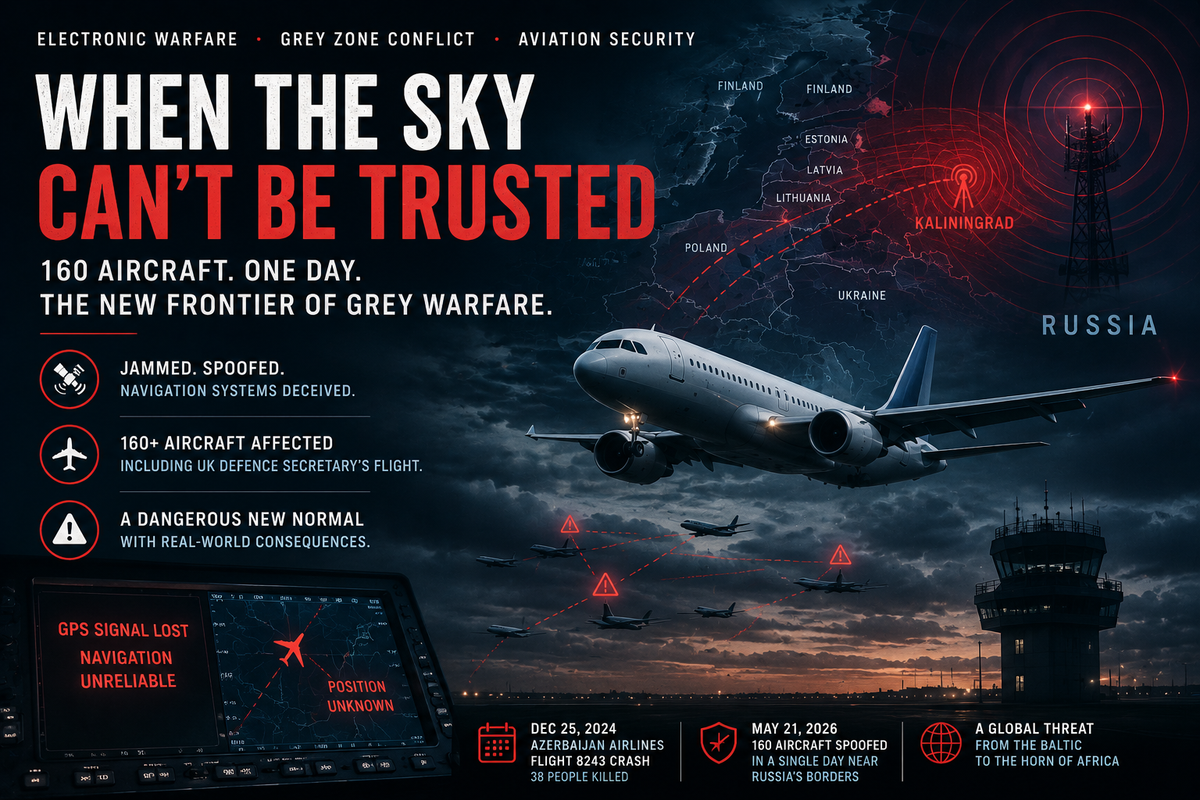
ELECTRONIC WARFARE · GREY ZONE CONFLICT · AVIATION SECURITY
On a single day in May, 160 aircraft lost their GPS signals near Russia's borders. One carried Britain's Defence Secretary. Another, months earlier, fell into the sea. This is grey warfare at altitude — and it's becoming normal.
It was, on the surface, an unremarkable Thursday. Flights departed London and Manchester. Passengers settled in. Somewhere over eastern Europe, navigation displays started lying — showing aircraft miles from where they actually were, feeding false coordinates to the systems that keep planes on course and out of each other's way.
That day — 21 May 2026 — at least 160 aircraft near Russia's borders experienced GPS "spoofing" or jamming. Among them was an RAF jet carrying UK Defence Secretary John Healey. Among them, too, were three commercial flights operating between UK airports and European destinations. None crashed. But the trend they represent is accelerating toward a threshold that aviation experts are increasingly unwilling to dismiss.
160+Planes jammed or spoofed on a single day — 21 May 20261M+Flights affected by GPS interference between 2021 and 202438People killed when spoofing contributed to Azerbaijan Airlines crash, Dec 2024
JAMMING VS. SPOOFING — THE TWO FACES OF THE ATTACK
HOW GPS INTERFERENCE WORKSJAMMING
Broadcasts noise on GPS frequencies, overwhelming the signal. The aircraft loses positioning entirely — it knows it is blind.
SPOOFING
Feeds the aircraft fake but convincing GPS signals. The plane believes it is somewhere it isn't — it does not know it is deceived.
The distinction matters enormously. A jammed aircraft knows something is wrong and can switch to backup navigation. A spoofed aircraft may fly confidently in the wrong direction, toward restricted airspace, a conflict zone, or terrain — with no warning light, no alarm, no indication that the coordinates on the display are fiction.
The three UK-linked flights on 21 May were spoofed, according to aviation intelligence firm SkAI Data Services — their navigation systems showed positions miles from reality while flying near or through Russian-adjacent airspace. Pilots reverted to traditional navigation methods. The flights landed safely. But the margin between "safely" and otherwise is narrowing with each incident.
THE ARC OF INTERFERENCE
THE THREAT GEOGRAPHY
A Whitehall cyber security source described "a huge arc from the Baltic Sea down to the Horn of Africa" where GPS interference is now a regular operational issue. The Baltic states — Finland, Estonia, Latvia, Lithuania — have become a particular hotspot. The suspected primary source: a Russian GPS jammer in Kaliningrad, originally deployed as a cost-effective missile defence system, now repurposed as a grey warfare instrument against civilian and military aviation alike.
Kaliningrad's position is strategically deliberate. The Russian exclave sits between Poland and Lithuania on the Baltic coast — a geographic wedge into NATO territory. A jammer positioned there can reach commercial flight corridors across Scandinavia, the Baltic states, and deep into central European airspace. It is relatively cheap to operate. It is deniable. And as defence consultant Paul Kendall bluntly noted: "Jamming is a hostile act, but what are we going to do about it? We aren't going to bomb jammers in Russian territory. Russia knows it can push us further."
"IF WE GET TO A POINT WHERE SPOOFING AND JAMMING IS NORMAL, IT COULD SET A DANGEROUS PRECEDENT FOR EUROPEAN SECURITY."
A PATTERN OF ESCALATING INCIDENTS
Dec 25 - 2024 Fatal Azerbaijan Airlines Flight 8243 crashes near Aktau
38 killed after GPS jamming and spoofing near Grozny left the crew navigationally blind. The aircraft was subsequently struck by a missile fragment and crash-landed across the Caspian Sea. Russia and Azerbaijan later settled, confirming "unintentional" air-defense involvement.
2024 - DefenceRAF plane carrying Grant Shapps jammed
UK defence secretary's aircraft had GPS disrupted flying near Russian territory — a near-identical precursor to the 2026 Healey incident.
2025 - Diplomatic Von der Leyen's plane diverts to paper charts
An aircraft carrying European Commission President Ursula von der Leyen experienced GPS disruption en route to Bulgaria. The crew landed using paper navigation charts. EU and Bulgarian officials attributed the interference to Russia.
May 21 2026- Escalation160 aircraft spoofed — including UK Defence Secretary's RAF flight
John Healey's plane joins more than 160 commercial and military aircraft experiencing GPS interference on a single day. Three flights linked to London and Manchester airports confirmed spoofed by SkAI Data Services.
May 28 2026 - OngoingGlobal GPS interference map shows broad active zones
GPSJAM.org data shows significant interference zones across the Baltic–Black Sea arc, Middle East, and beyond — reflecting the spread of GPS-guided drone and missile use in multiple active conflicts.
WHY THE AZERBAIJAN CRASH MATTERS MOST
CASE STUDY — FLIGHT 8243 · DEC 25, 2024
The sequence is a textbook illustration of compounding risk. First, GPS jamming near Grozny degraded navigation. Then spoofing fed the crew false positional data. Attempting approaches in worsening weather without reliable navigation, the crew decided to divert — only to be struck by a missile from an air-defence system responding to what it may have perceived, in the electromagnetic chaos, as a threat. The aircraft crossed the Caspian Sea and crash-landed near Aktau. Of 67 on board, 38 died. The crash was not caused by mechanical failure. It was caused by a cascade of electronic warfare effects in civilian airspace.
THE SYSTEMIC RISK HIDING IN PLAIN SIGHT
Modern aircraft depend on GPS for far more than knowing where they are. Satellite signals synchronise onboard electronics, provide timing for communications systems, and feed data to collision-avoidance and terrain-warning software. Jamming does not merely blind navigation — it can cascade through interconnected systems in ways that are difficult to predict and harder still to manage under pressure at altitude.
Airlines and airports in the Baltic region are already adapting operationally: additional crew briefings for GPS-degraded environments, revised routing to avoid the worst interference corridors, and in some cases longer flight paths and fuel loads to accommodate unplanned diversions. These are not theoretical precautions. They are current practice.
Aircraft manufacturers and navigation technology providers are accelerating investment in alternative positioning systems — inertial reference systems, eLoran ground-based navigation, and multi-constellation GNSS receivers that draw on signals from European Galileo and Chinese BeiDou satellites alongside American GPS, making total spoofing harder to achieve. But these solutions are years from universal deployment.
GREY WARFARE'S PERFECT TOOL
What makes GPS interference so well-suited to Russia's grey warfare doctrine is precisely its ambiguity. It is hostile enough to impose real costs — diverted flights, operational disruption, eroded trust in European airspace safety — while remaining below the threshold of any NATO response. No missile was fired. No border was crossed. The damage is statistical, diffuse, and deniable.
The Kremlin has applied the same logic across a spectrum of grey zone activities — undersea cable sabotage, arson attacks on logistics infrastructure, cyber operations against power grids, and coordinated disinformation campaigns. Electronic warfare in the sky is the aerial dimension of a strategy that has been operational for years and is systematically escalating.
"There is now a huge arc from the Baltic Sea down to the Horn of Africa where it is regularly an issue," a Whitehall security source told The i Paper. The arc is not metaphorical. It traces the geography of active conflict and Russian military interest — and it passes directly over some of the world's busiest commercial flight corridors every day.
The question is no longer whether GPS interference will affect a flight you are on. The question is whether the systems, protocols, and political will exist to keep that encounter survivable — and whether Western governments will treat the normalization of this threat with the urgency it deserves before the next crash forces the conversation.