
Sword 26 and the Quiet Battlefield: Why Cyber Defense of Critical Infrastructure is Becoming NATO’s Strategic Priority
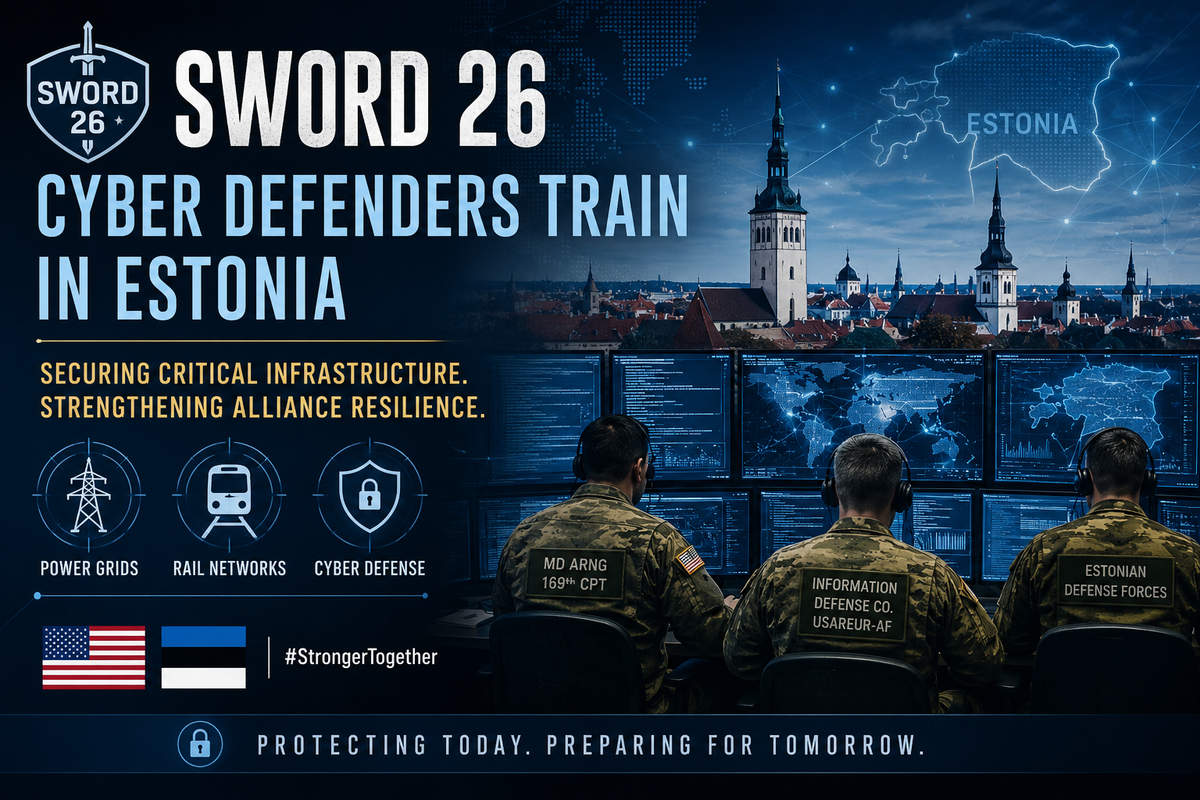
In the heart of Tallinn, Estonia, inside the unassuming walls of Cyber Range 14, one of the most important modern military exercises unfolded without the sound of artillery, armored vehicles, or fighter aircraft.
Instead, the battlefield consisted of network traffic, operational systems, simulated rail networks, energy infrastructure, and cyber defenders working silently behind computer screens.
The recently concluded “Sword 26” cyber defense exercise, conducted as part of U.S. Army Europe and Africa’s premier multinational training initiative, represents far more than a technical cybersecurity drill. It offers a glimpse into how modern warfare is evolving — where cyber operations and critical infrastructure protection are becoming central pillars of national defense and geopolitical stability.
Cyber Warfare is No Longer a Supporting Function
For decades, warfare was largely defined through kinetic operations: troop movement, territorial control, and conventional military dominance. Today, however, cyber capabilities are increasingly shaping the operational environment long before conventional forces are deployed.
The Sword 26 exercise demonstrated this shift clearly.
During the exercise, U.S. cyber defenders from the Information Defense Company and the Maryland Army National Guard’s 169th Cyber Protection Team trained alongside Estonian Defense Forces to defend simulated power grids and rail infrastructure against coordinated cyberattacks.
This is significant because modern military readiness now depends heavily on civilian-operated infrastructure systems.
Rail networks transport military assets.
Power grids sustain command operations.
Communication systems enable coordination.
Industrial control systems support logistics and defense manufacturing.
If these systems are disrupted, military effectiveness can degrade rapidly — even before physical conflict begins.
This is the essence of modern hybrid warfare.
Estonia’s Role: A Strategic Cybersecurity Leader
The location of the exercise is equally important.
Estonia has long been considered one of the world’s most cyber-resilient nations following the large-scale cyberattacks it experienced in 2007. Those attacks became a defining moment in international cybersecurity history and reshaped how governments viewed cyber conflict.
Since then, Estonia has positioned itself as a global leader in cyber defense, digital governance, and NATO cyber cooperation.
Hosting Sword 26 in Tallinn reinforces Estonia’s continuing strategic importance within NATO’s eastern flank and demonstrates how smaller nations with advanced cyber capabilities can significantly influence collective security frameworks.
The exercise also highlights a broader geopolitical reality:
Cybersecurity has become inseparable from diplomacy, alliance-building, and regional deterrence strategies.
Critical Infrastructure: The New Frontline
One of the most important lessons from Sword 26 is the growing recognition that critical infrastructure is now part of the battlefield itself.
Power stations, rail systems, ports, pipelines, telecommunications infrastructure, and industrial control environments are increasingly attractive targets for state-sponsored threat actors and advanced persistent threats (APTs).
Unlike conventional military attacks, cyberattacks against infrastructure can create strategic disruption without immediate attribution or escalation.
A successful cyberattack against rail operations could:
- Delay troop deployments
- Interrupt supply chains
- Create civilian panic
- Affect emergency response systems
- Undermine public trust in government institutions
Similarly, attacks on energy infrastructure could impact operational readiness while simultaneously creating social and economic instability.
This convergence of IT systems, operational technology (OT), and national security is rapidly changing how governments approach defense planning.
Exercises like Sword 26 are therefore not simply cybersecurity simulations — they are rehearsals for national resilience.
The Growing Importance of OT and ICS Security
One of the understated but highly significant aspects of Sword 26 is its emphasis on defending operational environments rather than traditional enterprise IT systems alone.
Protecting power and rail infrastructure requires expertise in:
- Operational Technology (OT)
- Industrial Control Systems (ICS)
- SCADA environments
- Threat intelligence
- Network segmentation
- Incident response coordination
- Infrastructure resilience planning
This marks an important shift in military cyber exercises globally.
Historically, many cyber defense programs focused primarily on protecting information systems. Today, the focus is expanding toward safeguarding cyber-physical systems where digital compromise can produce real-world operational consequences.
This evolution also aligns closely with international frameworks such as:
- IEC 62443
- NIST Cybersecurity Framework
- NIS2 Directive
- Critical Infrastructure Protection (CIP) standards
The integration of OT security into military readiness strategies is likely to become even more prominent in the coming years.
Cyber Defense is Built on Trust and Interoperability
Another critical insight from Sword 26 is the emphasis on coalition readiness and interoperability.
Cyber defense cannot operate effectively in isolation.
Modern infrastructure ecosystems are interconnected across borders, organizations, and sectors. This means allied nations must not only share intelligence, but also develop compatible operational procedures, incident response mechanisms, and communication protocols.
Exercises involving multinational cyber teams help establish:
- Shared situational awareness
- Trusted communication channels
- Joint response procedures
- Familiarity with partner capabilities
- Coordinated crisis management approaches
In a real-world cyber crisis, the first interaction between allied cyber teams cannot be an introduction.
That trust must already exist.
This is why exercises like Sword 26 have strategic value beyond the technical environment.
The Invisible Nature of Successful Cyber Defense
One of the most compelling aspects of cyber defense is that success is often invisible.
When cyber defenders prevent a disruption to a power grid or stop an intrusion into a transportation network, the public rarely notices. Trains continue operating. Electricity remains available. Communication systems stay online.
Nothing appears unusual.
But that quiet continuity is itself a strategic victory.
Unlike conventional warfare, where visible outcomes often dominate headlines, cyber defense succeeds by ensuring normalcy remains uninterrupted.
Sword 26 reinforces an important reality:
Modern defense is not only about winning battles — it is about ensuring societies continue functioning despite persistent digital threats.
Looking Ahead
As geopolitical tensions continue to evolve, cyber operations against critical infrastructure are likely to increase in sophistication, frequency, and strategic importance.
Nations that invest in:
- Cyber resilience
- OT security
- Joint defense exercises
- Cyber diplomacy
- Public-private collaboration
- International cyber partnerships
will be better positioned to withstand future crises.
Sword 26 demonstrates that the future battlefield is already here — and much of it exists within the networks, systems, and infrastructure that societies rely on every day.
The battlefield may be quiet.
The mission is not.
Source reference: U.S. Army Europe and Africa coverage of Sword 26 Cyber Defense Exercise in Estonia.