The Netherlands, Cyber Risk, and the New Era of Economic Resilience
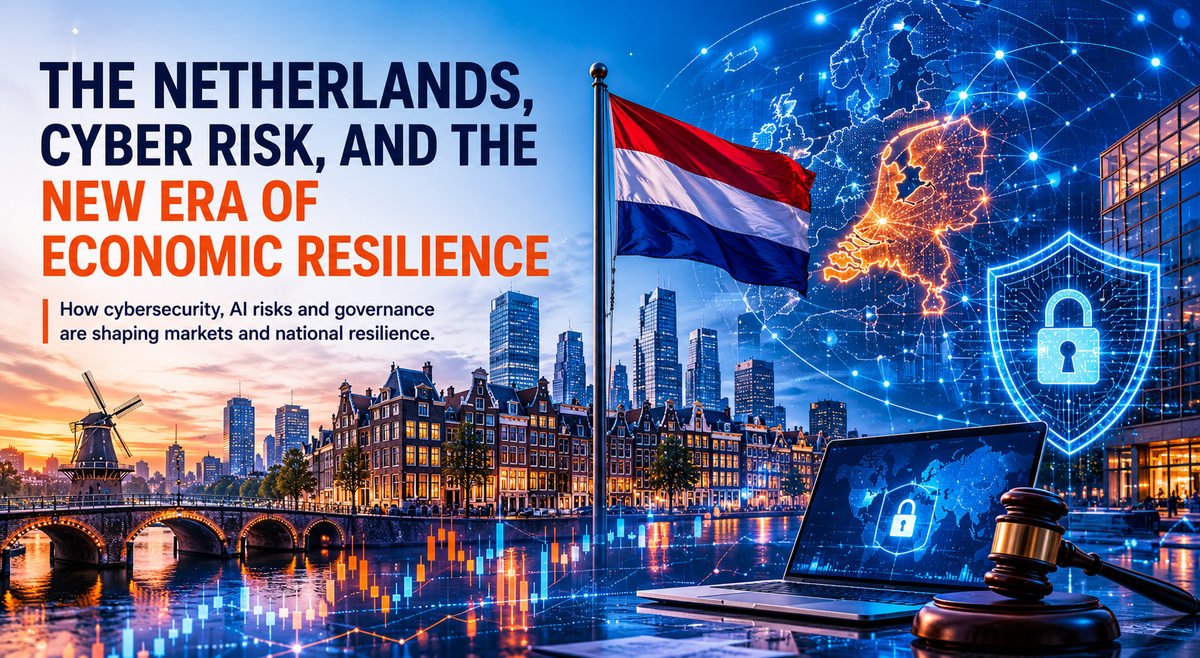
The Netherlands is increasingly confronting a new generation of economic and security risks where geopolitics, cyber threats, artificial intelligence, and financial stability are becoming deeply interconnected. Recent warnings from Dutch financial regulators and policymakers reveal a growing concern that modern economic resilience can no longer be separated from digital resilience.
The combination of geopolitical instability, cyber threats targeting financial systems, and rapidly evolving AI technologies is reshaping how the Netherlands approaches financial oversight, market stability, and national resilience. What makes this moment particularly significant is that regulators are no longer discussing cybersecurity as a standalone IT issue. Instead, cyber resilience is now being treated as a core component of economic security itself.
A New Era of Economic Uncertainty
Dutch regulators have described uncertainty as the “new normal.” Rising geopolitical tensions, particularly conflict involving Iran and instability in global markets, are increasing pressure on financial systems, inflation expectations, and investor confidence. At the same time, regulators are warning that stock market growth driven heavily by a small number of major AI and technology companies may create underlying vulnerabilities if expectations around AI profitability fail to materialize.
This reflects a broader global concern surrounding AI-related market optimism. Across international markets, AI has become one of the dominant drivers of investment activity, valuation growth, and speculative capital flows. However, as with many rapidly emerging technologies, the long-term profitability and adoption trajectory of AI remains uncertain.
The concern is not necessarily that AI lacks transformative potential. The concern is that financial markets may be moving faster than governance, risk oversight, and operational resilience frameworks can adapt.
The Rise of AI-Driven Financial Risk
One of the most striking aspects of the Dutch regulatory discussions is the growing focus on AI-related investment schemes and the possibility of market distortion driven by emerging technologies.
Artificial Intelligence is increasingly influencing:
- Investment strategies
- Automated trading systems
- Financial analytics
- Algorithmic decision-making
- Digital financial products
- Retail investment behavior
While AI improves efficiency and accessibility, it also creates new categories of systemic risk.
Regulators are increasingly concerned about:
- AI-driven speculative bubbles
- AI-generated financial misinformation
- Automated market manipulation
- Deepfake-enabled financial fraud
- Synthetic investment schemes
- AI-powered cyberattacks against financial institutions
As generative AI tools become more sophisticated, fraudulent financial content can be produced at unprecedented scale and speed. This creates a dangerous environment where manipulated narratives, fake investment opportunities, and synthetic digital identities may influence investor behavior and market confidence.
The rapid concentration of investment around AI-related companies also introduces concerns about market dependency and overvaluation. If investor expectations surrounding AI adoption fail to align with actual commercial outcomes, significant market corrections could occur.
Cybersecurity Is Becoming a Financial Stability Issue
Perhaps the most important insight emerging from Dutch regulators is the recognition that cyber threats are now directly tied to financial stability.
The Dutch central bank has warned that AI-powered cyberattacks may become capable of disrupting payment systems, financial operations, and digital infrastructure with unprecedented speed and sophistication. Modern AI systems are increasingly able to identify vulnerabilities, automate attacks, and launch highly adaptive cyber operations within minutes.
This fundamentally changes the cybersecurity landscape.
Traditional cybersecurity approaches built around delayed patching cycles and reactive security models may no longer be sufficient against AI-enabled threats capable of operating at machine speed.
The concern becomes especially serious in financial ecosystems where operational continuity, transaction integrity, and public trust are critical. A successful cyberattack targeting banking systems, payment infrastructure, or financial platforms during periods of market instability could amplify panic and undermine confidence in the broader financial system.
This reflects an important shift in regulatory thinking:
cybersecurity failures are no longer viewed merely as technical disruptions — they are increasingly seen as potential macroeconomic risks.
The Netherlands and Europe’s Regulatory Approach
Unlike the United States, the Netherlands does not have a direct equivalent to the Sarbanes-Oxley Act (SOX). However, Dutch and European regulatory frameworks collectively perform similar governance and oversight functions related to operational resilience, accountability, financial supervision, and risk management.
The Dutch Corporate Governance Code places strong emphasis on long-term value creation, internal oversight, executive accountability, and enterprise risk management. Increasingly, this includes cybersecurity governance, operational resilience, AI oversight, and digital risk management.
At the European level, one of the most significant developments is the Digital Operational Resilience Act (DORA), which introduces stricter cyber resilience requirements for financial institutions and digital financial ecosystems.
DORA requires organizations to strengthen:
- ICT risk management
- Incident reporting
- Operational continuity planning
- Cyber resilience testing
- Third-party vendor oversight
In many ways, DORA represents Europe’s recognition that digital operational resilience is now fundamental to financial stability.
The Netherlands is therefore operating within a broader European regulatory environment that increasingly treats cyber resilience as part of systemic economic governance.
The Convergence of Geopolitics and Cyber Risk
Another major concern highlighted by Dutch regulators is the growing relationship between geopolitical instability and cyber threats.
Modern cyber operations are increasingly linked to:
- Geopolitical tensions
- State-sponsored cyber activity
- Economic coercion
- Infrastructure targeting
- Financial disruption campaigns
Periods of geopolitical uncertainty often create ideal conditions for cyberattacks, disinformation campaigns, and market manipulation attempts. Financial systems become especially vulnerable during times of instability because operational disruption can further erode investor confidence and amplify volatility.
For highly interconnected economies like the Netherlands, this creates a complex risk environment where cyber resilience, geopolitical strategy, financial oversight, and economic security are becoming deeply intertwined.
Why AI Governance Now Matters More Than Ever
The Dutch discussions also highlight a larger global governance challenge:
AI adoption is accelerating faster than regulatory and institutional oversight mechanisms.
AI systems are increasingly embedded within:
- Financial markets
- Banking operations
- Customer service platforms
- Cybersecurity tools
- Investment ecosystems
- Public digital infrastructure
This creates urgent questions surrounding:
- Accountability
- Transparency
- AI-driven decision-making
- Operational oversight
- Security validation
- Human supervision
- Algorithmic risk
At the same time, regulators are recognizing that defensive cybersecurity strategies may also need AI integration. Financial institutions may increasingly rely on AI-powered defense systems to counter AI-enabled attacks.
This creates a technological arms race where both attackers and defenders rapidly adopt increasingly autonomous systems.
The Broader Strategic Shift
The Netherlands illustrates a broader international reality:
economic resilience and cybersecurity are rapidly converging.
In highly digitized economies, financial stability now depends not only on monetary policy and economic indicators, but also on:
- Cyber resilience
- AI governance
- Digital operational continuity
- Infrastructure security
- Cross-border regulatory coordination
- Trust in digital ecosystems
The challenge ahead will not simply involve technological innovation. It will involve ensuring that governance frameworks, cybersecurity oversight, operational resilience, and institutional accountability evolve at the same pace as digital transformation itself.
Conclusion
The growing concerns raised by Dutch regulators reflect a major shift in how modern economies understand risk. Cyber threats, AI-driven financial instability, geopolitical uncertainty, and operational resilience are no longer separate issues — they are increasingly interconnected components of economic security.
The Netherlands, as one of Europe’s most digitally advanced economies, sits at the center of this transformation. The country’s experience highlights how AI-enabled investment activity, cyber resilience, and financial stability are becoming deeply linked within modern digital economies.
While European frameworks such as DORA, the Dutch Corporate Governance Code, and financial supervision laws provide important foundations for resilience, the pace of technological disruption continues to accelerate. AI is simultaneously driving innovation, financial growth, cyber risk, and regulatory uncertainty.
The future challenge for advanced economies will not simply be adopting emerging technologies, but governing them responsibly while maintaining trust, resilience, and operational stability in an increasingly unpredictable digital landscape.