The Reel That Stole a Real Life: Inside the World of Cyber Slavery
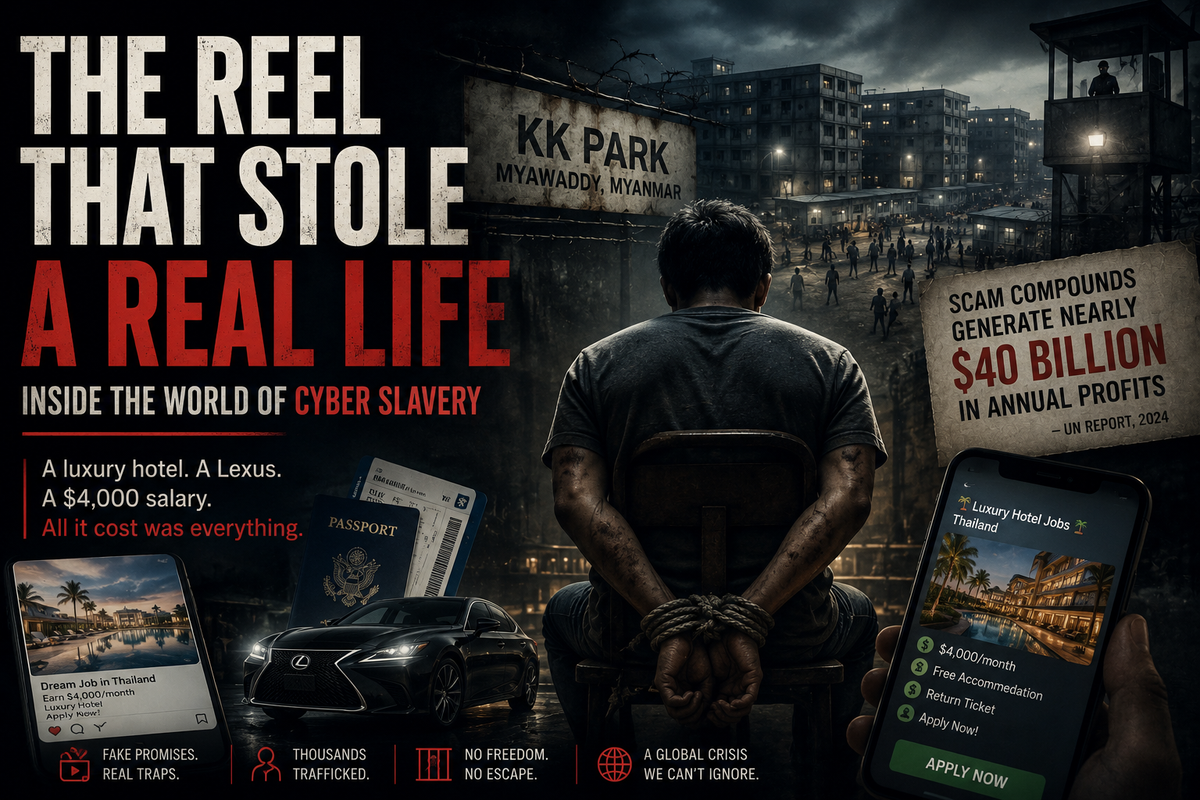
A luxury hotel. A Lexus. A $4,000 salary. All it cost was everything.
The Scroll That Changed Everything
It began, as so many catastrophes do now, with a thumb.
A quick scroll. A pause. A tap.
Late September 2025. A 34-year-old business administration graduate from Pune — we'll call him Sahil, because that is what he asked — was sitting at home, newly returned from three years working in Sierra Leone, staring at a future that had gone blank. The job abroad hadn't worked out. His savings were thin. His pride was thinner. He was desperate in the way that only the educated and unemployed know how to be desperate: quietly, achingly, every morning a fresh negotiation between hope and humiliation.
Then his Instagram feed offered him a lifeline.
A luxury hotel in Thailand. $4,000 a month. Apply now.
The images were immaculate. A gleaming lobby. A pool catching the afternoon sun. Smiling staff in crisp uniforms. The kind of life that fills your feed every day — someone else always living it, somewhere else always more golden.
This time, Sahil thought, it could be me.
He filled out the form.
The Reel Life Recruitment
This is how cyber slavery begins in 2025: not in a dark alley, not at the hands of a menacing stranger, but in the warm glow of a smartphone screen, algorithmically delivered to exactly the person who needs it most.
The architects of these scam compounds — sprawling, fortified industrial cities on the borders of Myanmar, Cambodia, and Laos — have studied social media the way a fisherman studies tides. They know that the young and jobless scroll Instagram looking for signs that the world has something better to offer. They know that reels of the high life — luxury hotels, international salaries, foreign travel — trigger a specific kind of longing in someone staring at a ceiling fan in a tier-two city. They know that the moment between seeing an ad and feeling suspicion is narrow, and that if the offer looks polished enough, that moment can be bridged.
The formula is consistent across hundreds of documented cases: a social media advertisement for a well-paying job abroad, usually in hospitality, customer service, IT, or digital marketing. A WhatsApp or phone call follows quickly — a "placement agency representative" who is warm, professional, and efficient. The offer is generous. The process is simple. Just buy a ticket. We'll take care of the rest.
There are no red flags that an ordinary person would recognise as red flags. The offer looks like opportunity. The agency sounds legitimate. The lifestyle promise looks exactly like what fills every feed, every day. The only difference between the Instagram ad that sells you a skincare cream and the one that sells you into slavery is the destination at the end of the link.
Two days after Sahil applied, the phone call came.
The Journey In
Bangkok airport. A Lexus waiting at arrivals.
"Imagine going from looking for a job," Sahil would later say, "to being picked up in a Lexus. I could hardly believe my eyes."
This, too, is part of the design. The luxury is not accidental. It is the reel made real — briefly, deliberately, just long enough to dissolve the last doubt. The car. The driver. The 3,000 Thai baht handed over for "expenses". The hotel stay. Every detail calibrated to confirm: yes, this is the opportunity you were promised. You made the right decision. Relax.
Then came car number two. And three. And four. By the seventeenth vehicle change, Sahil felt the first tremors of unease. He kept asking the drivers why they kept switching. He was assured everything was fine. His travel SIM hadn't activated yet — he couldn't call anyone. He was, without fully realising it, already being managed.
By the time they reached the riverbank at Mae Sot — the crossing point into Myanmar — the Lexus and the baht were distant memories. A gun. A large knife. Blindfolds. A boat. A group of sixty people, all wearing the same expression: the particular look of someone who has just understood that the reel they were sold has cut to a very different scene.
They trekked sixty kilometres into the jungle. Sahil discarded his shoes, his bags, his non-essential clothing. He could not carry the weight.
He arrived at KK Park on September 29, 2025.
Welcome to the Compound
KK Park, near Myawaddy on the Thailand-Myanmar border, is not a place that appears on any tourist map. It is, in the dry language of UN reports, a "scam compound" — a town-sized complex of office buildings, dormitories, restaurants, and in one surreal detail that Sahil would later describe, a karaoke bar. At its peak, it held two thousand people, all working up to fourteen hours a day. None of them chose to be there.
The United Nations estimated in 2024 that Myanmar's scam compounds generate nearly $40 billion in annual profits — a number that rivals the GDP of many nations, extracted entirely from fraud victims around the world.
Sahil's passport and identity documents were taken immediately. Three days in a room. Then, on the fourth day, the call centre floor.
He saw people from Nepal, Sri Lanka, Bangladesh, Pakistan, India. He saw young Indian women in their twenties who had dreamed of careers abroad. His job, he was told, involved something called "pig butchering" — a term that describes exactly what it is. You identify a target online. You establish contact, building trust over days or weeks. You introduce them to a cryptocurrency investment opportunity. You "fatten" them — feeding them small, convincing returns — until they invest everything. Then you "butcher" them financially. Their savings gone, they are blocked and discarded. Another target is found.
Up to fifteen people were being targeted in a single day from Sahil's floor alone.
He refused.
The Price of Conscience
What Sahil did next is either very brave or very reckless, and perhaps both. He napped on the work floor. He ignored calls. He resisted, quietly but absolutely, every attempt to make him participate. His captors shouted his name across the office. He ignored them.
"I was adamant," he says. "There was no way I was stealing money."
In November, a confrontation with a Chinese employee turned physical. Sahil — assessing that his captors were "thin and scrawny" — threw a punch. He won that fight. He lost the next eight days.
They hung him upside down. They beat him. They starved him, offering rice and fish balls every two days. He believes they drugged him to muffle his screams. Through all of it, his answer remained the same. I will not cheat people.
"I was ready to die," he says. "I remember yelling, 'tum sabko main maroonga'."
He passed out. His captors, apparently concluding he was more trouble than he was worth alive, dumped him in front of a local hospital. It took doctors a week to repair the damage. Still in bloodied clothes, he walked to a nearby detention centre.
For forty-five days, Sahil and other trapped Indians wrote emails and sent messages to every official address they could find — in Thailand, Myanmar, and India. They did not know if anyone was reading. They wrote anyway.
On January 7, 2026, at four in the morning, word came: they were going to Mae Sot. An Indian Air Force plane was waiting.
By evening, Sahil was in Delhi. He was the only one among the repatriated group with such extensive injuries. The officials, he says, were kind. They let him rest. They wanted to know everything.
The Real Numbers Behind the Reel
Sahil's story is singular in its detail and its survival. But it is not singular in its structure.
Since 2022, over 6,700 Indians have been repatriated from cyber slavery compounds in Southeast Asia. That number represents only those who made it back. How many remain — trapped, still working floors, still waiting for an IAF plane that may or may not come — is genuinely unknown.
The recruitment infrastructure is vast and sophisticated. Fake job advertisements circulate on Instagram, Facebook, Telegram, and LinkedIn, targeting people with real skills — languages, sales experience, digital marketing, customer service — that fraud operations need. The ads do not look like traps. They look like the thousands of other job advertisements that scroll through any feed on any given day. They look like the Instagram reels of "Dubai life" and "Thailand salary packages" and "work abroad no experience needed" that millions of young Indians watch and reshare every week.
The visual language of aspiration — the infinity pool, the business class seat, the expense account dinner — has been comprehensively colonised by criminal recruiters who understand that the desire to escape ordinary life is one of the most powerful forces in a young person's psychology. They are not selling jobs. They are selling the reel.
And the reel is carefully maintained all the way to the riverbank.
The Compound as a Mirror of the Feed
There is something deeply, darkly ironic about the work that happens inside these compounds. The people trapped inside them are forced to do, for criminal ends, exactly what the social media economy does every day: create false impressions of wealth, connection, and opportunity in order to extract money from vulnerable people.
The "pig butchering" script that Sahil was handed is structurally identical to the influencer playbook. Build trust. Show a lifestyle. Create desire. Offer access. Extract value. The difference is legal and moral, not mechanical.
The compounds run at industrial scale what the attention economy runs at civilisational scale: the systematic manufacture of desire and the exploitation of the gap between the life people have and the life they are shown. The reel as weapon.
Sahil was recruited through a reel. He was meant to become a reel's author — projecting false wealth and opportunity onto screens in American living rooms, targeting people whose own feeds had made them hungry for something more.
He refused. He bled for that refusal. He survived.
This Could Be Anyone's Story
The most important thing to understand about Sahil's story is how ordinary its beginning was.
He was educated. He had worked abroad before. He was experienced enough to know that some job offers are too good to be true. He was cautious enough to be in the middle of a difficult job search rather than leaping at the first thing he saw. He was, in short, not naive. He was desperate — and desperation and naivety are different things.
The Indian government's CBI has confirmed that networks trafficking people into cyber slavery are still active. The UN's Special Rapporteur on trafficking has documented the compounds in Myanmar, Cambodia, and Laos as among the most significant human rights crises in the region. The $40 billion annual profit figure is not a rounding error — it represents a criminal economy sophisticated enough to run HR departments, maintain social media advertising budgets, and manage a supply chain of human beings from recruitment in India to deployment in Myanmar.
The protection against it is not, primarily, intelligence. It is awareness.
Know the signs. An unsolicited job offer on social media that pays unusually well for unclear work. A placement process that moves very fast, asks you to self-fund only the ticket, and promises to "take care of the rest." A journey that involves multiple vehicle changes, a border crossing, and the collection of your documents upon arrival. Any job that involves calling strangers to build trust for a financial product you cannot verify.
Most importantly: if the reel looks too perfect, ask what the reality looks like. Ask who is filming. Ask what is just outside the frame.
Sahil, Now
He is back in Nigdi. He still feels pain when he works out. He is, once again, jobless.
He does not regret refusing. Not for a moment.
"I would rather be jobless than make money through such means," he says.
His police statement has been recorded. His case has been debriefed. His injuries have, mostly, healed. What has not healed — what may not heal for a long time — is the knowledge of what he saw on that compound floor: the young Indian women who had dreamed of careers abroad, the Nepali and Bangladeshi workers grinding through scripts, the sheer industrial scale of an operation built entirely on human misery, powered by Instagram ads and false promises and the universal, dangerous, deeply human desire for a better life.
He wants everyone to know such places exist.
"Do not click on something online that feels too good to be true."
It is the simplest sentence in the world. It should not have cost him what it cost him to say it.
This article is based on the account of Sahil (name used at subject's request), a Pune resident repatriated from Myanmar by the Indian Air Force in January 2026, as reported by the Times of India.