UK Spy Chief Warns of a “Narrowing Window”: Why the West’s Cyber and Intelligence Alliances Matter More Than Ever
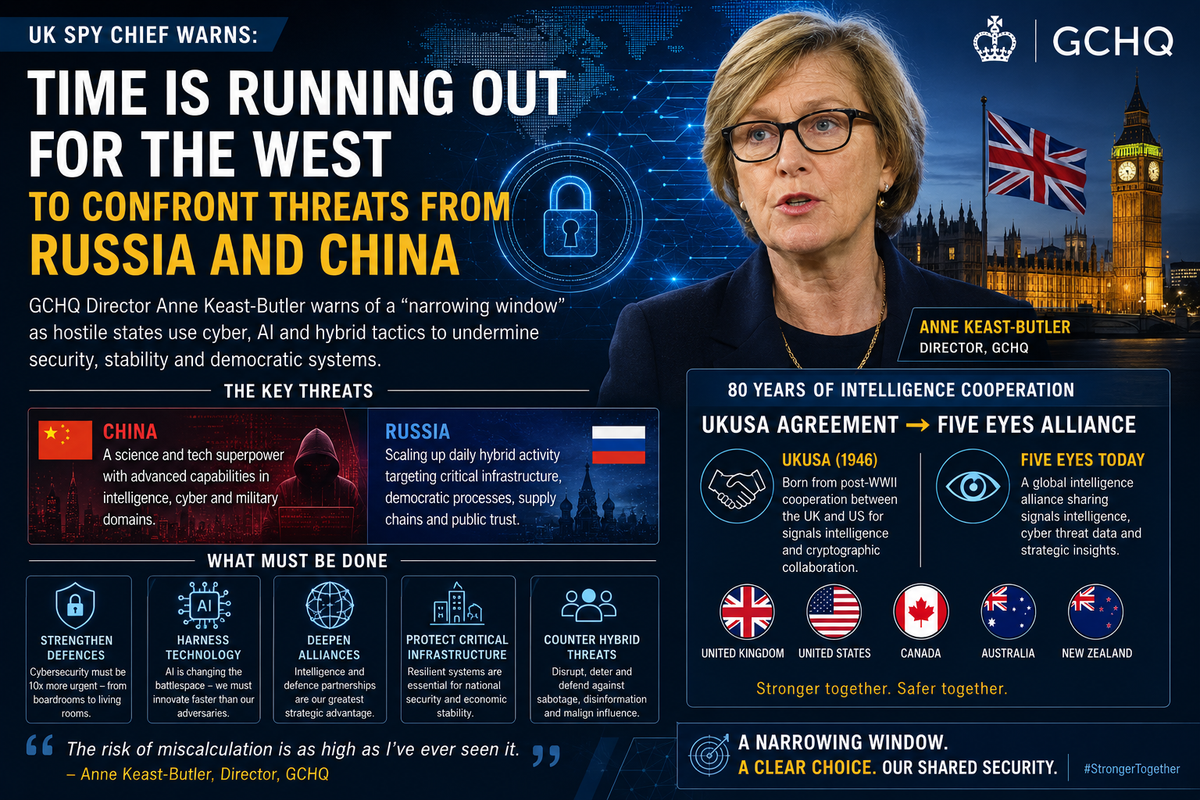
The warning from GCHQ Director Anne Keast-Butler is not simply another intelligence briefing.
It is a strategic signal.
As geopolitical tensions intensify and artificial intelligence rapidly reshapes the cyber threat landscape, the United Kingdom’s top intelligence official has warned that the West faces a “narrowing window” to stay ahead of adversaries such as China and Russia.
Her remarks reflect growing concern within Western intelligence communities that the global security environment is entering a new and more volatile phase — one defined by:
- AI-enabled cyber operations
- Hybrid warfare
- Strategic technology competition
- Critical infrastructure targeting
- Information manipulation
- State-sponsored espionage
- Digital influence operations
The speech also coincides with the 80th anniversary of the historic UKUSA intelligence agreement — the foundation of what later became the Five Eyes intelligence alliance.
Understanding why this matters requires looking beyond headlines and examining the deeper transformation taking place in global cyber strategy and intelligence cooperation.
The World is Entering a New Intelligence Era
Anne Keast-Butler’s warning comes at a time when the boundaries between:
- Cybersecurity
- Intelligence operations
- Geopolitics
- Economic security
- Technological dominance
- National defence
are increasingly disappearing.
Her statement that “the ground beneath our feet is shifting” is especially significant.
Artificial intelligence is not only accelerating innovation — it is also transforming espionage, cyber operations, and hybrid conflict at unprecedented speed.
Modern intelligence threats are no longer limited to traditional espionage.
Today’s threat landscape includes:
- AI-assisted cyberattacks
- Deepfake-enabled disinformation
- Automated vulnerability discovery
- Supply chain compromise
- Cloud infrastructure targeting
- Intellectual property theft
- Strategic technology infiltration
- Digital surveillance ecosystems
This creates a strategic reality:
Nations that fail to adapt rapidly may lose technological, intelligence, and geopolitical advantage.
China: The Long-Term Strategic Challenge
One of the strongest themes in the GCHQ Director’s speech is the growing concern around China’s technological and cyber capabilities.
According to Keast-Butler, China has evolved into:
“a science and tech superpower with sophisticated capabilities across intelligence, cyber and military agencies.”
This reflects a broader Western assessment that China is no longer simply an economic competitor — it is increasingly viewed as a strategic technological rival.
The concern extends across multiple domains:
- Artificial intelligence
- Quantum computing
- Telecommunications
- Semiconductor ecosystems
- Cyber espionage
- Data governance
- Critical infrastructure influence
- Emerging technology dominance
Western intelligence agencies have repeatedly warned about:
- State-linked cyber espionage campaigns
- Intellectual property theft
- Covert influence operations
- Infrastructure mapping activities
- Supply chain infiltration
- Long-term strategic access operations
The FBI and allied cyber agencies recently warned that China-linked actors were leveraging covert infrastructure and botnet operations to conduct malicious cyber activity globally.
This reflects a shift from isolated cyber incidents toward persistent strategic cyber positioning.
Russia and the Expansion of Hybrid Warfare
The speech also highlights growing concern over Russia’s “daily hybrid activity” against Europe and the United Kingdom.
Unlike conventional warfare, hybrid warfare combines:
- Cyberattacks
- Information operations
- Sabotage
- Political influence
- Economic pressure
- Psychological operations
- Proxy activity
- Infrastructure disruption
Russia’s cyber strategy has increasingly focused on:
- Critical infrastructure
- Democratic institutions
- Supply chains
- Public trust mechanisms
- Strategic destabilisation
The warning that “the risk of miscalculation is as high as I’ve ever seen it” reflects concerns that cyber incidents may increasingly spill over into broader geopolitical escalation.
This is particularly relevant in the context of:
- NATO support for Ukraine
- European energy security tensions
- Election interference concerns
- Digital infrastructure targeting
- AI-driven influence campaigns
Cyber operations are no longer peripheral to geopolitical conflict.
They are becoming central to it.
Why Cybersecurity is Now a National Security Imperative
One of the most important insights from the speech is the call for cybersecurity to become:
“ten times more urgent.”
This is a recognition that cybersecurity can no longer be treated solely as an IT function.
Today, cyber resilience directly affects:
- National defence
- Economic stability
- Public trust
- Democratic institutions
- Supply chains
- Healthcare systems
- Financial infrastructure
- Energy networks
The battlefield is increasingly digital.
And unlike conventional conflict, cyber operations often occur continuously below the threshold of war.
Understanding the UKUSA Agreement
The speech also marks the 80th anniversary of one of the most influential intelligence agreements in modern history:
The UKUSA Agreement.
What Was the UKUSA Agreement?
The UKUSA Agreement was a highly classified intelligence-sharing arrangement established between:
- The United Kingdom
- The United States
following World War II.
Originally formalized in 1946, the agreement focused primarily on:
- Signals intelligence (SIGINT)
- Communications interception
- Cryptographic cooperation
- Intelligence analysis
- Strategic surveillance coordination
The agreement built upon wartime intelligence cooperation between British and American codebreaking and cryptographic units.
At the time, the goal was to strengthen Western intelligence coordination during the emerging Cold War environment.
How UKUSA Became the Five Eyes Alliance
Over time, the UKUSA framework expanded to include:
- Canada
- Australia
- New Zealand
This evolution created what is now known as the:
Five Eyes (FVEY) Intelligence Alliance
The Five Eyes alliance is widely considered the most powerful intelligence-sharing partnership in the world.
The member nations include:
🇬🇧 United Kingdom
🇺🇸 United States
🇨🇦 Canada
🇦🇺 Australia
🇳🇿 New Zealand
What Does Five Eyes Actually Do?
The alliance facilitates extensive cooperation across:
- Signals intelligence
- Cyber threat intelligence
- Counterterrorism
- Cybersecurity operations
- Surveillance coordination
- Geopolitical intelligence
- Military intelligence
- Counterintelligence
- Technology security
The alliance allows member states to:
- Share classified intelligence
- Coordinate cyber defence
- Conduct joint intelligence analysis
- Monitor emerging threats
- Enhance interoperability
- Support collective security objectives
The Five Eyes network has become deeply integrated into:
- Cybersecurity operations
- Digital threat intelligence
- Global surveillance capabilities
- Strategic cyber defence coordination
Why Five Eyes Matters Today
In today’s geopolitical environment, the Five Eyes alliance has become increasingly important because cyber threats are:
- Borderless
- Persistent
- Rapidly evolving
- Technologically sophisticated
No single country can independently monitor and respond to all global cyber threats effectively.
Intelligence-sharing alliances therefore provide:
- Early warning capabilities
- Shared threat visibility
- Faster incident response
- Coordinated attribution
- Strategic cyber resilience
This is particularly important in the age of:
- AI-enabled cyber operations
- Quantum computing competition
- Strategic technology rivalry
- Global digital infrastructure dependence
AI is Reshaping Intelligence and Cyber Operations
Perhaps the most important long-term issue raised by Keast-Butler’s speech is the role of artificial intelligence.
AI is changing:
- Intelligence collection
- Threat analysis
- Cyber defence
- Offensive cyber operations
- Surveillance capabilities
- Influence campaigns
- Data exploitation
At the same time, adversaries are also using AI to:
- Accelerate reconnaissance
- Automate phishing
- Generate malware
- Create deepfakes
- Scale influence operations
- Enhance cyber espionage
This creates a dangerous acceleration dynamic where:
Attack speed increasingly outpaces traditional defensive processes.
The concern over a “narrowing window” reflects fears that Western democracies may struggle to adapt quickly enough to these technological shifts.
Cyber Diplomacy and the Future of Alliances
The speech also highlights a broader cyberdiplomacy reality:
Future security alliances will not only be military alliances.
They will increasingly become:
- Technology alliances
- Intelligence alliances
- Cyber resilience alliances
- Digital infrastructure alliances
Cybersecurity, AI governance, intelligence cooperation, and strategic technology policy are becoming deeply interconnected.
This means future geopolitical influence may increasingly depend on:
- Technological leadership
- Trusted digital ecosystems
- Intelligence partnerships
- Cyber resilience capacity
- AI governance capabilities
Final Thoughts
Anne Keast-Butler’s warning reflects more than immediate cyber threats from Russia or China.
It reflects a broader transformation in global security itself.
The world is entering an era where:
- Cyber operations shape geopolitics
- AI accelerates conflict dynamics
- Intelligence alliances become strategically critical
- Critical infrastructure becomes a frontline target
- Technology ecosystems influence national security
The UKUSA Agreement and the Five Eyes alliance demonstrate that intelligence cooperation has long been central to Western strategic stability.
But in the age of AI, cyber conflict, and hybrid warfare, these alliances may become even more important than ever before.
The challenge now is not simply defending networks.
It is defending trust, resilience, democratic systems, and strategic stability in an increasingly contested digital world.